
Orion spacecraft completes decisive maneuver: ‘The Artemis 2 crew is officially on the way to the Moon’
The four astronauts of the first manned lunar flight in 54 years receive the final push of their historic journey, which will take them around Earth’s satellite and back again like a boomerang
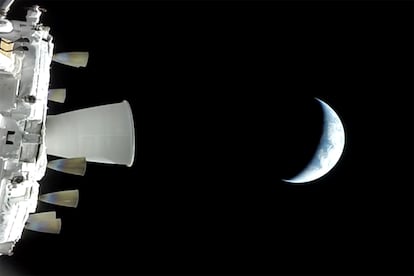

The true journey of Artemis 2 to the Moon finally began this Thursday at 7:49 p.m. ET, overcoming the most critical moment of this mission with the final roar of the Orion spacecraft’s engines. More than 25 hours had passed since the launch of the largest and most powerful crewed spacecraft in history from the Kennedy Space Center in Florida, when the Orion executed the critical translunar injection burn and propelled itself toward its destination: the far side of the Moon. The final confirmation came from the NASA administrator: “Nominal translunar injection burn complete. The Artemis II crew is officially on the way to the Moon,” Jared Isaacman stated in a post on the social media platform X.
And three hours later, in a video call from the Orion with reporters, mission commander Reid Wiseman acknowledged that the trans-lunar injection had been a tense moment. He also highlighted the feeling of another moment: when the spacecraft was moving away from Earth and reoriented itself, he was able to experience “the beauty of watching the sun set behind the entire planet, from pole to pole: we could clearly see Africa and Europe, and even the Northern Lights if you looked closely.” It was then that he began to feel the weight of what it means to go to the Moon: “There’s nothing normal about this. It’s a Herculean effort,” Wiseman said.
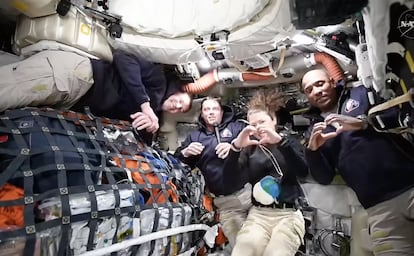
Mission specialist Christina Koch said she remains impressed by what happened the day before: “I was surprised by how smooth the start of the launch felt,” as the massive rocket began to climb, propelled by its side boosters. During the deep-space tests on the first day of the Artemis 2 mission, Koch became the woman who has traveled the farthest from Earth in the entire history of the space race.
The final thrust
At the start of its second day of mission, after completing two orbits around Earth, the spacecraft was once again just 185 kilometers from its surface. It then detached its solar panels from the engines and launched itself with a powerful acceleration into a free-return trajectory, precisely designed by NASA to allow the capsule to return on its own—without needing to be propelled again—and complete its mission in eight days.
If there are no incidents during the four days of this spaceflight—like the one suffered by Apollo 13 in April 1970—this will be the final boost the spacecraft will receive for the remainder of the Artemis 2 mission. The 5 minutes and 55 seconds during which the main engine of Orion’s service module ignited—with a declared thrust of almost 27,000 newtons—would be enough, on Earth, to accelerate an SUV from 0 to over 12,000 kilometers per hour. In the vacuum of space, that enormous power was enough to lift Orion out of Earth’s orbit and send it hurtling toward the Moon like a gravitational boomerang.
All that thrust, applied at the precise moment and in the exact direction following the millimeter-precise calculations of the Artemis 2 mission engineers, has set the spacecraft on a course for the Moon. And it will be a very special path, shaped like an 8, so that when the spacecraft enters the Moon’s gravitational sphere, it will curve and twist its trajectory.
The result will be that, without maneuvering or propelling itself again, the capsule carrying the four astronauts of the historic Artemis 2 mission will circle the Moon—flying over its far side at an altitude of more than 7,400 kilometers—and begin its return to Earth, pulled back by Earth’s gravity. This is how a free-return trajectory works, which is the simplest and safest way for humanity to visit another world.
In the Apollo missions, this trajectory was always available as a backup plan in case of problems, as happened in the case of Apollo 13 after an explosion in the spacecraft and a few epic hours in which the crew executed an emergency solution agreed upon with the NASA mission control center in Houston.
This time, Houston had multiple scenarios prepared in case the maneuver completed early Friday morning failed, in order to bring the astronauts back home. In the event that the main engine did not propel the spacecraft correctly and it could not reach the Moon, mission engineers clarified that several sets of auxiliary engines could always be used to rotate the spacecraft and return it to Earth.
The successful translunar injection maneuver, executed by the European segment of the Orion spacecraft—the service module designed by the European Space Agency (ESA) and manufactured by Airbus—symbolizes the international cooperation component of the Artemis Program, which the four crew members strive to emphasize in all their public appearances, while U.S. President Donald Trump cloaks this space feat in supremacist nationalist rhetoric. Ahead of the Artemis 2 launch, Trump declared on Wednesday on his social media account, Truth: “We are WINNING, in Space, on Earth, and everywhere in between.”
Sign up for our weekly newsletter to get more English-language news coverage from EL PAÍS USA Edition









































