
American vertigo: To the Moon and the abyss, at the same time
I eagerly await the voyage of Artemis 2. But I hope even more urgently that, against Trump’s authoritarianism, American democracy will be reaffirmed in the November midterms
Two news stories, both published on Monday, unintentionally yet eloquently express the state of the world we live in. While NASA announced the crew of Artemis 2, the first manned mission to the Moon in more than five decades, Donald Trump promised to blow up and obliterate power plants and oil wells in Iran if an agreement to reopen the Strait of Hormuz is not reached. The first news story symbolizes humanity’s capacity to dedicate all its will, knowledge, and ingenuity to conquering new frontiers. The second one moves in the opposite direction: the capacity to destroy by force and with our feet what our hands have worked unimaginably hard to build. It is not surprising that, in the world we live in, creation and destruction often go hand in hand. But what is curious is that the same nation is capable of producing two such contradictory feats simultaneously.
And that brings us to the issue of extremes. The atomic bomb was also a scientific feat that sought to force peace through unprecedented destruction. Although the United States needed to end World War II, history has left open the question of whether the bombings of Hiroshima and Nagasaki were necessary, or simply a show of force against an enemy that was already defeated—an exemplary punishment.
The same is true today with Iran, albeit on a different scale; although the Persian nation is not defeated, perhaps it is winning the long game in a war of attrition. The United States, in alliance with Israel, undoubtedly has far greater destructive power than Iran, but it lacks two things the Iranians possess: cheap and easily produced weaponry, and the willingness of its troops to give their lives against enemies who represent an existential threat to the ayatollahs’ regime. In this sense, the threat to “obliterate” Iranian energy facilities or seize Kharg Island to control Iranian oil can be understood as Trump’s attempt to regain control of a conflict he began believing he could win quickly, but which has since spiraled out of control.
And that’s why Trump’s threats seem desperate and unrealistic. Destroying energy infrastructure that supplies much of the world’s oil could not only send crude prices, currently above $100 a barrel, soaring to $150 or more and triggering a global recession, but also provoke an Iranian counterattack that would make reopening the Strait of Hormuz even more difficult. And the Houthis have already joined the war on Iran’s side.
Here’s the crux of the matter: seven months before the midterms, Trump may have stepped into a quagmire that could cost him not only a decisive defeat in those elections, but also the presidency. His warmongering adventure lacked congressional authorization. A new legislature, partially or entirely controlled by the Democratic Party, could lead to impeachment proceedings and his removal from office.
There are many conditionals when there is still room for maneuver, but Trump will not find it easy to reverse the dark clouds that have suddenly settled over the White House.
These dark clouds are reflected in the numbers. According to Yahoo News’ polling aggregator, while his approval rating remains stable between 36% and 42%, his disapproval rating ranges from 54% to 62%. Rising prices and inflation continue to be the weakest point of his administration, but now a negative perception of the economy and employment reveals another source of discontent. Other polls show that border control, which had been one of his popular campaign promises, is now a new source of discontent. Costing $1.3 billion daily, the war in the Persian Gulf only exacerbates this situation, as most Americans see it as a misuse of their tax dollars.
The sum of all these negative factors results in a structural unpopularity. It would seem that, at this point, Trump is only popular in places he governs remotely through puppet governments, like Venezuela.
But perhaps the most revealing finding of all these polls is not economic, but political: for the first time in years, “elections and democracy” is among the top four concerns of Americans. In other words, at the very moment when Trump is wielding power in its most destructive way, citizens are rediscovering what this destruction threatens. This is no small matter. Democracies don’t die only from blows from above; they survive when citizens remember that they are the ones who built them.
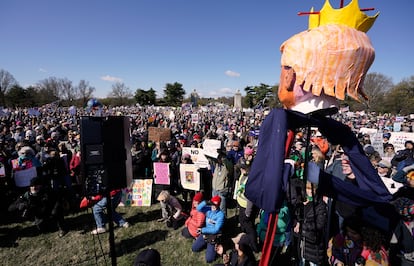
A restless and disillusioned society took to the streets in the No Kings protests of March 28. I attended the rally in Boston Common, the city’s main park. It was a bright, cold, but above all, festive midday. Citizens expressed their outrage by chanting mocking slogans against Trump and his cronies, such as Stephen Miller, the éminence grise behind many of the Republican administration’s most extreme actions. The signs they carried were satirical, humorous, or indignant and somber. But there was no doubt that those present were assembling like an army before the battle for democracy and calling for action against Trump and the class he represents, the so-called “Epstein class.” The sign that summed it all up read: “Grab’em by the midterms.”
Last year I attended the first No Kings demonstration. I had no doubt then that it was the seed of a larger movement. Saturday’s rally in Boston exceeded all expectations, drawing an estimated 180,000 people, according to organizers—twice the number anticipated.
But that’s not the most significant detail. The most important difference compared to the 2025 “No Kings” rally was its level of organization. It was clear that this was no longer a spontaneous gathering. This time, there was a robust logistical operation with resources behind the event. Furthermore, it was also clear that the more militant wing of the Democratic Party sees the movement, until now diffuse and lacking a clear roadmap, as an important electoral ally. The stage was filled with everyone from grassroots activists to Massachusetts Senators Elizabeth Warren and Ed Markey. Both took the opportunity to stir up discontent, whipping the crowd into a frenzy. “Trump wants to make us throw in the towel, but we’re going to fight!” Warren exclaimed, while Markey gave a masterclass in public speaking in under five minutes, reminding the audience that some of the movements that have shaped the country’s history had begun in that very park: the independence movement, the abolitionist movement, and the same-sex marriage movement “because the story of America has never been about those who seek to rule, it has always been about those who rise up to be heard.”
Democracy, he implied, is not an inheritance, but a continuous process of construction. The same collective energy that once ended slavery is what, decades later, won the space race while genuine battles for civil rights and against the Vietnam War raged in the streets. That legacy is alive and cannot be destroyed with impunity. It was Massachusetts Governor Maura Healey, the first woman and the first openly lesbian governor of the state, who drew the loudest ovation when she declared that ICE would not build immigrant detention centers in Massachusetts.
As I walked away from the Common, the famous quote by anthropologist Margaret Mead came to mind: “Never doubt that a small group of thoughtful, committed citizens can change the world: indeed, it’s the only thing that ever has.” There, amid satirical posters and indignant slogans against authoritarianism, that promise lived on.
When I read the two news stories on Monday—about the Artemis 2 crew and Trump’s threats against Iranian energy facilities—I thought again about what I had experienced at the No Kings protest. About the crowd that filled the park to remind power of its limits. And about the paradoxes it all entails: a nation capable of simultaneously producing a mission to the Moon and a president who threatens to destroy the world is a nation still at war with itself.
I eagerly await the Artemis 2 mission, which will take humans farther from Earth than any other journey in history. But I hope even more urgently that democracy will reassert itself in the November midterm elections, proving once again that it is a battle worth fighting. Despite the authoritarian destructiveness embodied by Trump. Or perhaps precisely because of it.









































