
No advertising, no clearance sales, just clothes for the stars: Husbands, the Paris boutique where Jarvis Cocker and Alex Turner shop
Nicolas Gabard, a lawyer-turned-designer, has a small shop in Paris where television personalities like Alexa Chung get their clothes custom-made
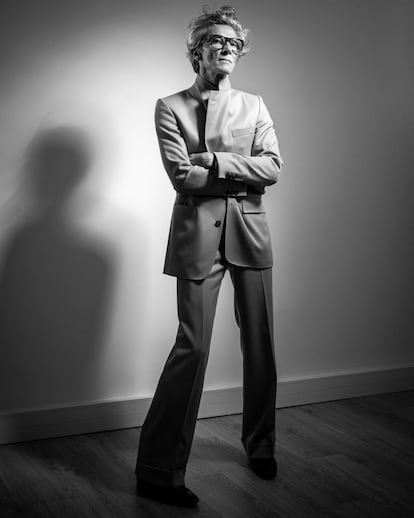
Nicolas Gabard’s clients include Jarvis Cocker, the lead singer of the British band Pulp; photographers Inez van Lamsweerde and Vinoodh Matadin; film director Baz Luhrmann; conceptual artist Philippe Parreno; and fashion designers like Guillaume Henry and Virginie Viard. Alex Turner, Arctic Monkeys’ frontman, once told him: “People used to stop me in the street for my music. Now, they want to know where my clothes are from.”
Gabard shares this anecdote with enthusiasm, like a little boy who’s been allowed to meet his idols. “I can finally say that my clients are also my inspiration,” he smiles.
This wasn’t the initial ambition of the lawyer-turned-fashion icon, who created Husbands Paris, a menswear label, back in 2012. He took the name from one of his favorite films: John Cassavetes’ Husbands (1970), a comedy in which three middle-aged friends (three married men, hence the name) try to reconnect with life’s little pleasures, following the death of a mutual friend.
“We’re named after our customers. Husbands are, first and foremost, a group of ordinary people who have lives and who consider clothing important… but not the most important thing. What is important is living, loving, having stories [to tell]. We help them because we know that clothes can transform a day,” the designer explains.
This is one of the brand’s leitmotifs, which has convinced many people that fashion doesn’t have to be frivolous. And, if it is, that’s okay, too. “It’s a cultural element, like food, sports, or literature. Not better than any other [passion] — just different. And it’s not for everyone,” Gabard acknowledges. However, he adds that ordinary men — “every kind of people,” as Joe Cocker would sing — also have the right to dream about fashion.
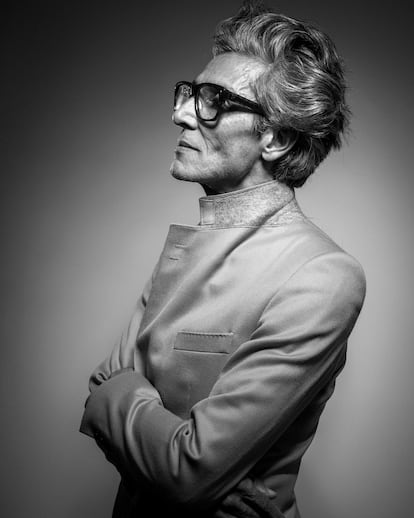
Gabard knows what he’s talking about. He doesn’t come from the bourgeois families of the Saint-Germain neighborhood, nor did he grow up in a celebrity environment. In his circle, no one would have dreamed of going into fashion.
“I studied law because that’s what my parents wanted for me. I was obsessed with clothes, but I always tried to defend that as a cultural interest. Because, in my environment, loving fashion was considered extravagant.”
That passion cost him his savings. After he started working as a lawyer, he would spend a good portion of his salary on clothes made by designers like Jil Sander, Helmut Lang, and Margiela.
Gabard knows what’s happening on the runways, but he doesn’t worry too much about trends. “The idea is to build a wardrobe of essentials — [pieces that are] sexy, contemporary, yet timeless. I want people to look at themselves in photos 10 years from now and say, ‘That [looks] great.’ And this is a very complicated exercise that the [haute couture] fashion industry doesn’t have to worry about, because they can be creative [in the moment]. We, on the other hand, worry about creating the classics of the future,” he explains.
The brand makes more of a conceptual statement than an aesthetic one. Husbands is known for its structured suits, wide-lapel jackets, and striped and Prince of Wales check patterns. It doesn’t share the minimalism of Jil Sander or Helmut Lang, but it does share the principles of dressing with intention, building a recognizable visual identity, as well as prioritizing cut and tailoring over fashion trends.
Gabard criticizes menswear for not offering the dreams that womenswear does: “We’ve never been interested in men’s desires when it comes to clothing. Women’s clothing is full of designers who promise to [elevate your style], but for men, clothes are simply an obligation,” he says.
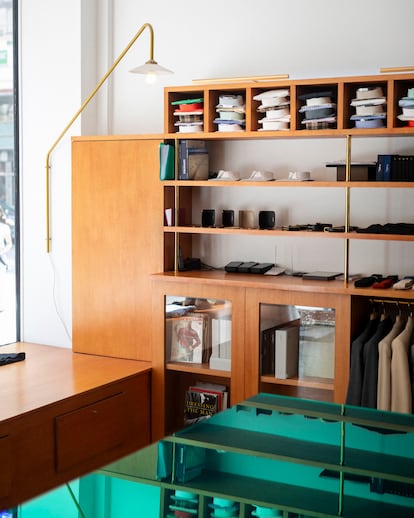
To explain himself, he heads to the library at his boutique’s offices. A dozen young men are at work: they look like they’ve just stepped out of a Britpop video. He picks up a volume of Des modes et des hommes — the bible of men’s style — which was published in 1993 by Farid Chenoune. Within its pages, two centuries of fashion are explained in a handful of rules, convictions and political anecdotes. It’s revealed that everything in a man’s wardrobe has a reason… even the length of his trousers.
“But what happens today, [when] there are no rules, no obligations, no gurus? [Men are forced to] turn to a wardrobe of basics, where everyone does the same thing: just chinos, jeans and zero risks,” he laments. “Men have been told that fashion is a frivolous matter. But if geniuses like Michel Foucault, Samuel Beckett, or James Joyce spent hours studying clothes and were willing to take a little time choosing an outfit, you can, too.”
Not many fashion designers would dare to include Foucault and Joyce among their sources of inspiration, but Gabard does. Perhaps because, before accepting that his relationship with clothing was an obsession, he spent a great deal of time reading Roland Barthes and Foucault himself, clinging to the idea that fashion isn’t merely a superficial matter.
In the end, it paid off: Foucault — with his turtleneck sweaters and leather jacket — is a reference point for Husbands, as are Lou Reed, David Bowie, Bob Dylan, Michael Caine and Serge Gainsbourg, among others. In honor of Gainsbourg, the French singer, Gabard launched a shirt whose production has its own story: “I became obsessed with a striped shirt [that Gainsbourg] wore; it had the perfect width between the lines,” he recalls. It took him a couple of years to be able to produce something similar with the fabric manufacturers he works with (primarily English). Finally, they succeeded. The Gainsbourg shirt is now a classic of the brand.
Films like The Italian Job (1969) and Blowup (1966) have also contributed to shaping Husbands’ image. “We like to be a bit snobbish,” Gabard admits wryly.
On the night of his interview with EL PAÍS, Gabard has booked a movie theater in the center of Paris for his team. Most of them are barely in their 30s. They’re going to see Bertolucci’s The Conformist (1970). “It’s the second screening we’ve done. The people who work with me [are acquainted] with film culture… but I admit that many of them would prefer to watch a Netflix series. They’re somewhat forced to [come],” he acknowledges. The young people — all dressed in outfits by Husbands and accustomed to working in the fashion industry — don’t seem particularly traumatized by their cinephile boss’s demands. Undoubtedly, there are worse jobs.
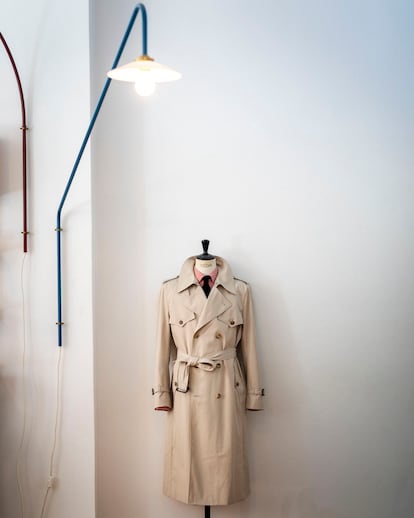
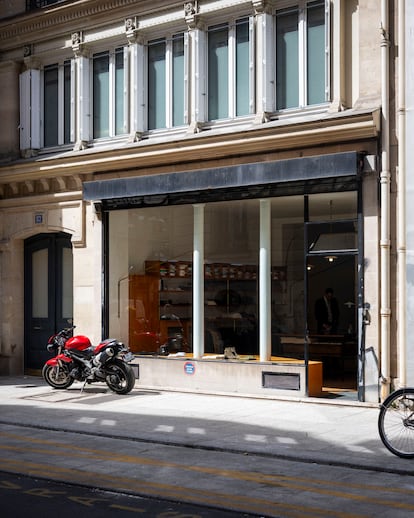
If Husbands didn’t need advertising to get where it is today, it also didn’t need a bigger store… that is, until now. The scene of all this Parisian excitement isn’t in the studio that Gabard takes us to, but in a small shop on the Right Bank, on Rue Richelieu. The boutique is a tiny space, with two shelves flanking a glass table. There’s a mirror at the back that creates a false sense of depth. Behind the mirror is the fitting room: two booths with armchairs and carpeted floors.
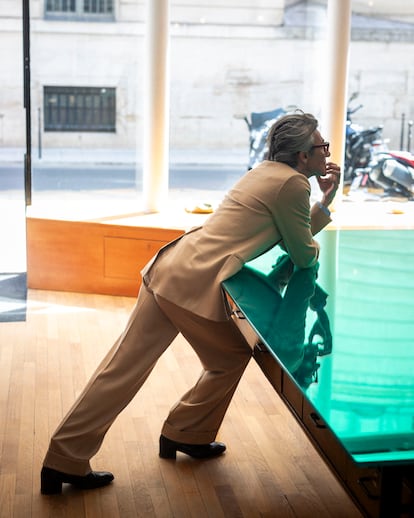
Come September, Husbands will move to Le Marais, the quintessential shopping district of Paris, which is much more connected to an international clientele. It will be just steps away from the bustling Bourse area, filled with law firms and multinational corporations. This won’t hinder its success by any means. In the new neighborhood, one might bump into a rugby player in a suit, a local lawyer, or even female fashion icons, such as former Vogue Paris (now renamed Vogue France) editor-in-chief Emmanuelle Alt, American designer Jenna Lyons, or British “it-girl” Alexa Chung. In several interviews, Chung has described Gabard as one of her style icons.
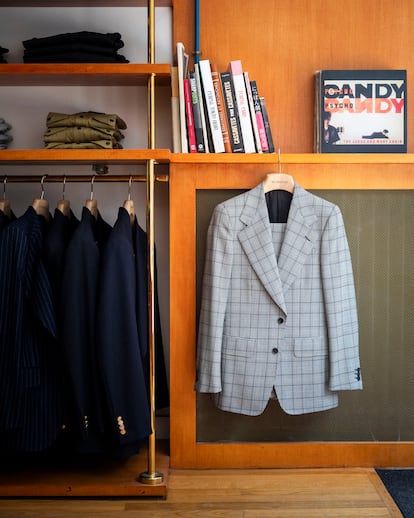
During Gabard’s interview with EL PAÍS, two women stop in front of the window to admire the suits. “The cut is perfect,” they remark. The truth is, Husbands doesn’t make women’s suits: it insists on presenting itself as a menswear brand, not unisex at all. However, at their private showings, women make up around 20% of the audience. And Husbands has a growing number of female clients.
“What they like is this idea of borrowing a piece from a man’s wardrobe. But they often come for the entire suit, looking for a more authoritative look,” the designer explains. “It’s very interesting to dress them, because women often have many insecurities… and a good suit enhances their beauty. Sometimes, they come [into our shop] saying that their body doesn’t fit our style, but it turns out to be quite the opposite; tailoring is forgiving. No body type is a problem.”
“The brand is very closely associated with my image,” he continues, “and people think that, because I’m tall and slim, you have to have this physique for [the outfits] to look good on you. But I’ve seen women with wide hips and men with muscular legs in magnificent suits,” he asserts.
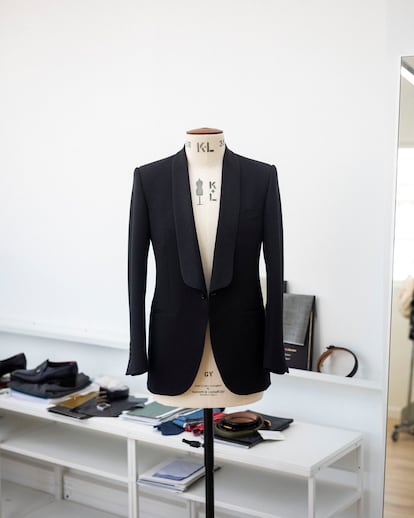
Over most of its nearly 15 years of existence, the company had to abandon ready-to-wear fashion, in order to focus on made-to-measure clothing. However, a few years ago, the positive economic conditions allowed for Husbands Paris to offer everything, including pajamas, boots, or even a complete ready-to-wear suit.
Eduardo, a Spanish salesman who works at the store, has had the opportunity to mingle with some of the clients: “They tend to be people who have a good sense of fashion and who look for quality products. There are few brands that have such a clear identity, season after season,” he tells EL PAÍS.
For discerning customers, they have the advantage of paying prices that are lower than the typically prohibitive rates of the top luxury brands. Suits are around $1,700, shirts range from $300 for poplin to $700 for silk, while a pair of trousers is around $450.
Today, Gabard dreams that the brand’s growth — which includes several points of sale abroad — will allow him to open stores in the United States and Japan, his main markets. He also dreams of stepping back from embodying the brand: he wants people to think about Husbands without thinking about him… a difficult task indeed.
Sign up for our weekly newsletter to get more English-language news coverage from EL PAÍS USA Edition









































