
Cocaine, bikers and aliens: The film that saved David Bowie at his lowest point
‘The Man Who Fell to Earth’ premiered 50 years ago and remains, to this day, a strange artefact that almost nobody fully grasps. By most accounts, not even the singer ever really understood it
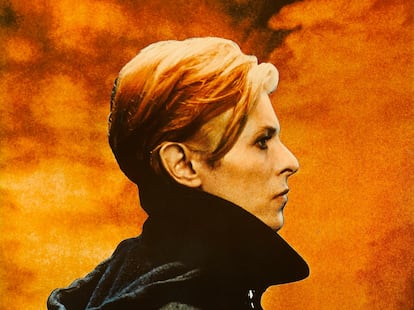

In the early days of 1975, David Bowie was a broken toy. Holed up in his grotesque Los Angeles mansion, the British musician spent his days reading obscure essays on Nazi esotericism, watching television sprawled across a wide Victorian four‑poster, and performing black‑magic rituals inspired by his new hero, the crackpot charlatan Aleister Crowley.
As Nicholas Pegg, the most meticulous of his biographers, would explain years later, the artist was then on a strict diet of tobacco, cocaine, peppers and milk cartons and, like a newly minted vampire, could barely tolerate sunlight. He suffered dark hallucinations “24 hours a day.” At one point he believed he had died and felt he scarcely cared.
His last public appearances had been calamitous. He tried to help promote what would become his most successful international album to date, the leaden and decadent Young Americans, but his legendary charm seemed to have evaporated: he weighed less than 40 kilos and could barely form a sentence. Journalists didn’t know what to write about him without doing damage.
I don’t want to be Hitler
Perhaps his last flash of lucidity had been an interview in London with Robert Hilburn, in late 1974, in which he explained his decision to stop touring, arguing that pop idolization terrified him.
“There were times, frankly, when I could have told the audience to do anything, and that’s frightening,” he told Hilburn.
In his view, the West had surrendered to personality cults and uncritical obedience and was doomed soon to have “a Hitler.” As fascinated as he was by Goebbels and his pursuit of the Holy Grail, the cadaverous, paranoid Bowie of the mid-1970s did not want to become that new Hitler.
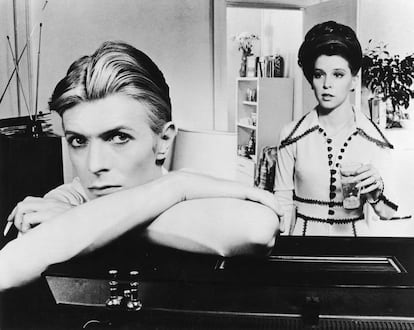
When he felt he was hitting rock bottom, a certain Nicolas Roeg, a 47-year-old film director, came to his rescue. Bowie had heard of him. He even believed he had seen two of his films, Performance and Don’t Look Now, but given his persistent narcotic stupor, he couldn’t be certain. In any case, Roeg was looking for “an alien” to star in his next project. And the most illustrious alien on Earth in those early days of 1975 was, without doubt, David Bowie.
Roeg had just seen Bowie in a now-legendary BBC television documentary, Cracked Actor, by Alan Yentob. In it, a BBC crew followed the singer through the long day of his Los Angeles concert on September 2, 1974. Yentob portrayed, with cruel relentlessness, a Bowie lost in his labyrinth, nauseatingly disoriented, oblivious to the media circus around him, immersed in an endless spiral of hotels, limousines, stages and drugs.
Roeg was planning to adapt Walter Tevis’s best-selling novel, The Man Who Fell to Earth, but first needed an actor who could convincingly play a humanoid newly arrived from the planet Anthea. He considered Peter O’Toole and the writer Michael Crichton for the role, but ultimately both seemed to him “too terrestrial.” In the Bowie shown in Cracked Actor — a man destroyed inside yet who, despite everything, remained courteous and unflappable — Roeg believed he had found the degree of strangeness and distance he was looking for.
I want to be an actor
Roeg was lucky: Bowie was hiding out in Los Angeles from his wife, Angela Barnett, and was determined to take a long sabbatical. He had instructed his agents not to bother him with any work offers unless, of course, they were film roles. In his youth, when he still called himself Davy Jones, he had studied mime and experimental theater with Lindsay Kemp and felt that was his true vocation. Music was, to him, no more than a philistine ambition that had taken him to the top only to throw him into the abyss. If the prospect of touring or recording another album was intolerable, taking orders from a good director and becoming another person — spending months on a film set with intellectually curious people — was a very attractive option.
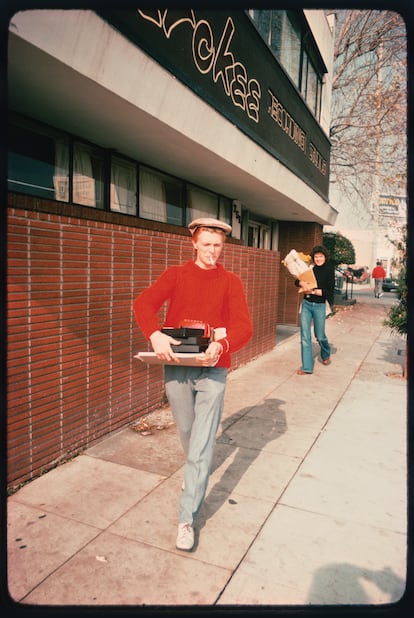
As soon as Bowie received the offer, he wanted to meet Roeg and felt an intimate connection with him. After all, Nicolas had directed another major rock star, Mick Jagger, in Performance, getting exceptional results from his very limited acting gifts. Bowie considered himself a much better actor than his friend Jagger. Moreover, Roeg made it clear he intended Bowie to play himself, or rather a sublimated, rarified version of himself — the Bowie of planet Anthea.
Maggie Abbot, Bowie’s film agent, managed to overcome his remaining reservations (they were going to pay him very little, he would have to travel) by insisting on something Bowie had thought for years: pop music is a young person’s sport and the natural next step to continue growing, at a certain age, was to move into film, “like Sinatra.” Almost nothing excited Bowie as much as following in Sinatra’s footsteps.
Fifty years later, the results are clear. The Man Who Fell to Earth is the oddest film by the quirkiest British director of his generation and Bowie’s best screen role, second only to the 1983 thrilling queer epic Merry Christmas, Mr. Lawrence, directed by Nagisa Oshima. At the time it was received as a productive failure, a low-budget production (especially considering it carried a superstar) that cost a modest $1.5 million and went on to gross just $3 million, far less than expected. But critics hailed it as the definitive consecration of a filmmaker of overwhelming originality.
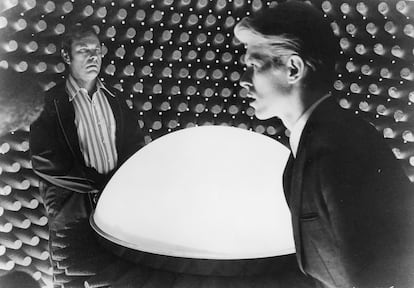
Pauline Kael called it “The Little Prince for adults,” a story of “purity made erotic.” Critics also praised the arrival of a Bowie who seemed less an actor than a fascinating cinematic “presence” — a man, indeed, fallen to Earth from his faraway narcotic cloud.
Bowie himself later admitted, contritely, that there wasn’t a day of the shoot that he didn’t do drugs. They began filming on July 6, 1975, in Albuquerque, New Mexico, and then moved to the state’s desert wastelands such as Artesia, Font Lake and White Sands. Bowie snorted cocaine in his bungalow around the clock at a pace that scandalized even Roeg, who was also fond of drugs but used far less compulsively.
Given the circumstances, it seemed impossible he’d be fit to work, yet he didn’t delay a single shot. As the shoot dragged on — partly due to Roeg’s stubborn perfectionism — Bowie and his team settled into a ranch in the hills around Albuquerque, which allowed him to stay out of sight and maintain his peculiar lifestyle without interference. He had a trailer shipped from New York filled with 400 books so he wouldn’t have to leave them in the apartment he shared with his wife, and that was increasingly frequented by “pimps and mobsters.” But in later interviews he acknowledged he did not remember reading a single line while in New Mexico.
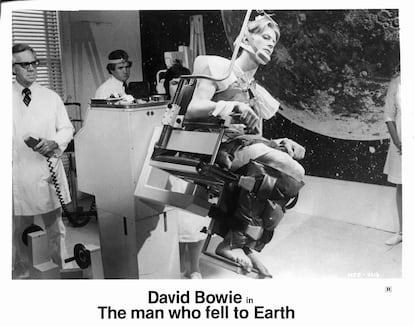
In 2016, coinciding with the film’s 40th anniversary, cinematographer Tony Richmond said: “I can’t think of anyone else who could have played [Thomas Jerome] Newton. Bowie was so strange, so ethereal, so androgynous.”
Richmond added that Bowie relaxed somewhat when his five-year-old son Zowie, the future film director Duncan Jones, came to visit. Working with the rock star was, for Richmond, a “weird” but satisfying experience.
“He always turned up on time,” he continued. “He went a bit funny for a few days, because he thought someone had put something in his orange juice. He was a very sensitive guy. In one scene, surgery is performed on him. I didn’t like the color of the makeup blood, so I said to the props boy: ‘Nip down to the butcher and get some pig’s blood.’ Bowie heard that and wouldn’t entertain it. But he would entertain human blood. We had a nurse on set, and Nic made her take my blood. Can you imagine doing that nowadays?”
Another famous anecdote involves a gang of Hell’s Angels who were camping in the desert very near one of the shooting locations. According to Roeg, Bowie ran away when he saw the bikers and refused to leave his ranch where he was staying until they moved on, forcing the production to come to some sort of arrangement with them. For all his stardom, he was a slight, spectral presence, said Roeg — the last person who’d willingly cross paths with men radiating that kind of brute swagger.
I understood nothing
What is the film about? It’s hard to say. Bowie insisted, even in the 1990s, that when he watched it he “didn’t understand a thing,” blaming his confusion on cocaine. But the same could be said of many viewers who saw it in 1976. Even today — now a cult object and properly contextualized within the work of its author, a giant of counterculture and cinematic psychedelia — The Man Who Fell to Earth is difficult to follow, with its deliberate incoherence and elliptical narrative style.
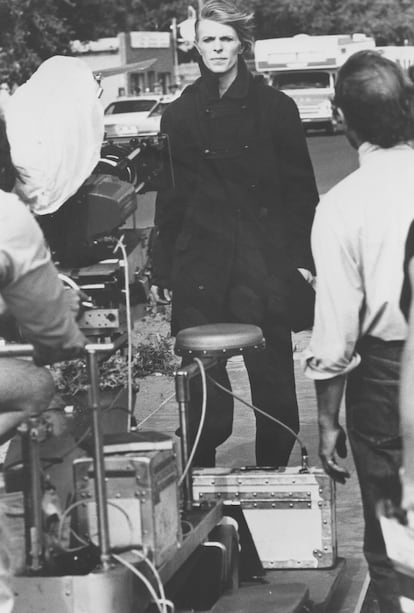
On its surface, it is the confusing story of a man who comes to Earth to secure the water resources that have been exhausted on his home planet, Anthea. Once in 1970s America, this strange individual with a British passport and orange-dyed hair becomes immensely wealthy by amassing technological patents, but his mission to rescue his family and bring water to his thirsty planet is postponed year after year for reasons not always understandable and not always beyond his control.
In the end, like a castaway thrown into an ocean of pettiness and stupidity, Newton becomes withdrawn, develops a taste for alcohol and for Earth’s narcotic television, and begins to mix with dubious characters: a dipsomaniac hotel maid who adores him (Candy Clark) and his personal Judas, a university professor played by Rip Torn. These people help him forget himself, lose his shadow and sink into melancholy while his family perishes light-years away. All he can do for them is record an album of experimental music titled The Visitor, hoping they will someday hear it and understand what has happened to him.
The details of this existential epic are blurry. Roeg started from a book that was already quite cryptic, turned it inside out, and set out to create a kind of social satire and a visual journey of dazzling eccentricity. But neither he nor his excellent screenwriter, Paul Mayersberg, seemed overly concerned with something as mundane as telling a coherent story. Bowie didn’t understand the film he had starred in, and neither do we. But the most unhinged and alien of Roeg’s already extraterrestrial projects retains, 50 years later, all its power to fascinate.
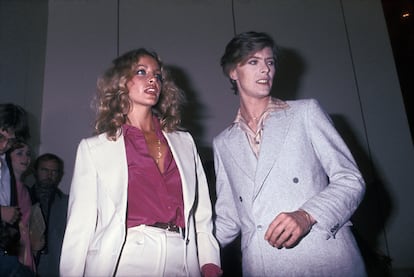
For film buffs, one scene remains unforgettable: the Earth surgeons implant in Newton’s eyes the pair of contact lenses he used to give himself a vaguely human look — lenses he will now never be able to remove. It is, besides an act of gratuitous cruelty, the metaphor for something deep and unsettling, though we may never know exactly what. It raises questions for which we have no answers. And that’s as it should be.
Sign up for our weekly newsletter to get more English-language news coverage from EL PAÍS USA Edition









































