
Nhandeflix, the Guarani platform that fights against colonization by digital apps
Instead of completely banning the internet, an Indigenous community in Brazil has created a local server with films, podcasts, and videos
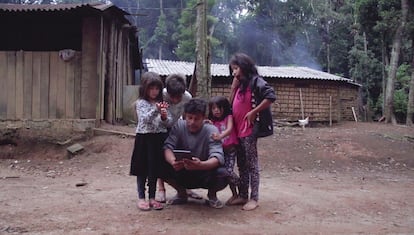
In 2021, when satellite internet connection came to the Tenondé Porã Indigenous Land, which is made up of seven ethnically Guarani communities just south of the city of São Paulo, unexpected collateral issues arose. Younger members began to detach from communal activities. They stopped going to the house of prayer (the sanctuary) and the mutirões, or collective actions. Instead, they spent evenings on their cell phones watching videos on TikTok, compulsively using Free Fire and consuming pornography. Though the internet did facilitate political organization for the inter-town committee of the region made up of 23 communities spread across five Indigenous reservations in southern São Paulo, it was leading to more problems than solutions.
Local elders decided to disconnect from the internet, and pulled out the cables. “The internet is a kidnapping tool to Indigenous communities, we aren’t used to it. People stop learning their cultural practices and fall into content that disrespects women, incites violence, and [encourages] drinking. They begin to laugh about the misfortunes of others in funny videos that circulate quickly,” Jerá Guaraní, one of the leaders of the Tenondé Porã Indigenous Land, tells EL PAÍS.
But merely unplugging the internet didn’t solve these issues. Given the closeness of the region to the São Paulo metropolitan area, younger members simply set out in search of a WiFi connection. Sometimes, they’d disappear for several days. “We began a series of conversations to find a collective way of dealing with it. We helped the elders to understand that there was no going back, that the internet is like television, here to stay. The youngest members also understood that they couldn’t immerse themselves in that way, because it was going to destroy the Guarani way of life,” says Pedro Ekman from the Intervozes collective, who works on technological projects with the inter-town committee.
Jerá Guaraní says the internet has worsened problems that arose with the entry of cell phones. “Those who have cellular phones stop understanding what others are saying, they waste a lot of time, they even stop paying attention to the children, grandchildren, husband or wife,” she says. This is why the Nhandeflix platform was invented: to strengthen their culture and to value that which took place in their own lands.
The idea didn’t come immediately. First, Intervozes and Coolab designed a kind of partial blockade of the internet. With the help of a Raspberry mini-computer and blockade software Pi-hole, they made it impossible to access pornography or betting sites from the area. Plus, platforms like YouTube and TikTok were blocked at night. “The first method was to block everything except messaging services like WhatsApp and Telegram. The problem is that young people made a mockery of that domain blocking with VPN services,” says Ekman.
In 2022, after several failed attempts, an idea arose to launch a platform featuring Guarani content. In Guarani, nhandé means “us” or “ours.” “In order to avoid a restrictive agenda, we are proposing a kind of local content server. Each town has a mini-computer with a memory card full of films, videos, audios, even podcasts, which everyone can access. This way, we’re offering an alternative, a Guarani internet,” says Lucas Kesse of the inter-town committee, in the mini-documentary Nhandeflix.
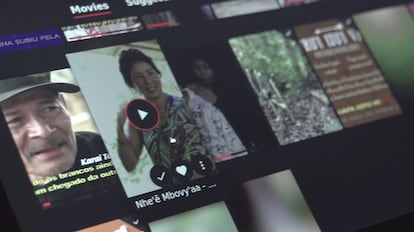
Nhandeflix works like a local intranet. It uses a familiar format, but one that is only accessible locally. The domain nhandeflix.com doesn’t exist, but the project works for the 23 towns through access to the community platform. It utilizes the program Jellyfin, whose interface is similar to that of Netflix, and is available on cell phones. Initial content curation was done by the inter-town committee. “The majority of its content is already online, but no one was accessing it. The algorithm leads you elsewhere, even if you’re interested in these things,” Ekman points out.
Using the platform, users can find Guarani cultural productions like Roda Cutia (a Guarani children’s song), Bicicletas de Nhanderú (a documentary about a Guarani-Mbya town in southern Brazil), Xondaro Mbaraete (a documentary about the passing down of Guarani wisdom) and Como a noite apareceu (a fictional film based on a Guarani legend). It also includes material from other ethnic groups, like A Arca dos Zo’é (1993), which is about a historic meeting between the Waiãpai and Zo’é communities in the Amazon. “In addition to documentaries and films about the lives of Indigenous peoples and healthier, educational things, we want to highlight content made in our own lands,” says Jerá Guaraní. And so, Nhandeflix also features content filmed in the region’s communities.
At a presentation of the platform in one of the area’s towns, young Karai Tiago highlights its “videos to raise awareness among young people,” because “it is a challenge to maintain the Guarani way of life.” That, according to Lucas Kesse, is due not just to the “battle for the land, for the space, but for control over time.” Since the launch of Nhandeflix, problems have arisen. For example, some families decided to buy fiber-optic internet instead of community satellite access — the accelerated timeline and infinite scroll of global platforms have already taken hold in many communities. On the other hand, content storage on memory cards for Nhandeflix has turned out to be a clunky process, requiring frequent upgrades.
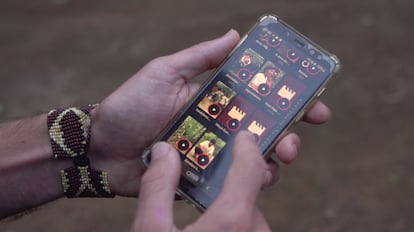
To address such concerns, the inter-town committee is re-launching the service. Plus, it is in talks with Intervozes to build a website and even the area’s own data center. “The Guarani are thinking about investing everything they have in a community data center that they will run themselves. In general, all this is a Guarani technological appropriation. They say, we’re not going to let technology destroy our world. We are going to appropriate it so that we can maintain our way of life,” says Ekman.
Nhandeflix is not an entertainment project meant to compete with Netflix. It’s really about autonomy, and what Jerá Guaraní and Kesse call “technologies of sufficiency,” technological tools that nurture other value systems beyond the “excess that sickens,” uncontrolled accumulation and consumerist escape. “We don’t want to live like social media mannequins,” says Jerá Guaraní. “We want to live like the roots in the earth.”
Sign up for our weekly newsletter to get more English-language news coverage from EL PAÍS USA Edition









































