
Ancestral tourism: Where Indigenous and Afro-Brazilians can tell their own stories
Traditional communities in southern Rio de Janeiro and northern São Paulo are organizing to offer visits that focus on local culture and steer clear of mass tourism
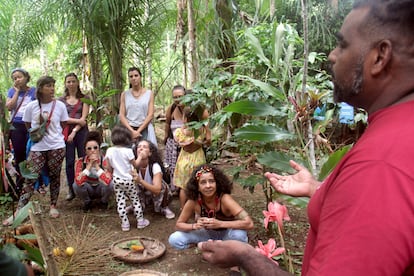

When Tupã Mirim, a 25-year-old Guarani-Mbya youth, learned he could become a tour guide in his own village, he felt a deep desire to change his life. After five years washing dishes in restaurants and mowing lawns in gardens, he decided to take a training course in community-based tourism from Rede Nhandereko, the leading organization in Paraty, on the south coast of Rio de Janeiro, and Ubatuba, in northern São Paulo. During the course, Tupã not only trained as a guide, but also managed to project a future for the 13 families in the village known as Rio Bonito.
Walking along a village path, three kilometers from Ubatuba’s popular Itamambuca beach, Tupã explains that his tour includes birdwatching, musical activities, archery practice, a visit to his agricultural plantation, and a handicraft exhibition. “We explain to visitors that we plant manioc (cassava) and bananas in the middle of the forest. For us, conservation is important. The Itamambuca is not just a river, it’s a river-spirit,” Tupã assures.
Around a campfire, Ivanildes Kerexu, the village matriarch, argues that mass tourism is harmful: “They only leave trash. They have no knowledge of the territory or our history.” The Rio Bonito village still lacks an official title. For Ivanildes, joining the Nnandereko Network could help the village become part of the Boa Vista Indigenous Land, located seven kilometers away.
Valdecir Mirim, the chief of the Boa Vista Indigenous Land, is proud that his village is one of the tourist routes of the Nhandereko Network. “Although few tourists arrive, we receive visits from many schools,” says Valdecir, after a ritual at the House of Prayer for the Santa Clara School in São Paulo. While watching a soccer match in the village, he talks about the challenges facing a community of 222 inhabitants. The solar panels are from the central government’s Luz do Povo program. The community receives funding from the Guardiões da Floresta project for its environmental conservation work. Still, their main source of income comes from handicrafts. “To attract tourism, we need better infrastructure. We want to open a trail that leads to the Rio Bonito village. It will be an attraction for visitors,” the chief explains.
An ancestral network
In Guaraní Mbya, nhandereko means “our way of being.” In 2019, the Nhandereko Network, launched by the Forum of Traditional Communities (FCT), with support from the Oswaldo Cruz Foundation (Fiocruz), began to market tourist tours. In 2024, the network inaugurated a sales headquarters in the city of Paraty. At the moment, it offers five itineraries: the Boa Vista village and the Quilombo da Fazenda (both in Ubatuba), the traditional communities of São Gonçalo and Trindade and the Quilombo do Campinho, all three in Paraty. “We joined forces to try to eliminate intermediaries. Agencies take a cut of between 12% and 20% on the tours we offer. They also prioritize their conventional routes,” says Daniele dos Santos, one of the founders of Rede Nhandereko. The community founded by emancipated slaves where Dos Santos lives began organizing tours in the early 2000s: “Tour guides would come with groups and explain everything. So we decided to organize and tell our own story,” says Daniele. In a short time, the quilombo established itself as an educational destination for schools, universities, and researchers.
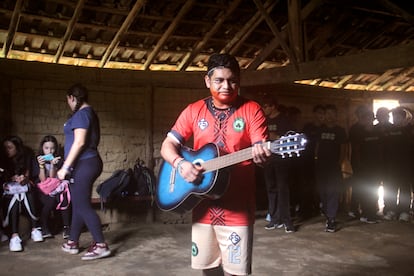
Adilsa da Conceição da Silva, 68, shares her story with a group of local educators in a building belonging to the Association of Residents of Quilombo do Campinho. “Before, when we went to Paraty, we were ashamed of being quilombolas. Now, we are proud of our jongo (dance) culture, the Casa da Farinha (Flour House), the Casa do Artesanato (Crafts House), a restaurant,” Adilsa explains. In the quilombo plantation area, Vagner do Nascimento, one of the Forum coordinators, shares with visitors the secrets of an agroforestry operation: “We don’t use pesticides. Monsanto takes care of its agribusiness. We take care of the genetic heritage of our ancestry. We only use native seeds.” Surplus coffee, pupuña, cocoa, corn, beans, bananas, and cassava, among other products, are sold. The production of the palmito-juçara palm, whose fruit is similar to the açaí, is Campinho’s “national pride.” “Thanks to the rescue of our traditions, people who left the quilombo have returned. Young people are getting involved in agricultural work,” explains Vagner.
Eloá Chouzal, a historian and audiovisual researcher based in São Paulo, confesses to being enchanted by the tour of the Campinho quilombo: “We heard the history of the place and its struggle. We met its leaders, ate local products. We enjoyed a ciranda and a samba dance [musical activities]. It was an intense learning experience.”
Staying in the land
Community-based tourism is a concept that has emerged in recent decades. “In the 1990s, people talked about ethnic tourism or ecotourism. Later, we introduced agroecotourism, involving farmers,” says Vagno Martins, a member of the São Gonçalo community, one of the ideologists of the Nhanderekó Network and currently a councilor for the Workers’ Party (PT) in Paraty. The experiences of the São Gonçalo community, the Quilombo do Campinho, and Ilha do Araújo in the 2000s were key to conceptualizing community-based tourism. In 2008, the Brazilian Ministry of Tourism channeled public resources toward community tourism and published a book. “Community-based tourism reconciles the permanence of communities in their territories with environmental conservation. Conventional tourism can’t visit waterfalls in conservation areas. We can, because our sustainable flow and community practices respect protected areas,” Vaguinho tells América Futura while preparing lunch in his home in São Gonçalo.
São Gonçalo Beach is moving in the opposite direction to mass tourism. The owners of the 17 beach bars are locals. Nine directly feed São Gonçalo’s community-based tourism network, and the remaining 17 indirectly. The person largely responsible for this feat is 65-year-old Tânia Ayres, the true matriarch of the beach. In 2012, after working for many years as a domestic worker in the hospitality industry, or selling on the beach, she decided to start her own business: “I founded Rancho da Tânia on my grandmother’s land.” Little by little, she encouraged acquaintances to open their beach bars. Andreza Fraga, 33, was one of them. In 2018, after eleven years working in a commercial pousada in Paraty, she decided to open Rancho Franga. Upon returning to her community, Andreza left behind the deep depression she had been mired in. She reconnected with the family’s roça (plantation) and the cycle of the earth. “Instead of offering a portion of frango à passarinho (a chicken dish common throughout Brazil), we serve seasonal fish from an artisanal fisherman. The herbs and seasonings are local. Each traditional dish involves several people. The income is shared,” he says.
Mauricéia Pimenta, one of the leaders of the Nhandereko Network in São Gonçalo, reflects at Rancho da Tânia on the memory of the territory. “Some tour guides call the Taquari Power Plant waterfall the Twilight waterfall, because the Twilight saga was filmed there. Pitanga beach is known to locals as the Happy Corner, because there was a woman there who helped women give birth,” she says. In her opinion, this tourism is a counterpoint to the market’s exploitation that erases collective memory. By reclaiming their identity, communities are strengthened.
Scaling experiences
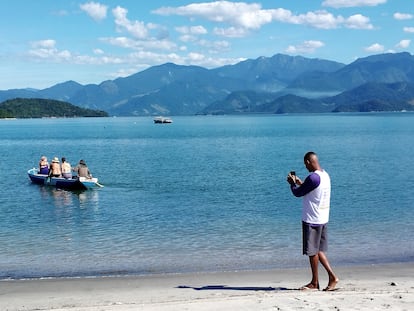
Sergio Salvati, advisor to the Social Technologies Incubator of the Observatório de Territórios Sustentáveis e Saudáveis da Serra da Bocaina (OTSS), which supports the Nhandereko Network with funding from Fiocruz, believes that tourism in Paraty is at a crossroads. The UNESCO World Heritage status of Paraty and Ilha Grande (2019) has triggered tourism pressure. “Community-based tourism needs a boost. We want to invest in digital marketing. We also want to close agreements with travel agencies in Rio de Janeiro and São Paulo. At the same time, we have to reach foreign tourists who are interested in culture,” he says. The strategy, according to Salvati, also involves exchanging lessons learned with other community-based tourism experiences in other parts of the country.
Vaguinho de São Gonçalo believes the challenge is to grow without the “advertising logic of predatory tourism.” Marcos Westley, coordinator of the Rio Negro Program at the Socio-Environmental Institute (ISA), feels similarly. He knew Trindade in the past when it was just a fishing village. Upon learning that this neighborhood of Paraty had become a tourist hub, he lost interest. But upon learning about the Rede Nhandereko proposal, he decided to return. “I was guided by the children and grandchildren of those caiçaras [the local name] who welcomed me. It was exciting to find such an organized community. The fishing, the food, the conversations—they were all fantastic,” he says. Marcos compares Trindade’s community tourism with that offered by the Yanomami indigenous people to climb the Neblina Peak, in the middle of the Amazon: “Many tourists who go on the expedition say: I came here to conquer the Neblina Peak, and it was the Yanomami who conquered me.”
As in that remote territory, in Paraty and Ubatuba, the emotional connection with the territory through its inhabitants emerges as the main tool to protect them from mass tourism.
Sign up for our weekly newsletter to get more English-language news coverage from EL PAÍS USA Edition









































