
Trump removes Venezuela from list of countries failing to combat drug trafficking but keeps Colombia on it
The United States highlights the ‘positive steps’ taken by Delcy Rodríguez in Caracas and signals that it could reconsider its stance toward Bogotá following Abelardo de la Espriella’s rise to power

The U.S. government has decided to remove Venezuela from its list of countries it accuses of not doing enough to combat international drug trafficking. In a statement, the State Department said the decision, which marks a sharp departure from previous years, was prompted by the arrest and removal from power of former president Nicolás Maduro in January, and by the death of Tren de Aragua gang leader Héctor Rusthenford Guerrero in June. Both events followed U.S.-led military operations in the country. The move also amounts to a reward for acting President Delcy Rodríguez, who governs under U.S. supervision.
“Given the positive steps taken under interim President Delcy Rodríguez, I have determined Venezuela should no longer be designated as having failed demonstrably to fulfill its drug control commitments,” reads the statement from U.S. President Donald Trump. The measure comes at a time when Rodríguez’s government is deepening its cooperation with the Trump administration through a series of oil agreements.
Until his arrest last January, Washington regarded Maduro as the leader of the Cartel of the Suns, an alleged drug-trafficking organization. In a 2020 indictment, the United States claimed that Maduro had “helped manage and ultimately lead” the group “as he gained power in Venezuela.” References to the cartel, which has never been shown conclusively to exist, were removed from the indictment filed against Maduro after his imprisonment in New York.
Despite the shift in policy, Venezuela remains on the list of countries that the United States considers major drug-transit and drug-producing nations, alongside Colombia, Bolivia, El Salvador, Ecuador, Mexico, and Guatemala, among others.
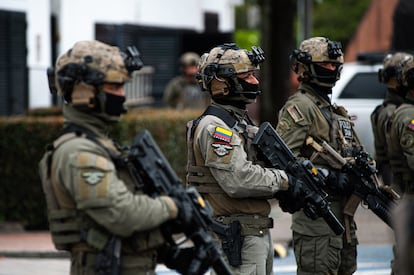
In Colombia’s case, the State Department chose to keep the country on its list of nations deemed not to be doing enough to combat drug trafficking. It coupled that decision with criticism of the outgoing government of Gustavo Petro, while offering clear support for Abelardo de la Espriella, who has been Colombia’s president for the past 40 days: “Colombia is poised to resume its place as our foremost security partner in the hemisphere, and the country’s military, police, prosecutors, and courts now finally have a worthy champion in President de la Espriella,” reads the message Trump sent to the U.S. Congress, as required annually.
In fact, the statement suggests there is a strong likelihood that the designation will be reversed in 2027. “The people of Colombia made the courageous choice to elect Abelardo de la Espriella as president. He has pledged to lead an aggressive campaign against coca cultivation and cocaine production, which reached record levels under the failed socialist policies of his predecessor,” it says. “If, as expected, Colombia makes progress on aggressive coca eradication and dismantling its narcoterrorist networks over the coming year, [the administration] will consider lifting the country’s ‘failed demonstrably’ status, which remains in place solely due to the incompetence and chaos produced by the previous far-left government in office throughout the bulk of the past year.”
As in 2025, Trump granted Colombia a waiver exempting it from the suspension of security cooperation and the economic sanctions that can result from decertification. For that reason, the Colombian-American Chamber of Commerce argued that the decertification “must therefore be understood on two levels: the technical and legal outcome remains unchanged, but the political context has shifted substantially.”
In Colombia’s case, relations between the two governments had improved during the 12 months since the country’s decertification in September 2025. Former Colombian president Gustavo Petro visited Trump at the White House in a meeting both leaders described as positive, while police and judicial cooperation at the operational level continued largely unchanged.
After a dispute with the U.N. agency responsible for monitoring coca cultivation in the world’s largest cocaine-producing country, Petro released the report last June showing that Colombia had 261,000 hectares of coca under cultivation as of December 2024, a historic record that nevertheless reflected a slowdown in growth, which had been accelerating sharply since 2020. De la Espriella frequently cites a figure of 300,000 hectares without disclosing the source.
The current president has made the fight against crime in all its forms one of the hallmarks of his administration, in part as a contrast to Petro’s policy of seeking agreements with armed groups as a way of resolving Colombia’s multiple overlapping conflicts. “Those who persist in drug trafficking, terrorism, or organized crime will face the full legitimate force of the state,” he said a few weeks ago while outlining the broad contours of his security strategy.
Sign up for our weekly newsletter to get more English-language news coverage from EL PAÍS USA Edition









































