
Colombian government reconciles with the UN, publishes 2024 report on illicit crops
After a year of disputes over methodology, the Gustavo Petro administration accepts a 3.5% increase in coca cultivation

After more than a year of disagreements and tensions between the Colombian government and the United Nations Office on Drugs and Crime (UNODC), the agency on Thursday released its report measuring the growth of coca cultivation in Colombia. According to the document, the country ended 2024 with 261,000 hectares of coca, a 3.5% increase compared with the 253,000 recorded the previous year. It is the lowest growth rate in the past four years. The report was released 18 months late following a dispute over methodology between the two sides.
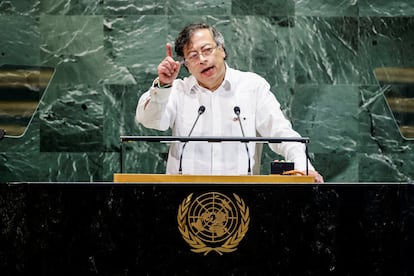
The standoff grew so intense that Colombian President Gustavo Petro called in the media to explain it, devoted public addresses to the issue and, as usual, posted repeatedly about it on X. Petro argued for weeks that the figures — which he considered flawed — helped U.S. President Donald Trump build a narrative against him and put him on the OFAC sanctions list.
“The indicator of potential cocaine production has been poorly constructed by UNODC for years. Given the opaque statistical methods used, the government will no longer rely on it,” the president said last January. However, he never terminated the contract between the Ministry of Justice and the U.N. agency; it was only suspended while both sides debated the methodology.
Justice Minister Jorge Iván Cuervo acknowledged that it took months of talks and negotiations to reach a consensus. “There were several months of conversation, discussion and negotiation in Colombia and in Austria [the UNODC’s global headquarters] until a consensus was reached on how to understand illicit drug markets, their evolution in Colombia and their relationship with the armed conflict,” said the lawyer, who took office in February when the dispute was in full swing.
The report shows an increase in cultivated areas, though the smallest rise since the pandemic. In 2023, coca crops grew by 10%; in 2022, by 13%; and in 2021, the increase was 43%.

The most striking takeaway from the report is not the highly contested figure for cultivated area, but another one that has been left out: for the first time since monitoring began in 1999 — when Colombia contracted the system to provide independent verification of its progress — the report does not include an estimate of potential cocaine hydrochloride production, the projected tonnage of the drug the country could produce. EL PAÍS previously reported that UNODC had put that figure at 3,001 tonnes, a 12.6% increase on the previous year. Its omission represents a win for the Colombian government.
As far back as 2023, the report by the Integrated Illicit Crop Monitoring System (SIMCI) had already triggered alarm with a sharp jump: a 53% increase in potential production, reaching 2,664 tonnes. That figure angered the government, which also draws on internal estimates from the National Police based on satellite imagery.
According to the introduction to Thursday’s report, both the ministry and UNODC concluded that the methodology used so far did not adequately reflect the pace of production changes on the ground. The 2023 estimate effectively bundled together shifts spanning up to four years into a single figure.
This stems from the system adopted since 2007, under which the country is divided into four regional blocks. Each year, one block is selected at random for fieldwork and rural surveys, and the results are then extrapolated nationwide. In other words, increases or changes in coca dynamics in just one region of Colombia are extrapolated nationally, and each block is directly measured only once every four years.
The government’s objections to this approach led to the suspension of the figure in this year’s report. Instead, the parties agreed on a roadmap to revise the methodology, incorporate margins of uncertainty, and develop complementary indicators. Among the new technical measures under consideration are estimates of “available cocaine” and “avoided cocaine.”
Evidence supporting these criticisms can be seen in the report itself, which shows that the growth in coca cultivation is far from uniform. The Pacific region — led by the departments of Nariño and Cauca—accounted for 121,612 hectares, a 14% increase from 2023. By contrast, neighboring Putumayo, in the Amazon — once the country’s coca-growing heartland — saw its cultivated area fall by 14% to 49,190 hectares. This was partly because it absorbed 87% of all land targeted for forced manual eradication in 2024, although only 36% of those efforts were methodologically verified.
Overall, the report shows that Nariño, with around 74,500 hectares, is the department with the highest concentration of coca for the fourth consecutive year, while the municipality of Tumaco has regained the top spot nationally, with roughly 31,000 hectares. The Catatumbo subregion in Norte de Santander continues to be another key hotspot: it expanded by 11% in 2024 to reach 48,739 hectares, making it — alongside Nariño — one of the main drivers of growth. Three departments (Nariño, Norte de Santander, and Putumayo) together account for 64% of the country’s total cultivated area.
The report also underscores a trend noted in previous editions: coca cultivation is not spreading into new territories but is increasingly concentrated in established clusters. Ninety percent of the coca detected in 2024 was located in areas that have had crops for at least a decade. It also notes that zones near land borders — especially those with Ecuador (Nariño and Putumayo) and Venezuela (Norte de Santander) — as well as the Pacific coast, continue to see the highest concentrations.
A central concept in the report is that of “production enclaves”: areas with a very high and sustained concentration of crops, where the processing chain from coca leaf to cocaine is fully integrated. In 2019, there were seven such enclaves; by 2024, that number had risen to 15. Together, they now account for 44% of all cultivation, covering 114,000 hectares — double their share five years earlier. The enclave referred to by SIMCI as the Tumaco border area grew by 43%, while Catatumbo-Barí expanded by 10%. Only the Putumayo enclaves and some in the central region showed declines.
Coca production has been one of the major burdens on Gustavo Petro’s government. The most visible consequence has been tensions with U.S. President Donald Trump’s administration, which — before easing frictions with Petro earlier this year — went so far as to suggest, without evidence, that the Colombian leader was profiting from the drug trade. That, in turn, led Washington to suspend the aid it had been providing Colombia to combat the spread of coca cultivation. The incoming government of Abelardo de la Espriella, fully aligned with Trump’s rhetoric, will face this issue under the watchful eye of its northern allies.
Sign up for our weekly newsletter to get more English-language news coverage from EL PAÍS USA Edition









































