
Mass trials without due process in El Salvador: ‘Judges are afraid. They’re convicting everyone’
Court records and testimony from defense attorneys show how prosecutors and the courts are securing convictions based on opaque police files, anonymous allegations and trials conducted behind closed doors
“As a defense attorney, I have done everything possible, everything established by law to prove my clients’ innocence, but it’s useless,” says a disheartened Salvadoran lawyer. “There is nothing to be done.”
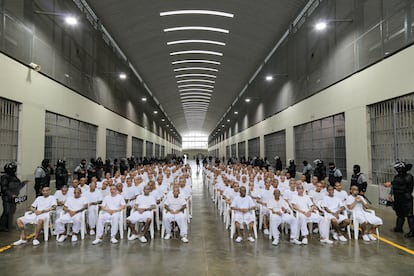
He is one of hundreds of private defense lawyers involved in the so-called “mass trials,” the controversial mechanism through which El Salvador’s justice system has begun handing down sentences to thousands of people prosecuted under the state of emergency imposed by President Nayib Bukele. The trials, which began last December, are intended to convict the more than 92,000 people arrested during the four years the measure has been in force. Although authorities have repeatedly insisted that the proceedings will be fair, what takes place behind closed doors suggests otherwise.
Since the start of the state of emergency, the government has requested that all courts place the cases against tens of thousands of Salvadorans under complete seal, even as thousands of complaints of arbitrary detention emerged. Despite the veil of secrecy surrounding the proceedings, EL PAÍS obtained four indictments filed by prosecutors in four separate mass trials. It also interviewed around a dozen defense attorneys participating in such cases. Together, those materials made it possible to reconstruct aspects of a judicial process that the government is keeping hidden from the public.
The four case files involve 1,226 defendants. Of these, 134 are charged with terrorist organization offenses and 1,092 with unlawful association. All were arrested between March 2022 and May 2023, meaning they have spent between three and four years in pretrial detention without knowing their sentence. Analysis of the documents shows that most defendants were arrested under remarkably similar circumstances: police officers or soldiers on patrol in areas with gang activity would spot one or more individuals with a “suspicious appearance,” who would then allegedly attempt to “flee.” After detaining them, officers checked police databases and identified them as gang members. Of the 1,226 cases reviewed, only two involved arrests were made under an arrest warrant or following a judicial search warrant.
The documents also reveal how indiscriminate the arrests were. In one case, authorities even detained a man who had voluntarily gone to a police station to find out whether he had any pending legal matters. Antonio M.A. was arrested at a police substation in San Vicente on April 25, 2022. “This is because the person now detained presented himself voluntarily at the police facility to verify whether he had pending cases, and upon being stopped, identified and having his name checked in police systems, he was registered as a collaborator of Mara Salvatrucha,” the indictment says in a single paragraph.
In virtually all of the 1,226 cases reviewed by this newspaper, the key evidence justifying detention was that the individual appeared in “police systems” identified as “a gang member,” without specifying which database was used or providing any further details.
Since the beginning of the state of emergency, human rights organizations have alleged that police officers created “express police files” at the moment of arrest and that many officers were pressured to meet daily arrest “quotas.” Four years later, defense lawyers handling these cases say those allegations are borne out by their experience.
“It’s a police file created at the moment or days before the arrest. Sometimes they would go to someone’s home, take their details and a photo, and two days later return to arrest them. On the file they’d write ‘according to police intelligence the person is an MS‑13 collaborator,’ and that was enough to lock them up,” says one of the lawyers.
This newspaper interviewed around a dozen defense attorneys participating in the mass trials. All said that the police file has effectively become incontrovertible evidence and that there has been no way to verify its authenticity through forensic or technical means.
“We have asked judges to order the police to conduct a forensic examination to determine when these files were created, because sometimes they were prepared even after the arrest had taken place. But the answer has always been no,” one attorney explains.
All the lawyers requested anonymity for fear of reprisals, despite the fact that the rights to legal defense and to practice law are protected under El Salvador’s Constitution.
Justice with loaded dice
These attorneys say the right to a defense has been all but nullified in the mass trials, with both prosecutors and judges steering proceedings toward conviction rather than toward establishing the facts. They argue that most cases rest on three pieces of evidence: a police file identifying the defendant as a gang member or collaborator, the testimony of the arresting officer, and the statement of a protected witness, usually a gang member, who identifies the accused as part of the organization.
“The same witness can identify more than 500 people, not even in person but from photographs shown by prosecutors, often blurred,” warns one defense lawyer.
The attorneys also complain that they are placed at a severe disadvantage because they are denied access to the complete case file throughout the proceedings. In many instances, they are allowed to see the indictment against their clients only one or two days before trial begins.
“They only give us access to what they say pertains to our clients, even though we might find evidence elsewhere in the case file that could help our defense. But they don’t care about that because all they’re after is a conviction,” says one of the lawyers.
Another challenge faced by defense attorneys is the shortage of witnesses for the defense due to fear of retaliation. “Usually, you bring a family member or someone who really knows the defendant to testify before the judge that this person is honest and hardworking, but often they themselves are afraid of being accused of being gang members too because they’re told they’re defending a gang member, and there have been cases where they’ve withdrawn from the proceedings. Then we’re left even more defenseless,” says another of the attorneys.
Cristosal, El Salvador’s leading human rights organization, which has documented thousands of complaints of arbitrary detention, likewise believes that both defendants and their lawyers have few tools with which to defend themselves in the mass trials, a situation it says is likely to result in thousands of unjustified convictions.
“The judges — who are supposed to ensure due process — bow to the interests of the Attorney General’s Office and reject the defense attorneys’ motions, even threatening to prosecute them if they file too many appeals,” says one of the organization’s attorneys, who asked that his name be withheld. “Under normal circumstances, the defense should have equal standing to counter the prosecution’s arguments and present exculpatory evidence, but in practice, after four years of preliminary proceedings, the defense does not gain access to the indictment until just days before the hearing.”
Another defense attorney interviewed by this newspaper says that there is still work to be done, but only after the convictions are handed down. “I’ve stopped defending my clients right now because it’s impossible to defend them,” says the attorney. “The dice are loaded, and they’re convicting everyone. I don’t know of any judge who has had the courage not to convict someone, even when they know they’re innocent. It’s like defending the indefensible. I’d rather wait until they’re convicted and then, during the appeal phase, I’ll vigorously present my arguments. If the appellate courts also refuse to listen to reason, I don’t know what else I can do.”
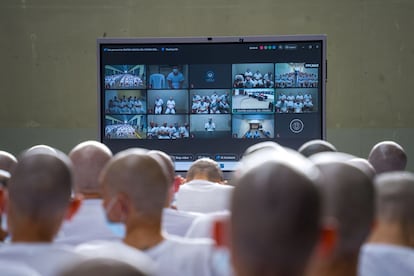
Two other defense lawyers with decades of experience were even more blunt. Both say they have chosen not to represent people prosecuted under the state of emergency because they believe the trials offer no guarantees for an effective defense.
“What am I supposed to do there if there’s no possibility of defending anyone? Judges don’t even wait for all the defendants’ names to be read out anymore. They immediately ask the prosecutor, ‘How many years do you want for each one?’ And then the proceedings continue,” says one of them.
EL PAÍS sought comment from the Supreme Court through its press office but received no response.
Only Bukele can decide who gets out of prison
Human rights organizations have taken their complaints to every available forum, but none of their efforts has had any effect. In March of this year, a group of experts accused the Bukele government before the United Nations of committing crimes against humanity. The Salvadoran government, for its part, has shown contempt for such criticism, arguing that anyone who denounces abuses is either defending gang members or has ties to them.
On April 2, less than a month after the complaint was filed with the United Nations, Ibrajim Bukele, one of the president’s brothers, claimed on X that an “independent team” within the government was reviewing “one by one” the cases of people detained under the state of emergency, as well as allegations concerning the more than 500 deaths reported in Salvadoran prisons.
“Cases come in and are reviewed every day,” said the president’s brother, who holds no official position in either the government or the justice system.
According to Ibrajim Bukele, the team has the power to decide who is released and who remains behind bars. It is not overseen by judges or courts but operates through institutions under the president’s authority. The president’s wife, Gabriela de Bukele, is also involved.
“[That team] works hand in hand with the Attorney General’s Office, the Justice Ministry and the prison system. Part of the team also works out of the First Lady’s Office. Nobody wants innocent people in prison,” Ibrajim wrote during a discussion on social media.
It was the first time a member of the Bukele family, who have consistently maintained that all detainees are gang members, publicly acknowledged the possibility that innocent people may still be imprisoned four years after the state of emergency began.
This newspaper also sought an official response from the presidential office regarding the commission but received none.
Lawyers at Cristosal believe that only international bodies will be able, in the future, to compel the Salvadoran authorities to respond and to establish individual responsibility for potentially unjust convictions.
“The state is obligated to respect human rights and due-process guarantees, and so are its officials. As a result, both the state and public officials may be held responsible when crimes against humanity, such as arbitrary detention, enforced disappearances, torture or deaths in custody, have been carried out in a widespread and systematic manner,” says one of the organization’s lawyers.
Sign up for our weekly newsletter to get more English-language news coverage from EL PAÍS USA Edition









































