
El Salvador tries nearly 500 Mara Salvatrucha gang leaders amid international criticism
Trial opens against the leaders of MS-13, accused of rebellion and of ordering a massacre that triggered the country’s state of emergency
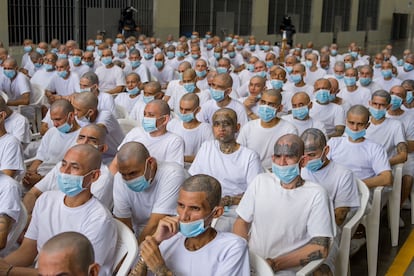
El Salvador began a mass trial on Monday against 486 members of the Mara Salvatrucha (MS-13) gang, including members of the national leadership known as the Ranfla Nacional, whom the government accuses, among other crimes, of ordering the massacre of 86 people during the last weekend of March 2022. That event triggered the establishment of a state of emergency by the government of Nayib Bukele, a measure that has since been renewed 49 times.
According to the arguments presented by the Prosecutor’s Office, the accused are leaders of the criminal structure and responsible for ordering more than 47,000 crimes nationwide between 2012 and 2022. Among the charges attributed to them are homicides, femicides, extortion, drug trafficking, forced disappearances, and arms trafficking.
The institution released a series of photographs showing hundreds of inmates at the maximum-security prison known as Cecot and other prisons across the country designated for gang members. In the images, the detainees are seen sitting in plastic chairs with shackles on their hands and feet, attending a hearing via videoconference while being guarded by armed men.
The images reveal for the first time the whereabouts and condition of several national MS-13 leaders, about whom nothing had been known for many years. One of them is Borromeo Enrique Henríquez Solórzano, alias “El Diablito de Hollywood” (The Little Devil of Hollywood), the boss of MS-13. Also seen is Rubén Antonio Rosa Lobo, alias “Chivo” (The Goat), identified by authorities as the gang’s CEO, a member of the national leadership, and wanted for extradition by the United States. Another high-ranking member is César Humberto López Lario, alias “Greñas de Stoners” (Stoners’ Hair), who was facing trial in a New York court but was returned to El Salvador as part of the negotiations between Bukele and Donald Trump. All of them appear emaciated.
“Among these criminals are those responsible for the wave of violence ordered in 2022. This event left 86 victims, marking a turning point in the state’s response,” the Prosecutor’s Office posted on its official X account. According to journalistic investigations, the massacre was a show of force after the pact between the gangs and the Bukele government broke down.
Policy of repression
The state of emergency ushered in a policy of mass repression that suspended constitutional guarantees for the entire population, such as the right to defense and the non-intervention of communications, and modified secondary laws and the Constitution to increase penalties and impose life imprisonment, even for minors.
Entre estos criminales se encuentran los responsables de la ola de violencia ordenada en el 2022. Este hecho dejó 86 víctimas que marcaron un punto de quiebre en la respuesta del Estado.
— Fiscalía General de la República El Salvador (@FGR_SV) April 21, 2026
413 cabecillas ya se encuentran en prisión y otros 73 tienen órdenes de captura activas.… pic.twitter.com/qf74k8aWk3
The measure has been in effect for four years, and under it the government has already arrested more than 91,500 people, representing 2% of the adult population of the Central American country. It has also implemented mass trials presided over by anonymous judges. In these trials, hundreds of detainees are grouped together and accused of belonging to the same gang.
With the trial beginning on Monday, the 6th Organized Crime Court of San Salvador could impose new sentences against several top leaders of MS-13 who were already imprisoned and convicted before the state of emergency was declared. The Attorney General’s Office reported that of the total number of defendants, 413 are already in custody while 73 remain fugitives.
According to Luis Enrique Amaya, an international consultant on public security issues, the state of emergency is a security and justice policy similar to “fishing with a net.” He explains: “(The government) has departed from the principle of individual responsibility in criminal matters. What is legally accepted is ‘fishing with a rod,’ which involves an effort of investigation, capture, and prosecution aimed at proving the participation of each individual in specific events, even in cases of crimes committed by groups.”
The Salvadoran state has for the first time accused gang members of the crime of “rebellion,” arguing that the gang members “attempted to maintain territorial control to establish a parallel state, defying the authority of the state and threatening national sovereignty and the constitutional order.”
The Inter-American Commission on Human Rights (IACHR) expressed on Tuesday “serious concerns about the human rights impacts resulting from the excessive and undue prolongation of the state of emergency in El Salvador” and reiterated its call to the Bukele government to end its continued use.
A new Amnesty International report also warned of the risks to the administration of justice under the state of emergency, as many of those arrested during the regime had only been detained “because the police were under pressure to meet daily quotas. Therefore, arrests were often based on false or unconfirmed evidence, anonymous reports, or discriminatory checks on people,” the report says.
Salvadoran Attorney General's Office will implement the use of AI in its investigations
While the trial against the gang members began with a dramatic spectacle, the Attorney General's Office announced it will begin implementing artificial intelligence to carry out its work. At an international AI conference held in San Salvador, called “SovAI 2026,” representatives of the Attorney General's Office announced that the “Sovereign AI Platform” will initially be used to receive, structure, and evaluate complaints filed by citizens. Authorities did not specify whether the use of artificial intelligence will be linked to processes related to the state of emergency. “What sounds like science fiction everywhere else is becoming a reality here. @FGR_SV will be the first justice institution in the world to operate with AI,” the National Artificial Intelligence Agency of El Salvador posted on its X account, along with photos of Attorney General Rodolfo González, announcing the “AI-Assisted Criminal Complaint System.” Bukele’s technological bets seem to be touching every aspect of Salvadoran life. Last week, the president announced that he will delegate a large part of the management of the health system to Google’s AI, Gemini. Previously, one of his biggest gambits failed: the use of Bitcoin as legal tender.
Sign up for our weekly newsletter to get more English-language news coverage from EL PAÍS USA Edition









































