
Nayib Bukele’s inmates could spend up to seven years in prison without trial
New legislative reforms join other tough measures against any suspected gang member approved during over three years of the emergency regime in El Salvador
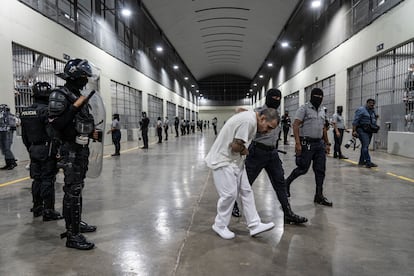
On June 1, as he began his seventh year in office, Nayib Bukele issued a promise regarding the fate of the nearly 90,000 people imprisoned under the state of emergency: “We are not going to release them now, nor ever,” he said. Two and a half months later, in mid-August, the Legislative Assembly under his control approved a series of reforms to the Law Against Organized Crime that will help him make good on that threat. Among other things, the measure allows those arrested in his so-called “war on gangs” — even those who are ultimately found innocent — to remain in prison for up to seven years before a verdict is delivered.
The amendment to eight articles of the law, hastily approved on August 15, was hailed by Attorney General Rodolfo Delgado as “the largest procedural reform” in El Salvador since the end of the last century. Delgado assured the members of the National Security Committee that these changes corrected the “errors” of a justice system that he described as “overly protective of guarantees,” and which, according to him, is responsible for turning the courts into a sort of “revolving door” that allowed judges to release detainees almost at the same rate as the police captured them.
Some of this was true: before Bukele took control of the Salvadoran justice system, if the Prosecutor’s Office couldn’t prove a defendant’s gang membership or specific involvement in a crime such as homicide or extortion, judges typically let them go relatively easily. But the Bukele administration has taken the system to the opposite extreme: now the official logic is that everyone is guilty until proven innocent.
Justice tailored to Bukele
Part of Bukele’s transformation of the justice system has targeted the judges. In 2021, through his deputies, he carried out a judicial purge, mandating the retirement of all judges aged over 60 and appointing 168 new ones to suit him. Before that, on more than one occasion, he threatened to remove or even arrest judges who did not comply with his guidelines and place them “in a cell alongside” their defendants.
The state of emergency, contemplated in the Salvadoran Constitution, limits fundamental rights for a period of 30 days, although it has already been extended 41 times. Over the course of more than three years, this measure has been accompanied by legal reforms that extend procedural deadlines, toughen sentences, and allow minors accused of being gang members to be tried as adults. With the most recent changes, the Attorney General’s Office will have until 2027 to formalize charges, meaning thousands of detainees could spend five years in pretrial detention before being charged. Added to this is the modification that allows trials to last two years or more, completing a total of seven. That trial could also be reopened, increasing the period indefinitely.
Other reforms have introduced anonymous judges and the adoption of mass trials in which thousands of defendants will be grouped together, all of whom share the same common factor of belonging to the same criminal organization.
Human rights organizations have documented more than 6,000 reports of arbitrary arrests, although they suspect the actual number is much higher. Many of these arrests are based on anonymous complaints or on behavior interpreted as “suspicious” by police or soldiers during a search, such as becoming agitated, according to at least three prosecutorial investigations reviewed by EL PAÍS.
“Keeping a person in pretrial detention for more than five years is an irrational and unjustifiable period,” the human rights organization Cristosal said in a statement, warning that the practice is aggravated by the lack of impartial judicial oversight and the obstruction of the right to defense.
Since March 2022, when the state of emergency was established, 88,750 people have been arrested, according to figures from Prosecutor Delgado himself. In the first year alone, 66,000 people were detained, including minors, according to Amnesty International. This means that over 70% of those currently imprisoned under the regime could face nearly seven years of detention before being sentenced.
Jonatan, a 28-year-old, is one of them. He has been in prison for three years and five months. He was arrested during the first week of the emergency regime. His mother, Ana, says he was captured while eating lunch at a cafeteria near the auto mechanic’s shop where he had worked for a decade. “There were two gang members eating there. The police arrived, arrested those two, and found a gun and drugs on them. But it wasn’t enough: they also took the two mechanics and the owner of the cafeteria,” she says.
During the first months of the state of emergency, police reported that the government required them to meet a “quota” of arrests per day, which even led them to fabricate false evidence. This practice was documented and confirmed by Human Rights Watch, according to a report published this year.
Ana keeps the hope alive that Jonatan’s innocence will be proven. She has her son’s clothes ironed, his bed made, and his shoes in their place. “I have everything ready for him to come today,” she says. In these three years, she has spent more than $6,000 on cleaning supplies and food to bring to her son each month. This is in addition to paying three different lawyers, all of whom have yielded little. “The only thing I know is that he’s alive. That’s what the last lawyer told me. From then on, nothing more,” she says in a phone call.
The Bukele administration has declared security information a state secret, but Justice Minister Gustavo Villatoro has acknowledged that some 3,000 people have been released on parole. This does not mean the case against them is over, but simply that a judge determined there is not the slightest evidence to keep them in prison. Several of them have reported being tortured while incarcerated. The Humanitarian Legal Aid organization estimates that there have been more than 400 deaths inside prisons since the regime began. In many of these cases, the bodies were identified bearing signs of violence or a lack of medical attention.
There is little certainty regarding the fate of the nearly 90,000 people detained under the Bukele regime. Even the president himself sends contradictory messages. At the end of June, weeks after promising that the detainees would “never” be released, he wrote on his X account that “more than half” are in rehabilitation and will be released “in a couple of years.” He accompanied the message with an image of the Marvel villain Thanos, in which the character is seen telling his daughter, Gamora, “I reduced crime by 98%.” In the image, the girl asks him at what cost, and he replies “1.5%,” the percentage of the Salvadoran adult population that is imprisoned. In the fictional saga, Thanos is a character who sacrifices half of the world’s population to restore “balance” to the Earth. A comparison that, far from clarifying the fate of those detained in El Salvador, reflects the scale of a project that conceives of justice as the sacrifice of innocents.
Sign up for our weekly newsletter to get more English-language news coverage from EL PAÍS USA Edition









































