
Mexico has seen 13 mayors killed since Sheinbaum took office
The latest victim, Temoac Mayor Valentín Lavín Romero, was shot dead inside town hall. Oaxaca, with five cases, is the state hardest hit, followed by Michoacán with three
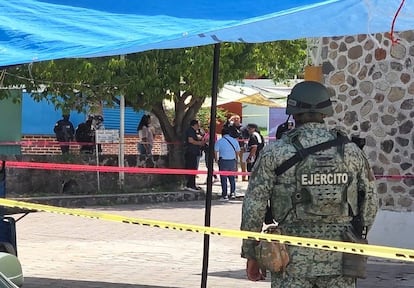

The fatal shooting of Valentín Lavín Romero, the mayor of Temoac, a municipality in the eastern Mexican state of Morelos, inside town hall on Wednesday has once again drawn attention to a stark indicator of violence and insecurity in Mexico, where municipal officials are increasingly targeted by organized crime.
With Lavín Romero’s killing, 13 mayors have died violent deaths so far during President Claudia Sheinbaum’s administration, a figure that already exceeds the toll recorded over some previous presidential terms in their entirety. According to Víctor Sánchez, a scholar at the Autonomous University of Coahuila, the trend points to a broader and more troubling phenomenon: the growing capture of municipal governments by criminal organizations.
Oaxaca, with five cases, has recorded the highest number of killings of sitting mayors over the past 18 months, followed by Michoacán with four. Lavín Romero had already survived a similar attack in January, when gunmen opened fire on his vehicle along the Mexico-Oaxaca highway. He took a leave of absence after that first attack.
His death adds to a grim tally that began with three cases in 2024, rose to eight in 2025 and has already reached three so far this year. Besides the mayor of Temoac, Eduardo Saavedra López, who was killed on July 12, and Joel Ángel Bravo Martínez, murdered on June 13, were both shot dead this year. They were the mayors of Miahuatlán de Porfirio Díaz and San Miguel Amatitlán, respectively, in the state of Oaxaca.
Sheinbaum’s administration took office on October 1, 2024, and has been in office for just one year and nine months. With four years still remaining in her term, the number of mayors killed during her presidency is already approaching the total recorded under her predecessor, Andrés Manuel López Obrador, when 26 mayors were murdered over six years.
The figure remains below the toll recorded during the administrations of Felipe Calderón, when 37 mayors were killed, and Enrique Peña Nieto, whose presidency was the deadliest on record for local elected officials, with 42 murdered mayors, according to data compiled by nongovernmental organizations and local media.
One of the most high-profile attacks was the killing of Carlos Manzo, the mayor of Uruapan, Michoacán, who was shot dead in November 2025 by the Jalisco New Generation Cartel (CJNG). The murder shocked the country and prompted the federal government to deploy additional security forces to the state.
Another case that drew national attention was the murder of Alejandro Arcos Catalán, the mayor of Chilpancingo, Guerrero, who was beheaded on October 6, 2024, just six days after taking office.
Mayors killed since Sheinbaum took office
- Alejandro Arcos Catalán. Chilpancingo, Guerrero (October 6, 2024)
- Román Ruiz Bohorquez. Candelaria Loxicha, Oaxaca. (October 15, 2024)
- Jesus Franco Lárraga. Tancanhuitz, San Luis Potosí. (December 15, 2024)
- Mario Hernández García. Santiago Amoltepec, Oaxaca. (May 15, 2025)
- Isaías Rojas Ramírez. Meltratónoc, Guerrero. (June 2, 2025)
- Salvador Bastida García. Tacámbaro, Michoacán. (June 5, 2025)
- Lilia Gema García Soto. San Mateo Piñas, Oaxaca. (June 15, 2025)
- Martha Laura Mendoza Mendoza. Tepalcatepec, Michoacán. (June 17, 2025)
- Miguel Bahena Solórzano. Pisaflores, Hidalgo. (October 20, 2025)
- Carlos Alberto Manzo Rodríguez. Uruapan, Michoacán. (November 1, 2025)
- Joel Ángel Bravo Martínez. San Miguel Amatitlán, Oaxaca. (June 13, 2026)
- Eduardo Saavedra López. San Miguel Yogovana, Oaxaca. (July 12, 2026)
- Valentín Lavín Romero. Temoac, Morelos. (July 22, 2026)
Mario Vázquez, a senator from the conservative National Action Party (PAN) representing the northern state of Chihuahua, has described the situation as the result of the federal government’s abandonment of municipalities, arguing this neglect is costing lives.
“They [municipal governments] have been left to face organized crime on their own, in a failure so grave that its consequences are themselves criminal,” he said in a statement issued at the end of June. “A mayor is the leader of a community. When a mayor is murdered, the goal is to instill fear in an entire town and demonstrate that criminal organizations can prevail over public institutions.”
EL PAÍS sought comment from Mexico’s Interior Ministry regarding those claims, but had received no response by the time this article went to press.
Sánchez, who is also a security and organized crime specialist, argues that the ability of criminal groups to exert such an impact on local politics is further evidence of their growing grip on municipal governments. According to him, municipalities serve multiple purposes for criminal organizations. Control over local authorities can ensure cooperation from police forces, advance warning of federal security operations, and even intelligence on rival criminal groups.
“That’s why we see these conflicts where organizations get involved politically, finance campaigns, cause violence and intimidate candidates,” Sánchez explains by phone. “In other words, the attacks against mayors hide a bigger problem than the struggle for territorial control by the organizations themselves. Political violence is a symptom of the fight between two or more organizations to control an area.”
Erubiel Tirado, a professor at the Ibero-American University and an expert on national security, argues that despite the Mexican government’s claims that high-impact crime has fallen by 31% since October 2024, the federal security strategy is not being implemented evenly across the country.
“Municipal governments are the first level of government people come into contact with, but the security strategy has not been applied uniformly in terms of building capacities and containing violence,” he says.
Sánchez is realistic and believes confronting organized crime is impossible, especially given these organizations’ military capacity. In that context, he says, only sustained support from the federal government can enable municipalities to push back against criminal organizations.
“The abandonment of municipal governments in the face of organized crime is a chronic problem. The same reflection applies to when the PRI [Institutional Revolutionary Party] and PAN governed, but I agree that it must be addressed by the federal executive and that now, with the Morena party leading the government, it is their responsibility.”
The Ibero-American University scholar notes that the municipalities where these killings occur are “almost always” small jurisdictions. “That is, the ones that are hit hardest,” he says. “Larger municipalities are left alone for political reasons. Take into account that of the more than 2,500 municipalities in the country, 500 of them have very few police officers. Some have between three and 10 officers.”
Next year, Mexico will head to the polls to elect 17 governors, as well as mayors, state lawmakers and federal legislators. During the 2024 election cycle, 37 aspiring pre-candidates and official candidates were murdered, the vast majority of them seeking municipal offices such as mayor, council member and municipal trustee.
Tirado notes that less than a year remains before the elections, yet violence against elected officials is already escalating, much as political parties have begun their campaigns ahead of schedule.
Sign up for our weekly newsletter to get more English-language news coverage from EL PAÍS USA Edition









































