
The Chilapa mountain range, a crossroads between crime and politics
For over 10 years, Los Ardillos, a criminal group entrenched in municipal power in central Guerrero, have been fighting to expand their territory
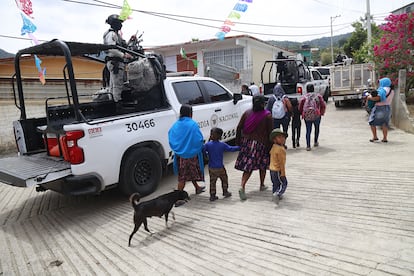

Four years ago, Salvador Rangel, then Bishop of Chilpancingo-Chilapa, outlined in an interview the motivations behind the battles in central Guerrero state, a territory he knew very well. At the time, he was close to Celso Ortega, leader of the Los Ardillos criminal group. Rangel pointed out that the fighting in the region, which has recently resurfaced in several communities in the lower mountains, has never been about drugs. “It’s not about drugs, because there aren’t any drugs here!” the bishop declared. “Celso tells me, ‘not even the damn marijuana grows here.’ So, the issue is political,” he added. Read in retrospect, his statements offer an interesting perspective on the current violence.
Communities in Chilapa and Atlixtac, between the Central and Mountain regions, are reliving a familiar nightmare. For more than a decade, Los Ardillos, whose stronghold is in the neighboring municipality of Quechultenango, have been trying to consolidate their control in towns and communities in the area and expand into surrounding areas. The communities of Tula and Xicotlán, targets for years, form the front line. On one side, Los Ardillos; on the other, the Indigenous and Popular Council of Guerrero-Emiliano Zapata, or CIPOG-EZ, a self-defense group trying to halt their advance. And in the middle, the population, viewed by both groups — but primarily by Los Ardillos — as friend or foe, depending on where they live or their political affiliation.
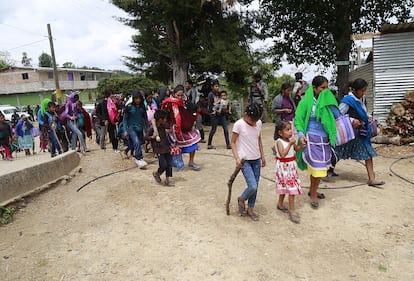
The latest wave of attacks by Los Ardillos, including drone strikes, has displaced dozens of families, according to the state government. The CIPOG-EZ puts that number at several hundred, mostly residents of Tula and Xicotlán, who have taken refuge in the neighboring community of Alcozacán. Furthermore, the community police report more than 70 members killed and 25 missing since 2014, when hostilities began in the region. The last six murders have occurred in the past month. This week, reports of attacks have even reached Alcozacán itself and communities in Atlxitac, further east, the theoretical boundary of the Ortega family’s territory — a family known for its skillful and successful political maneuvering in the state.
Politics underlies the criminal advance. Control of electoral districts in the central part of the state, both local and federal, municipal governments, and the co-opting of community assemblies — part of the region’s layered administrative structure — are the objectives of powerful groups, and there are none as powerful in the central region as Los Ardillos. A source familiar with regional politics says, “Los Ardillos feel very strong, very secure, with this Peace and Justice group,” referring to a local group that masquerades as a community organization. “To what extent are these 10 or 12 communities in Chilapa crucial for maintaining political control in the region, over municipal resources and commercial interests?” the source asks, regarding Tula and the others. “Honestly, I don’t know.”
There is no doubt about Los Ardillos’ intentions to seize territory, nor about the suffering of the local population. Currently, uncertainty centers on the role and motivations of the CIPOG-EZ, which the federal security secretary, Omar García Harfuch, has equated with Los Ardillos, placing them under the umbrella of another criminal group known as Los Tlacos. Harfuch’s statements have been met with surprise in Guerrero. Los Tlacos do exist, but their influence is far removed, in Tlacotepec, the municipal seat of Heliodoro Castillo, on the other side of Chilpancingo, several hours away by car.
A more logical explanation is that Los Ardillos are reacting to the moves of the CIPOG-EZ and its leader, Jesús Plácido, who in January announced an alliance with another self-defense group, the UPOEG, to operate together in several municipalities in the area, particularly in Juan R. Escudero and Tecoanapa. For years, especially after the assassination of its founder, Bruno Plácido — Jesús’s uncle — the decline of the UPOEG has been evident. In some regions, such as Acapulco and the Costa Chica, the group has allied itself with criminal gangs. In the port city and the surrounding area, its alliance has been with the criminal group Los Rusos. “That’s why it seems to me that now, for Los Ardillos, the CIPOG-EZ are just like them,” says the source above. “In other words, they see another group that wants to maintain its power and try to do the same things they do. And that, in reality, they are disguising the intentions of Los Rusos or whatever group it may be. And they’re not going to let them.”
The finance department
In the interview with Rangel, now retired and living far from Guerrero after a mysterious disappearance of several days two years ago, he pointed out that the battle in the lower mountains was related, at least at that time, to the interests of the political parties in the region: President Claudia Sheinbaum’s party, Morena, on the one hand, and the PRI-PAN-PRD coalition, on the other. “In Alcozacán and those communities, the community police forces are divided over money,” the religious leader said. “Deep down, Morena supports those communities because the PRI is currently in power. And what Morena wants is to gain control of those places, those communities. How? By giving money to those people,” he reasoned.

On that occasion, Rangel recounted an anecdote that, in his view, reinforced the argument he had made. “A few days ago, I had to go to Ahuacuotzingo, beyond Chilapa, where Ranferi Hernández was killed,” the priest explained, referring to the historic leader of the left in Guerrero, who was assassinated in 2017. “I was waiting for my guide at a gas station, and ahead of me was a pickup truck carrying five people. The guide arrived, and it turned out he knew them, and he said to me, ‘They’re from the State Government’s finance department.’ Well… Just then, the state police arrived and pulled up alongside us and said, ‘Are you going to Alcozacán?’ And we said, ‘No, no, we’re going somewhere else.’ So, the finance people were going to Alcozacán. What were the finance people going to Alcozacán for, protected by the state police? What’s going on? What’s the point? It’s that Morena is supporting this rebel movement to establish Morena there,” he said.
Rangel’s logic was that if state finance officials were going to Alcozacán, a CIPOG-EZ stronghold, it was to give money to the community police and thus fund their fight against Los Ardillos. True or not, the religious leader’s statements complicated reality and moved it away from Manichean portrayals. There were no good guys or bad guys. There was a hunger for power. The question, as now, was whether the ambition stemmed from a genuine idea of progress for the local population, a pure defense of the communities’ way of life, or a political project of plunder and accumulation disguised as the former, as Secretary Harfuch has suggested recently.
Four years later, Morena has made progress in some areas, but not all. The PRI still controls Chilapa and has won Chilpancingo. The PRI’s mayoral candidate in 2024, Alejandro Arcos, was assassinated shortly after taking office. Hitmen linked to Los Ardillos slit his throat. The PRD, which has moved closer to the PRI in recent years, governs Quechultenango. The Green Party governs Atlixtac. Its mayor survived an assassination attempt last year. As for the CIPOG-EZ, its venture in Tecoanapa and Juan R. Escudero hasn’t fully taken hold. The worst news of all is that next year there will be elections for all positions: mayors, governor, and state representatives. Given the circumstances, the fight could be fatal.
Sign up for our weekly newsletter to get more English-language news coverage from EL PAÍS USA Edition









































