
Killed for being a journalist: Another attack on press freedom in Mexico
Alejandro Leyva had reported death threats to both state and federal authorities a year ago, but no measures were taken to protect him. He is the seventh journalist to be killed in the country this year
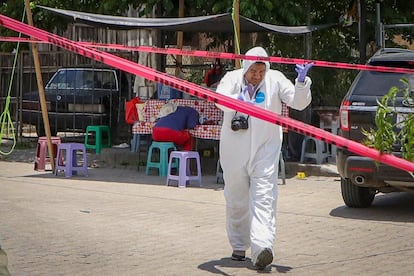

The image conveys a profound sense of helplessness. Mexican journalist Francisco Alejandro Leyva Aguilar was eating on the street, at a quesadilla and taco stall set up on the pavement, when gunmen on a motorcycle shot him dead. His body remained in the chair, slumped forward, with his head resting on the table. He was wearing sweatpants, a T-shirt and trainers, the kind of clothes people wear at home, nothing formal, the sort of outfit one throws on to run a quick errand and return moments later.
A blanket was placed over his head to soften the impact of the crime-scene photographs. Everything in the image speaks of vulnerability: the simple act of eating, the humble food stall, Leyva’s life and death, his work as a journalist. He is the seventh journalist to be killed in Mexico this year. The attack took place in San Pablo Etla, about a 40-minute drive from Oaxaca City. Once again in Mexico, one of the most dangerous countries for the profession, a journalist has been murdered.
Leyva, 60, was an independent journalist and a columnist known for his direct, scathing criticism of the state government led by Salomón Jara of the ruling Morena party.
“Do you know me? My name is Alejandro Leyva, but many people call me The Gadfly, the one who buzzes in the ears of the dull governor, in lowercase and in quotation marks, with the truths that Oaxacans endure because of his incompetence and mental illness,” the journalist said in one of the outspoken videos that resurfaced on social media following his murder on Wednesday.
Leyva frequently said that Jara was “misgoverning” the southern Mexican state and accused him of “denigrating” and censoring critical journalists. “For every voice you silence in the media, Salomón [Jara], 10 more will rise,” he warned.
With three decades of experience, the veteran journalist had served as director of the Oaxaca State Radio and Television Corporation (CORTV), the public broadcaster, and wrote a column titled The Buzz of the Horsefly.
In it, he accused Governor Salomón Jara of having “drug traffickers up to his neck” in his administration, which he said explained the rise in violence in the state. In one of his last articles, he exposed a scheme involving land grabs and money laundering through investments in hotel developments — a business allegedly involving drug traffickers and officials from Morena, whom Leyva named directly.
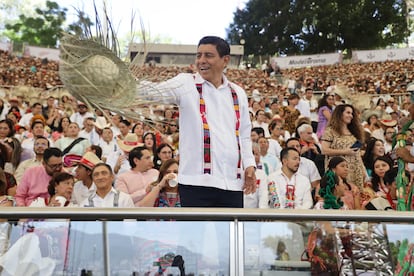
In a statement issued after the killing, Governor Jara acknowledged that Leyva had been a critic of his administration, “like many other journalists who exercise their right every day to question, point out issues, and freely express their opinions.”
Jara said the motive for the murder was unclear but was quick to stress that his government was “respectful of criticism and freedom of expression.”
The governor ordered the state prosecutor’s office to conduct a thorough investigation and instructed it to work in coordination with the Office of the Attorney General of the Republic (FGR).
“We will not speculate or jump to conclusions about the motive. What is required is a serious, professional and transparent investigation that determines who is responsible and allows them to be brought to justice,” he said.
Abandoned by the state
According to Reporters Without Borders (RSF), Leyva had been reporting death threats since last year. The organization says he believed the threats stemmed from being singled out on a programme broadcast during the governor’s press conferences.
The program, Trapitos al Sol (Airing Dirty Laundry), was ostensibly created to debunk information that the state government considered false or misleading, RSF notes. It closely resembled former president Andrés Manuel López Obrador’s Quién es Quién en las Mentiras (Who’s Who in the Lies) segment and President Claudia Sheinbaum’s more recent Detector de Mentiras/Derecho de Réplica (Lie Detector/Right of Reply), both of which the ruling party has defended as tools to combat disinformation. Press freedom organizations, however, argue that such initiatives stigmatize journalists and leave them exposed to harassment and attacks.
Indeed, Leyva said that the public exposure he faced “was followed by a smear campaign promoted by media outlets and online accounts, as well as death threats made by phone by unidentified individuals.” Leyva attributed that campaign to the state government and publicly held the governor responsible for any harm that might befall him.
The journalist filed complaints with the State Human Rights Commission and with the FGR, which referred the case to the state prosecutor’s office. According to RSF, none of these authorities implemented protective measures on his behalf. The organization is now demanding a “public explanation” for their inaction, arguing that officials were fully aware of the risks he faced and nevertheless failed to provide protection.
Leyva also reported being the target of judicial harassment after the state auditor under Jara opened an investigation into alleged mismanagement at CORTV almost six years after Leyva had left the director’s post. Once again, the governor distanced himself from the matter, which rights organizations described as judicial harassment against independent media.
The case is yet another illustration not only of the lack of protection afforded to journalists, but also of the hostility they have faced under governments led by Morena and its allies in the Green Party (PVEM). From the criminalization of the press and the use of judicial harassment in states such as San Luis Potosí, Campeche and Puebla, to the outright murder of journalists and the impunity that so often follows, the dangers are evident across much of the country. In Mexico’s states, journalism is frequently practised under highly precarious conditions, leaving reporters particularly vulnerable to local networks of political power and organized crime, which are often deeply intertwined.
Leyva is the seventh journalist to be killed in Mexico this year. Before him were Carlos Castro (Poza Rica, Veracruz, Jan. 8), Juan David Gámez (Nuevo León, Mar. 18), Roxana Guzmán (Veracruz, abducted on June 2 and found dead later that month), Luis Ángel López (Poza Rica, June 11), Alex Serna (Zihuatanejo, Guerrero, July 3) and Josué Martínez (Puebla, July 16).
Some of them were enrolled in government protection programs; others were denied access despite the risks they faced. Each killing lays bare the profound shortcomings of the Mexican state and its indifference to a crisis that is in plain sight and continues to worsen.
Sign up for our weekly newsletter to get more English-language news coverage from EL PAÍS USA Edition









































