
No sign of the journalist who filmed her own abduction in Mexico
An armed squad took Roxana Berenice Guzmán, founder of Pulso Informativo del Sureste, from her home in the state of Veracruz in front of her family. Despite the recorded evidence, no arrests have been made and the victim remains missing
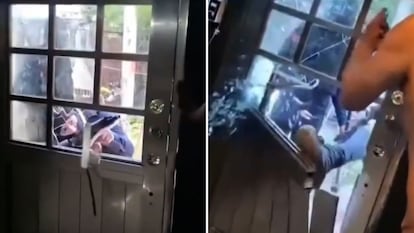

The journalist Roxana Berenice Guzmán was inside her home when armed men showed up and smashed the door. Like in a nightmare, they did not succeed immediately: they broke the glass and then began hammering at the lock. Blow after blow, up to a dozen. A man inside asks them to wait, but one of the attackers silences him, sticking a rifle through the broken glass and taking aim. They begin to kick at the door. The kicks are combined with the hammer blows. The man inside the house pleads again: “There’s a baby, calm down!” But, as in nightmares, the squad finally manages to break a piece of the door and enter the house. “Get on the floor!” one of the hooded men shouts, before grabbing the phone that is recording him. There are no images after that, but the attackers took the founder of the local media outlet Pulso Informativo del Sureste. The recording has shaken a country used to attacks on its journalists.
The Veracruz prosecutor’s office has opened an investigation into illegal deprivation of liberty, but despite having the moment of the crime captured on camera (in which one of the attackers can even be seen without a mask), more than 24 hours have now passed with no sign of the journalist.
Veracruz is the deadliest state for the press in all of Mexico, and Mexico is the second-deadliest country in the world. The state is what experts and journalists call “a zone of silence.” Since 2000, 176 journalists have been murdered in the country; of those, 32 killings have occurred in Veracruz, the most recent one this year when the independent reporter Carlos Leonardo Ramírez was killed. He had received threats and had protection in 2024; nonetheless, on January 8 he was shot dead while eating at a family establishment in Poza Rica. Two days later his girlfriend, Wendy Arantxa Portilla, and her friend Karime Monserrat Murrieta disappeared after attending his funeral. Silence has reigned since then.
It had been only a few months since Roxana Berenice Guzmán, together with two other collaborators, had launched the Pulso Informativo del Sureste page on Facebook. There they reported to their 21,000 followers on disappearances and executions, gas tanks that exploded, traffic accidents and demonstrations, as well as congratulating neighbors on their 50th wedding anniversaries and posting medical, sports and leisure announcements. “It’s a hyperlocal project that is very common in the area precisely because it has been imposed as a zone of silence. Especially southern Veracruz, bordering the state of Tabasco, is a very high-risk area and the scene of criminal disputes where larger journalistic projects rarely flourish,” reasons Leopoldo Maldonado, director of the organization Article 19 in Mexico.
Nanchital, like Coatzacoalcos or Minatitlán, is criminal territory: a corridor for huachicol, drug and migrant trafficking: Exactly one year ago a brutal decapitation (also recorded on video) forced the Movimiento Ciudadano candidate to drop out of the campaign for allegedly having links to the Jalisco New Generation Cartel (CJNG). Guzmán herself had to leave the state for years, Reporters Without Borders records, after her husband was killed in 2017. She had now returned.
“We are demanding two things: an immediate search, because more than 24 hours have already elapsed and nothing is known yet,” Maldonado says, stressing that the journalist is now officially missing, “and for the prosecutor’s office to activate the protocol to investigate crimes against freedom of speech so that the victim’s journalistic work is a priority line of inquiry.” The latter is one of the usual obstacles in crimes against the press.
The first reaction of governments and prosecutors is to deny that victims are journalists, and to discredit their work: either they were no longer working as journalists, or they worked only for a small outlet, or they had ties to organized crime. That just happened in San Luis Potosí with the arrest of two communicators, and it was a common practice under the former governor of Veracruz Javier Duarte (2010 to 2016), when 18 journalists were killed. It was the deadliest period for any governor in Mexico.
That memory returned this Wednesday in Veracruz amid accusations against the journalist. “Discrediting journalistic work serves to minimize the problem, to acquit authorities of responsibility and, above all, to end up guaranteeing impunity,” Maldonado says. That impunity, which Article 19 has estimated at 99%, is what allows the crimes to continue. “In a region where journalists are persecuted by Bukele in El Salvador, by the Ortega-Murillo regime in Nicaragua, by Noboa in Ecuador, by Milei in Argentina, in Cuba, in Venezuela... Mexico is the country with the highest levels of violence against the press on the continent,” the organization’s director in the country notes.
It’s not only the 174 murdered and 32 disappeared individuals in 26 years; it is the growing judicial harassment, the stigmatization campaigns, the threats and the physical assaults. “Last year we recorded 451 non-lethal attacks against the Mexican press, at a rate of one every 19 hours, and 69 cases of judicial harassment, one a week,” Maldonado points out. In that context, even when a journalist manages to record her own abduction inside her home, nothing happens.
Sign up for our weekly newsletter to get more English-language news coverage from EL PAÍS USA Edition









































