Mexico’s missing people crisis casts a shadow over World Cup venue
The discovery of at least 500 bags containing human remains within a 10-mile radius of Guadalajara’s Akron Stadium tarnishes expectations for the FIFA tournament
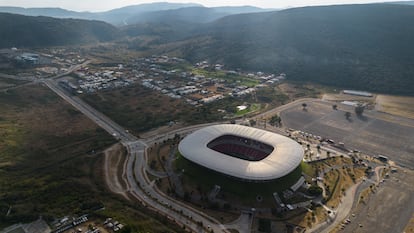

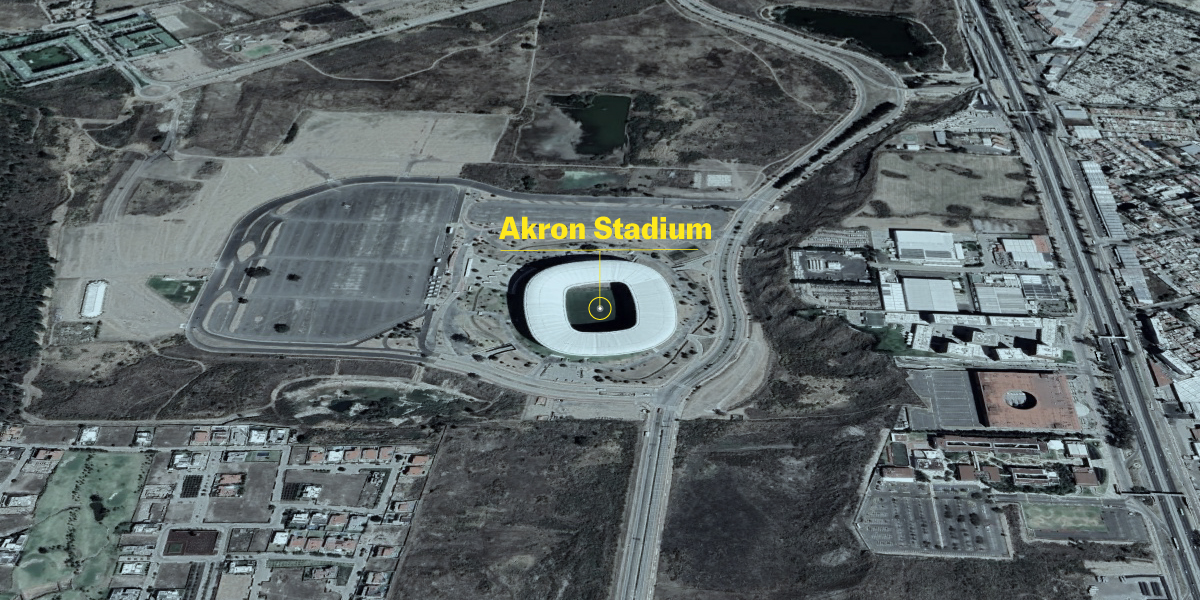
There isn’t just one clandestine grave. Or two, or three. At least a dozen have been located on properties and abandoned land within a 10-mile radius of Akron Stadium in the Guadalajara metropolitan area, located within the Mexican state of Jalisco. This is one of the three sports complexes that will host four matches during the 2026 World Cup.
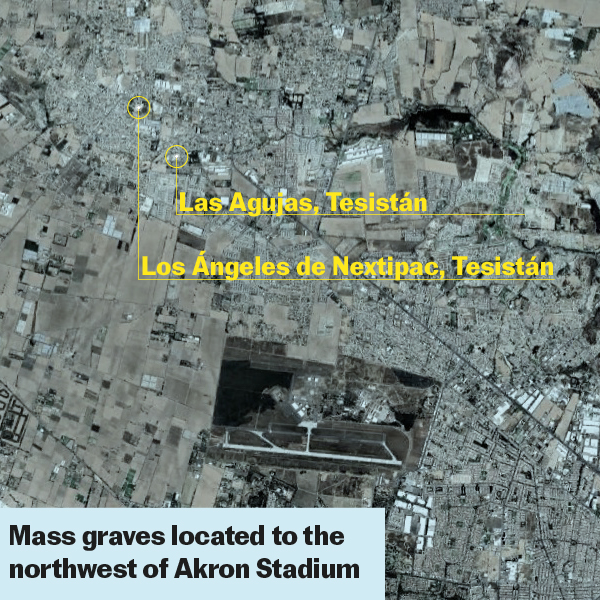
The first discoveries, which received little coverage in the national media, came to light in February, when construction workers building a housing development in Las Agujas (a site located just over nine miles north of the stadium) found plastic bags that contained human remains.
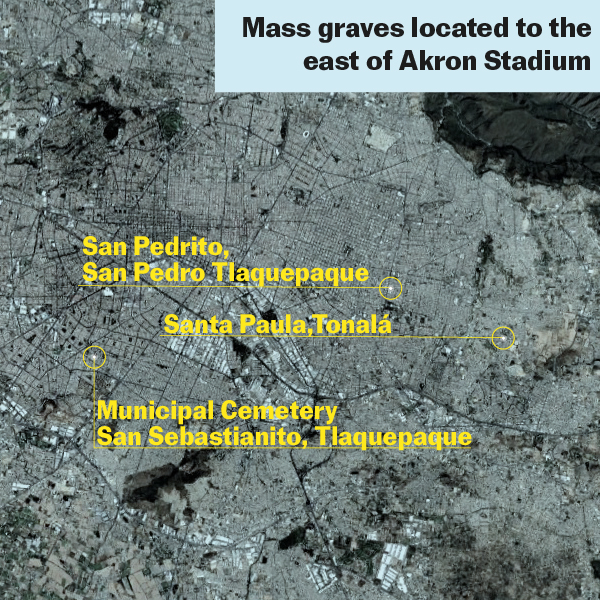
In recent months, in just four of the graves found near the stadium, groups of families of missing people have already counted at least 500 bags. “In Jalisco, the missing are made to vanish. This is so it won’t be known; they want to erase all traces of the disappeared,” says Jaime Aguilar, of Guerreros Buscadores de Jalisco (the Jalisco Searching Warriors collective). According to the group, at least 22 clandestine graves have been discovered in the vicinity of the stadium.
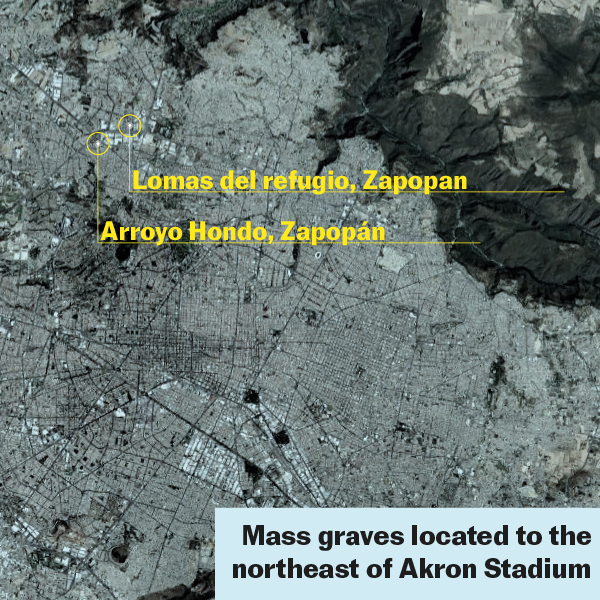
It’s almost midday. Some members of the collective are waiting at the entrance to the Arroyo Hondo property, located 10.5 miles from the Akron Stadium. Personnel from the Attorney General’s Office and the Public Prosecutor’s Office, as well as forensic experts, are expected to arrive.
Back in September, Aguilar and his fellow members found this clandestine grave under an abandoned auto repair shop, where vehicle remains still protrude from mounds of earth and rubble. The first to arrive is the operator of an excavator. For about four hours nonstop the machine removes the soil, the giant rocks and the undergrowth.

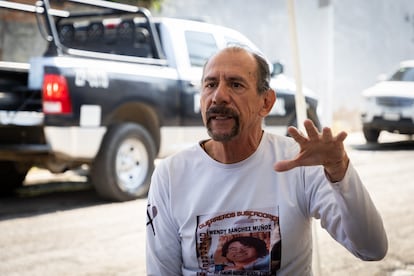
“We’re going to make sure they do their job properly. We shouldn’t have to do this, but we quickly realized, at the beginning of these field searches, that we would find [clandestine] graves, notify the authorities… and then, they wouldn’t do their job. We would go back and find more, which is why we started this practice of going back whenever something is found, to have a record of the work they do,” Aguilar explains, before putting on a t-shirt that bears the face and name of Wendy Sánchez. The 33-year-old woman disappeared on January 9, 2021, while traveling from San Francisco, Nayarit, to Guadalajara, Jalisco.
Aguilar is a volunteer with the Jalisco-based collective. And, since he’s not a direct relative of a missing person, he has instead “adopted” Sánchez’s case and story, in order to honor her and continue the search. “All the disappeared are now ours,” he affirms.
A few minutes go by. Personnel from the Attorney General’s Office and the Public Prosecutor’s Office arrive in Arroyo Hondo, but there are no forensic experts. In the mass grave, 47 bags containing human remains were found by the first week of December. The work is left unfinished.
The state government has reported that, in Mexico, Jalisco ranks fourth nationally in missing persons cases, according to data from January to November of 2025. There are 2,483 missing people, only behind the State of Mexico (Edomex, 5,526), Nuevo León (2,939) and Mexico City (2,870). The Jalisco officials assert that they’ve significantly improved their capacity to locate people who’ve been reported missing. “So far, in 2025, the location rate is 61.38%... the highest in the last seven years,” they note. State authorities recently declared that November had the fewest disappearance reports so far this year, with 205 cases. March of 2025, by comparison, had the highest number of reports, with 319.
Furthermore, the authorities emphasize that Jalisco is the only state with a registry of missing persons, as well as a public platform that reports on the graves found and the status of the search efforts. “Mexico has been experiencing a crisis of violence and disappearances for years. We’ve acknowledged this in Jalisco,” reads a statement from the Jalisco government’s communications office.
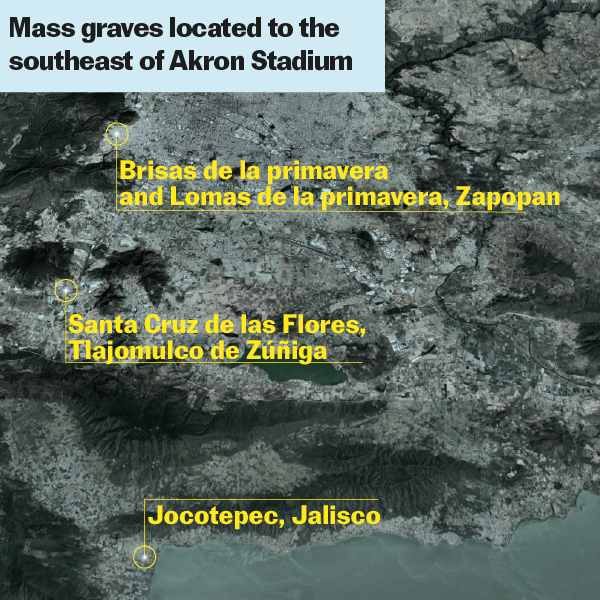
However, the reality that the families face while searching for their loved ones is quite different. A day before the visit to Arroyo Hondo, Aguilar explains, they were notified that two new clandestine graves had been opened: one in Santa Cruz de las Flores and another in San Pedrito, in the municipality of Tlaquepaque – both about 16 miles away from the Akron Stadium.
Those who are searching for missing people note that the process will be lengthy. This is because the local and state governments lack sufficient machinery and the necessary tools to handle the volume of anonymous tips that the search collectives filter, in order to identify all the locations that may contain buried remains. According to Aguilar, there are approximately 22 groups of family members searching for their missing loved ones in the Guadalajara metropolitan area alone.
As the collectives do their work, Arroyo Hondo – a neighborhood in the city of Zapopan – is just one of the sites on the outskirts of the state capital where clandestine graves have been appearing. Previously, between February and September of 2025, another 270 bags containing human remains were recovered from Las Agujas, a 54-acre property also located in Zapopan.
Las Agujas is one of the mass graves with the highest number of remains found in Jalisco in recent years. However, there’s been skepticism about the findings there, since the collectives weren’t present during the three months of work carried out by authorities at the site: “We’re not certain about the number of bags they reported,” Aguilar admits.
Discoveries of bags and sacks since 2024
The discovery of human remains in bags hasn’t been limited to this year. Between November 2024 and January 2025, at least 100 sacks containing human remains were found in a clandestine grave in the Lomas del Refugio neighborhood of Zapopan, about 11 miles from the stadium. “There are many more, but the focus is on the three most recent graves that were discovered,” Aguilar explains.
In addition to the bags and sacks with remains found in Las Agujas, El Refugio and Arroyo Hondo, another 89 bags were found in Nextipac, also 11 miles from Akron Stadium, where more than a dozen bodies have been pre-identified. “All the findings are gaining attention, because they’re being linked to the World Cup. It’s several miles away, but this is happening near a World Cup stadium! But, for example, right in front of the Akron Stadium is the Primavera Forest, where, for years, many mass graves have been found… and that’s much closer than Las Agujas or Arroyo Hondo,” members of the Searching Warriors collective point out.
Just by adding up the bags and sacks found by the search collectives at the four sites — Las Agujas (270 bags), Arroyo Hondo (47), Lomas del Refugio (at least 100) and Nextipac (89) — the number already exceeds 500. And this isn’t counting the new findings that continue to be recorded at several of these sites, where work is still underway.
Aguilar acknowledges that finding human remains in bags and sacks in the most recently-discovered mass graves is a “new” method that criminal groups are using to make people disappear. Furthermore, members of the collective have reported that, during these field searches, they’ve discovered animal carcasses before reaching the depth where the bodies or human remains are located. They interpret these animal carcasses as a diversionary tactic.
Aguilar explains further: “In Nextipac, for example, the wrapping was done with plastic wrap [and] the bags were taped shut. That was the common element in all three graves (Nextipac, Las Agujas and Arroyo Hondo). They offer very little information, because while the remains still had skin, there were almost no bones left.”

“A process to beautify the city”
In addition to the mass graves discovered in recent months, the search collectives point out that others are still being processed, such as the one in the municipal cemetery of San Sebastianito – 11 miles from the stadium – where at least 18 bags containing human remains were found, or in the Santa Paula neighborhood, in the municipality of Tonalá, where forensic specialists are still working.
Members of the collectives recall that, four years ago, the visit to the state by the Madres Buscadores de Sonora (the Searching Mothers of Sonora) was a turning point for their work. “There were collectives here, but no one went [to sift through the clandestine graves]. They taught us how to search in the field, how to dig. They had many locations marked in [the municipality of] Tlajomulco; we began to find bodies buried in houses, in garages, in patios, in bathrooms. It’s a huge residential area, but it’s very neglected, because [everything was] built haphazardly, without the provision of basic services. People who live there know that there are people buried there,” Aguilar sighs.
The state authorities, who claim to have improved their response to this crisis, are also focused on dozens of projects to improve roads and parks in the Guadalajara metropolitan area, in preparation for the World Cup. “We’re experiencing a process of whitewashing, of beautifying the city, of giving it a new image [...] They’ve already worked on the Minerva roundabout, Parque Rojo, a thousand other things... we’re witnessing the displacement of homeless people. Basically, it’s gentrification. Beautifying the city for the World Cup,” he laments.
María de la Paz Aguilar has been searching for her son, Sergio Vallarta Aguilar, for almost two years. Lilia Reyes is searching for her brother, Juan Fernando Reyes, who disappeared eight years ago. Despite their daily efforts, they still haven’t received support from the authorities. On the contrary, women like them assert that they’re the ones who have to conduct the searches and investigations to move their cases forward.

Fear also reigns, though the members of the search collectives don’t show it. But the women, who have superhuman energy, can’t help but project an incurable sadness. They never feel hungry or sleepy. When they gather for searches or patrols, they take advantage of the opportunity to do so while accompanied by others like themselves, who see, in the earth and in the undergrowth, the possibility of peace.
Jaime Aguilar reflects: “We feel that the government works for [the criminals]. Sometimes, we’re asked who we fear more: the government or the drug traffickers. And I think we fear the government more, because you feel the machinery of its power working against you.”