
Russia steps up attacks on Ukraine and threats to Europe: ‘The peaceful sleep is over’
In Moscow, the EU is equated with Nazi Germany. An escalation against the bloc would allow the Kremlin to carry out a new mobilization
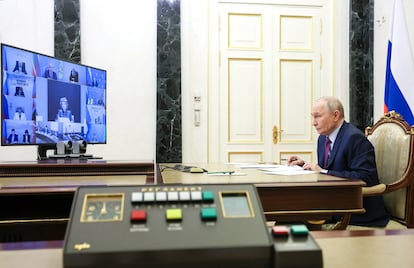

A sense of calm runs through Russia despite the fact that these are dangerous months. The hopes the Kremlin had placed on U.S. President Donald Trump handing Ukraine to it on a platter have faded; the war is a drain on Russia with no strategic victories, and security forces are tightening their control over the state just months before legislative elections that are shaping up as a plebiscite on Russian President Vladimir Putin.
Russia is not ruling out the possibility of military escalation — both against Europe, which Moscow equates with Nazi Germany and which could be used as a pretext to further mobilize Russian society for the war, and against Ukraine, which it continues to bombard even more heavily. The Russian leader says he trusts in “an imminent victory,” but the course of the war suggests otherwise. The decision lies in his hands, and he shows no sign of abandoning any of his objectives.
The war against Ukraine also overshadowed the opening of one of the Kremlin’s most important events of the year, the St. Petersburg International Economic Forum, which began on Wednesday and runs through Saturday. A massive column of smoke rose over the city on the opening day, visible to the thousands of visitors to the event, many of them foreign.
Several people were injured by Ukraine’s drone attacks on various energy and port infrastructures in the districts of Kronstadt, Kirov, and Krasnoselsky, according to the city’s governor, Alexander Beglov. At least 50 drones were shot down, and dozens of flights were canceled at the city’s international airport due to the threat posed by the devices. Putin will speak on Friday in an extended session where he will address the country’s internal situation and its war against Ukraine.
“It is not prudent to give a concrete deadline [for the end of the war] amid the fighting in Ukraine,” Putin said on April 29, though he ventured to predict a rapid victory. “The situation on the battlefield in Ukraine is developing in such a way that Russia can talk about the imminent end of the conflict. [...] Our troops are advancing in all directions,” he said.
This is the fifth year of the war. On February 24, 2022, Putin ordered his troops to depose the government of Ukrainian President Volodymyr Zelenskiy and install a puppet regime in a disarmed Ukraine. But his forces are still bogged down in the Donbas region in the east. The Kremlin’s main conquest — the strip of territory linking southern Russia with Crimea — is no longer secure for its convoys because of next-generation Hornet drone attacks, and Elon Musk took from the Russian army its compass, the Starlink satellite network.
Meanwhile, officials at the Bank of Russia and the Finance Ministry warn Putin that military spending — around 40% of the national budget — is becoming unsustainable, according to a document revealed by Bloomberg and verified by independent Russian media.
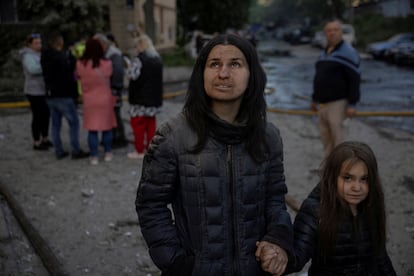
The Kremlin launched its invasion as a “special military operation” that left the civilian population on the sidelines, but in September 2022 it had to carry out a forced mobilization of soldiers to stabilize the front. Since then, it has avoided repeating this traumatic experience by offering extraordinarily high pay to those who enlist as volunteers, but this reserve is not infinite. Nor are there many prisoners left to recruit, as it has already emptied prisons by 39% of their capacity.
The difference compared with 2022 is that in recent years the Kremlin has prepared all the mechanisms for another possible mobilization, including the closure of the border, and has now ordered its security services to have ready a system to cut off all internet access for Russians — without bringing down e-government services — from July 1.
In this context, an escalation of the conflict could serve the Kremlin as a way to forcibly mobilize Russian society. Senior officials and state propaganda have stepped up threats of escalation, and in the State Duma some deputies, such as former general Andrey Gurulyov, are openly calling for a new mobilization in response to Ukraine’s technological superiority.
“Germany is once again leading the movement in support of Nazism in Europe. President Zelenskiy has now been appointed to the role of Führer, and a new unification of Europeans is underway. [...] This is alarming news, and historical reminiscences are conjuring up a disquieting picture,” Russian Foreign Minister Sergei Lavrov said days ago.
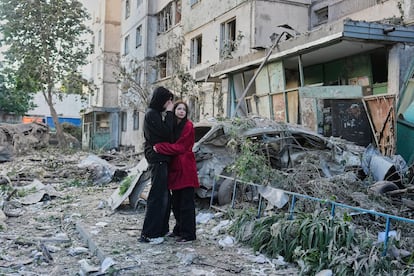
“I would not single out Germany here. Because, in total, 56 countries are effectively fighting against us,” said Russia’s Security Council chairman Sergey Shoigu when asked about a drone factory built on German territory together with Ukraine.
Former president Dmitry Medvedev said in April that all European military companies supplying arms to Ukraine are “potential targets.” Last week, after several people were injured in Romania — a NATO member — by the crash of a Russian drone, he warned the EU with these words: “Citizens of EU countries. You should realize your authorities have unilaterally entered into a war with Russia. So be vigilant and don’t be surprised by anything. The peaceful sleep is over.”
Moscow has also circulated several accusations to reinforce the idea of escalation without providing evidence. Russia’s Federal Security Service (FSB) said its divers found several mines attached to a gas ship “in a NATO country,” pointing to Belgium. And Russia’s Foreign Intelligence Service (SVR) accused Kyiv of preparing a drone attack from Latvian soil, a claim Riga flatly denies.
“Every place from where direct military threat has emanated towards Russia is a legal target for us,” Putin warned last Friday when commenting on this allegation.
Moscow has also revived old talking points from its war against Ukraine, such as the existence of a network of U.S. “biolabs” developing viruses that attack only Slavs (in reality, what exists is a public international network for pandemic prevention), and claims of a supposed “genocide by the Kyiv regime” following an accidental Ukrainian shelling that killed 21 young people in the occupied town of Starobilsk. It was a tragedy in a war that has claimed thousands of other civilian victims — although this one has served the Russian government to threaten to step up “systematic attacks” against Kyiv.
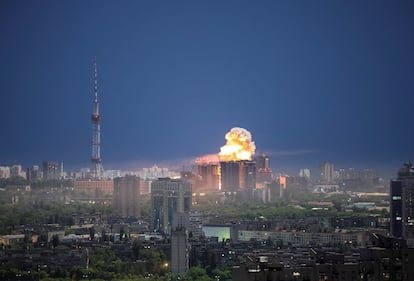
Moreover, the Kremlin’s messages aimed at calming tensions are contradictory. “European weapons are directly shooting at us. [...] Europe cannot claim mediation in any way,” Putin’s spokesman Dmitry Peskov said last Friday. At the same time, however, he insisted: “The biggest stupidity that Europeans and people in Brussels are making is completely refusing any dialogue with Russia.” “Solving problems and discussing them without dialogue is impossible,” he added.
Dmitri Trenin, a noted Russian expert and former director of the Carnegie Moscow Center, blames Europe for Russia’s attrition in Ukraine. According to Trenin, the Old Continent is not seeking “an invasion of Russia like Hitler or Napoleon,” but rather “to exhaust Russian resources by supporting the Kyiv regime and keep its forces frozen.”
Instead of stopping the war, Trenin advocates “launching powerful strikes, ultimately nuclear, against the enemy’s [Europe’s] logistical, industrial and political-military targets.” “It would be useful to show Europe with facts that we are serious,” he added in an article.
Another column published in Global Affairs, a magazine linked to the Kremlin, has ignited further debate in Russia. Its author, Vasily Kashin, stresses that “the goal of liquidating the anti-Russian regime in Ukraine is unattainable without a complete and prolonged occupation of the entire country, and that is technically impossible for Russia with the current special military operation.”
Unlike other experts who favor escalation, Kashin suggests settling for securing “the protection of Russian territory, banning Ukraine from joining military blocs and imposing certain restrictions on its armed forces.”
Other military experts believe the Russian leader will make no concessions. “Putin’s unconditional objective is the conquest and total subjugation of Ukraine,” Ruslan Pukhov, director of the Russian Center for Analysis of Strategies and Technologies (CAST), says by phone. “This war is Putin’s life work, and he will wage it while he lives and remains in power. Any slightest concession is unacceptable; it would leave the image of a man who ended his political career in failure.”
“Since the options for a limited war are practically exhausted for Russia, it seems likely the focus will be on increasing the mobilization of human and economic resources,” Pukhov adds. According to the analyst, Western technological support has been “decisive” for Kyiv and “continues to raise the cost of the war for Russia.”
For Pukhov, this frustration stems from Putin’s disappointment with Trump, “from whom he thought he shared similar ideas.” “Russian diplomacy’s dream was a pact that would divide Europe between the United States and Russia,” the analyst notes, “but Trump was only willing to accept peace with compromises, not for Russia to annex Ukraine.”
Trump, focused on Latin America and Iran, stopped supplying arms to Kyiv and now requires that Europe buy weapons from the U.S. NATO Secretary-General Mark Rutte has denounced that “only six or seven countries are sharing this heavy burden.”
Sergei Poletaev, co-founder of the Russian analysis center Vatfor, explains by phone that “dialogue would only be possible if Europe changes its approach, at least to something like Trump’s,” he adds.
The analyst sees no manpower shortages in Russian forces and argues the Kremlin is banking on Ukraine collapsing through attrition. “In thousands of years of military history, a war has never been won by a defending army. They are gradually losing their ability to conduct counterattacks, and when they lose it completely, and we maintain offensive operations of the same magnitude, then they will fall like dominoes.”
Ivan Timofeyev, director of programs at the Kremlin’s major think tank the Valdai Club, lays out three possible medium-term scenarios.
For the analyst, a war with Europe is feasible, though the likelihood is “low” because “the risks are too great, including the use of nuclear weapons.” He assumes the Ukraine conflict will remain entrenched and sanctions on Russia will gradually increase. In his most optimistic scenario, there would be a truce, but he doubts it would be sustainable over time. In all three cases, the threat of war will hang over Europe in the coming years.
Sign up for our weekly newsletter to get more English-language news coverage from EL PAÍS USA Edition









































