
Beirut shrugs off its fear in the wake of Israel’s deadliest offensive: ‘Let them kill us all as soon as possible’
Residents of the areas affected by Israel’s deadliest offensive continue their daily lives amid the rubble and rescue work
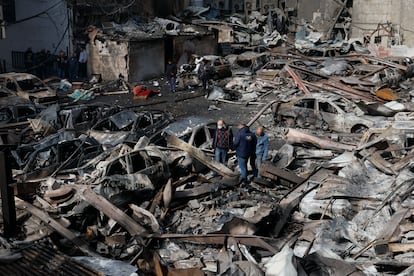

The more observant residents of the Corniche el-Mazraa neighborhood in downtown Beirut know where to look. Where a residential tower once stood, now only a gaping hole remains, as if a button had caused the ground beneath the structure to vanish. The walls of the neighboring buildings are charred or have collapsed. Against this backdrop, dozens of soldiers, paramedics, firefighters, and construction workers continue their rescue efforts. Others, like Ziad, are resuming their daily lives despite the escalation of violence recently unleashed by the Israeli army, which has left dozens dead right outside his shop. “That’s it, let them kill us all as soon as possible,” he said Thursday from behind the counter. “But I’d rather be killed in my own neighborhood.”
The major offensive that Israel launched on Lebanon on Wednesday — the largest in five weeks of war, with 160 airstrikes on 100 different locations in just 10 minutes — hit previously untouched districts of Beirut and attempted to separate the Lebanese front from the ceasefire agreed between the United States and Iran, even though Pakistan, the mediator of the truce, had announced the inclusion of Lebanon in an immediate regional cessation of hostilities.
After the Trump administration denied Wednesday that Lebanon had benefited from the truce — thus contradicting Pakistani Prime Minister Shehbaz Sharif, whom the U.S. president presents as a personal friend — Lebanese leaders are pushing to ensure that they are not forgotten.
Diplomacy on the move
Sharif’s office announced on Thursday that he had held a phone call with his Lebanese counterpart, Nawaf Salam, regarding an end to the Israeli attacks. Meanwhile, other actors are also making moves. Iranian President Masoud Pezeshkian reiterated that the hostilities against Tehran’s ally Hezbollah, which continues to hold weapons in Lebanon despite Beirut’s ban on them, constitute a violation of the ceasefire with Washington, and warned that Iran “will not abandon the Lebanese people.” From Israel, in a surprising announcement amid the escalating offensive in Lebanon, Prime Minister Benjamin Netanyahu announced the start of negotiations with the Beirut government, a significant step into uncharted territory between two countries, which have no diplomatic relations and have been in a state of war since the founding of Israel in 1948.
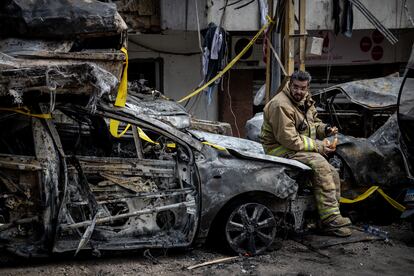
But while diplomacy proceeds along uncertain paths, the search for lifeless bodies continues in the rubble of Corniche el-Mazraa. A residential building near the corner of a busy avenue was the scene of one of the deadliest bombings of the day on Wednesday, which left more than 300 people dead and 1,150 wounded, according to the latest count from the Lebanese Ministry of Health. A powerful barrage of four missiles, according to residents, brought the building down. Among the dead that were recovered was a seven-day-old baby girl, said a paramedic who was not authorized to speak to the press.
Facing the gaping hole is a row of charred cars. On the first floor of the building opposite, now just a concrete skeleton, a man says there used to be a dental clinic. A little further on, the buildings are slightly less burned, to the point of being recognizable, although completely unusable. A baby clothing store and a hookah shop will have to start from scratch. From a corner, a teething boy watches the clatter of the machinery in amazement, gesturing wildly with his arms to describe how his world has been shaken.
An attack without warning
This attack, like the rest of those launched by Israel on Wednesday, came without warning in the early afternoon, when people were picking up their children or leaving work. The operation, which Israel dubbed Eternal Darkness, wreaked unprecedented destruction on areas of the capital only sporadically targeted during the three years of simmering conflict between Hezbollah and Israel, due to the militant group’s traditional absence from the area.
The western neighborhoods of Manara and Ain al-Tineh; the central districts of Tallet al-Khayat, Basta, and Moseitbeh; and the northern district of Ain al-Mreisseh suffered deadly bombings that reduced other residential blocks to rubble. The Israeli army, commanded by Eyal Zamir, killed 92 people in Beirut alone, according to the Lebanese Civil Defense. But the prolonged Israeli offensive — which broke the 15-month truce that had held until this March — has led many Lebanese to a state of resignation so deep-seated that it is incompatible with any sense of fear.
Ziad eagerly serves customers from behind the counter, which is overflowing with pristine, colorful pastries that stand in stark contrast to the gray devastation outside. He shows the images captured by the security cameras during the bombing: despite being somewhat protected by the angle of the street corner, the terror was palpable. Pedestrians ran in the opposite direction, terrified. Ziad and his coworkers took refuge inside the shop; when the barrage of missiles subsided, they tossed the chairs from the patio inside and closed up.
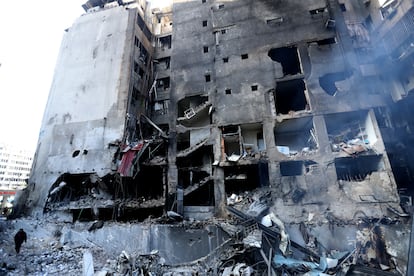
“Everything was covered in dust and the streets were deserted,” Ziad explains. His house is only two blocks away, but he didn’t think about leaving the neighborhood, just as he won’t leave his job despite having the option to emigrate. “I’ve lived here my whole life and I love my country despite all its problems,” he says with a smile.
A neighborhood operating at full capacity
Far from being an exception, and even if it’s just to earn a daily wage amid the uncertainty of tomorrow, Ziad’s shop is part of a neighborhood that was operating at full capacity this Thursday, despite the government’s declaration of a day of mourning. Men and women go to the barbershop, where tarpaulins replace the shattered windows. Food delivery drivers — many of whom are immigrants — pick up orders from restaurants, where they wonder how the day now known as “Black Wednesday” or the “8 April massacre” will be remembered.
Some compare it to the ammonium nitrate detonation in 2020 that caused one of the largest recorded non-nuclear explosions in history at the port of Beirut, killing 220 people. Others, like Samir, a man in his sixties, say they haven’t seen bombings like this since the civil war (1975-1990), in which Israel besieged Beirut until it expelled the Palestine Liberation Organization.
Samir fled all of that and spent 15 years between Brazil and Paraguay, but today he sleeps in the fast-food restaurant he runs in Corniche el-Mazraa to escape the continuous Israeli bombings of the Beirut suburbs where he lives. It’s an urban sprawl of 8.5 square miles, indistinguishable from downtown Beirut, which Israel is demanding be emptied due to Hezbollah’s presence in the area.
His house, he says, has lost windows, doors, and balconies, “but it’s still standing.” Samir is content with that, while he reviews the rumors coming from Rafik Hariri University Hospital, the largest in the Beirut metropolitan area, where he claims there are dozens of unidentified dismembered or charred bodies. Many, he adds, are Syrian refugees or Asian migrants with no one in Lebanon who can go and inquire about them.
A healthcare worker quoted by Reuters on Thursday confirmed this. “We are mostly collecting body parts,” he said outside the hospital. “It’s very rare that we find whole bodies.”
Now, a new eviction order issued by Israel on Thursday, which for the first time includes the Jnah neighborhood, could leave that hospital and another large one in the area empty. “I urge Israel to reverse this order,” the Director-General of the World Health Organization, Tedros Adhanom Ghebreyesus, said on Thursday. He warned that the area contains a Lebanese Ministry of Health complex and houses five large collective shelters with more than 5,000 forcibly displaced people. “Evacuation is not feasible,” the healthcare worker warned. “More than 450 patients, 40 of them in intensive care, have no alternative.”
Sign up for our weekly newsletter to get more English-language news coverage from EL PAÍS USA Edition









































