
Loose ends remain after the downfall of El Mencho, the last great drug lord
The Attorney General Office’s failure to secure the site where the cartel kingpin was killed, the gaps in the narrative about the subsequent violence that left dozens dead, and the doubts about the future of the CJNG paint a picture of the current criminal landscape in Mexico
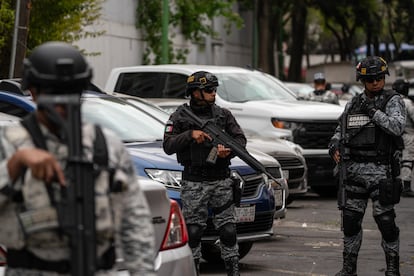

A chess game is being played in western Mexico, which is anxiously awaiting the new shape of organized crime. The capture of Nemesio Oseguera, alias “El Mencho,” a month ago now calls into question the future of the criminal group he led, the Jalisco New Generation Cartel (CJNG), one of the most powerful on the continent, with roots in that area of Mexico and sustained by the firepower of its underlings and the businesses it was able to build. Doubts about the group’s leadership and the consequences of a foreseeable succession share the spotlight with the gaps in the official narrative about the violence in the hours following the kingpin’s death, and with the failure of the Attorney General’s Office to secure the cabins where the military located the criminal.
Elusive, ghostly, El Mencho died from gunshot wounds in a military helicopter that was attempting to evacuate him from the forests of Jalisco, near the cabins where he spent his final days. Surprised in the early morning by special forces soldiers, El Mencho and his men responded with a firefight that left three military personnel and 11 cartel members dead. El Mencho died en route to hospital, a situation the government has explained several times in recent weeks. There is little doubt about where and how the confrontation took place, the area where it occurred, and the nearby forest where it ended. What little is known about is the violence that followed the CJNG leader’s death, which left more than 60 dead, including 25 National Guard soldiers.
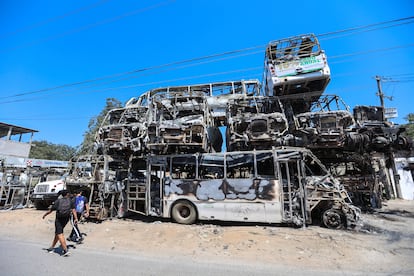
On Sunday, February 22, Jalisco and Michoacán, strongholds of the CJNG, relived a familiar horror in that and other parts of Mexico: the virulent reaction of a criminal group in response to a perceived slight from the state. Blockades and attacks on authorities followed the takedown of El Mencho, a criminal leader who rose under the wing of Ignacio Coronel, one of the old guard of the Sinaloa Cartel. After Coronel’s death, El Mencho built a criminal empire dedicated to drug production and sales, international trafficking, fuel theft, real estate fraud, and more. The response from the criminals reflected the scale of the group’s operations, as well as its territorial reach, which over the years had expanded beyond its strongholds and reached virtually every state in the country.
On February 23, Federal Security Secretary Omar García Harfuch released some figures regarding the previous day’s violence, such as the 25 National Guards who lost their lives, the 35 alleged criminals killed, and the 70 people arrested, as well as the death of a woman caught in the crossfire. But the numbers painted a black-and-white, two-dimensional picture, far removed from what had actually happened. For example, it is unknown exactly where and how the 25 troops died, beyond the fact that it occurred in Jalisco. The locations where the 35 alleged cartel members were killed are also undisclosed. The woman caught in the crossfire is known to have died in Zapopan, according to news reports. A prison guard and a Jalisco state prosecutor’s office agent were also killed, but the circumstances surrounding their deaths remain unclear.

The list goes on and extends beyond the dead. Of the dozens of roadblocks that occurred across much of Mexico that day, it’s unclear which were the most serious or persistent. Nor is it known whether any of those roadblocks were preceded or followed by clashes between criminals and the authorities. The hours following the confrontation at the cabins remain shrouded in a fog that no one — not the military, which led the advance against El Mencho, nor Harfuch, nor President Claudia Sheinbaum — has yet dispelled. With the World Cup just around the corner and the White House always keeping a watchful eye on its southern neighbor, the silence and the passage of time are allowing criticism of the government to fade.
The battle between the CJNG and the military has generated significant attention in the country, similar to that sparked by the arrest of Mayo Zambada in the United States a year and a half ago, following his betrayal by the sons of “El Chapo” Guzmán, his old partner; or the violent reactions of Los Chapitos when the military attempted to arrest one of the faction’s leaders, Ovidio Guzmán, in 2019 and then again in 2023, when the authorities finally succeeded. Journalists arrived at El Mencho’s cabins in the municipality of Tapalpa, Jalisco, on Monday, February 23, and were surprised to find them unguarded after the military had departed. This newspaper arrived there three days later and confirmed that the site was still unguarded.
During a tour of the property, known as Cabañas La Loma, one of the first reporters to arrive, from the newspaper El Universal, claimed to have found an envelope full of documents containing information about the CJNG, payments to various authorities in Jalisco and other states, maps outlining the group’s expansion plans, and so on. El Universal began publishing this information on Thursday, February 26. That same day, another national newspaper, La Jornada, which is aligned with the government, published an article in which “ministerial sources” indicated that “experts and investigators from the Attorney General’s Office (FGR)” had seized documents at the cabins “related to financial operations and the drug payroll managed by El Mencho.”
The lack of official explanations led to speculation about a leak, but El Universal insisted it had found the documents on-site. The situation became even more complicated when the FGR stated this Monday, three weeks after El Mencho’s death, that it did not know whether the documents were authentic, contradicting the “ministerial sources” cited by La Jornada. The agency justified its inaction by stating that the cabins “did not offer minimum security conditions for the protection of ministerial and expert personnel” due to the events of February 22. It added that it did not take custody of the properties “until the situation was contained.” EL PAÍS has asked the spokesperson when this occurred, but has not received a response.
So much uncertainty has shaped the present, dominated by a huge question mark, in the form of a throne. The discussion about El Mencho’s drug payroll — and therefore the possible collusion of public officials and authorities with the CJNG — has quickly given way to another about the succession within the criminal group. Last week, The Wall Street Journal indicated that El Mencho’s stepson, Juan Carlos Valencia González, alias “El 03,” will occupy the vacant throne. The newspaper bases its information on data from officials in the Mexican and United States governments. Last Friday, the newspaper Reforma clarified that the reign of El 03 will be shared: the stepson will lead the administrative apparatus, and another of the group’s strongmen, Gonzalo Mendoza, alias “El Sapo,” will be the “guardian of firepower.”
The idea that succession within a criminal group is based on blood ties is not new. In fact, it’s commonplace: the factions of the Sinaloa Cartel bear witness to this. In the case of 03, being El Mencho’s stepson only reveals part of his criminal lineage. Valencia González is the son of Armando Valencia Cornelio, one of the leaders of the clan that dominated drug trafficking in Michoacán at the end of the last century. His mother, Cornelio’s wife, later married El Mencho, hence the connection. 03’s uncles also formed their own criminal group, known as Los Cuinis, a longtime ally of the CJNG but now practically dismantled.
The question now is whether the notion of succession that exists in the Mexican collective imagination corresponds to the reality of the criminal group. The accounts that attribute leadership to 03, or to him and El Sapo together, ignore the power that another of the group’s strongmen, Audias Flores, alias “El Jardinero,” has accumulated over the years. If the group’s leadership were truly important, this latter figure would have something to say. It is possible, however, that the strength of each individual’s business interests carries more weight than this particular game of thrones. And that, beyond the fireworks of criminal successions, money will ultimately be the deciding factor.
Sign up for our weekly newsletter to get more English-language news coverage from EL PAÍS USA Edition









































