
The relentless struggle between factions deepens the Sinaloa war: bodies in coolers and a surge in homicides
The attacks have intensified, and the Mexican government acknowledges a recent increase in homicides as the sons of El Chapo and El Mayo fight for territory
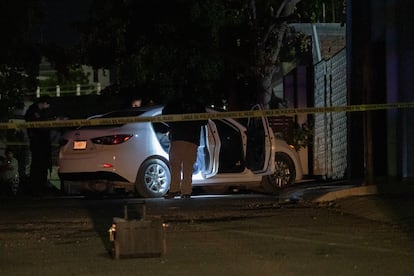
The kidnapping and subsequent surrender to U.S. authorities of Ismael “El Mayo” Zambada by Joaquín Guzmán López, son of his former partner, drug kingpin Joaquín “El Chapo” Guzmán, in July 2024 at the Santa Teresa airport in El Paso, Texas, was like a metaphor for Chaos Theory. This theory states that a small disturbance, like the flap of a butterfly’s wings, can cause disproportionate effects thousands of miles away. This betrayal within the Sinaloa Cartel triggered, just a few months later, an all-out war between the heirs of the leaders of an international empire worth billions of dollars, generated by trafficking cocaine, methamphetamine, fentanyl, and other illicit drugs. The war in that state has left a trail of violence and bloodshed that continues unabated a year later, with 1,824 murders recorded—triple the number from the previous year—and nearly 800 disappearances. Despite having fewer and fewer key players on the board, due to the constant blows Los Chapitos have received from the Mexican federal government and the Trump Administration in their war on drugs, the violence is once again escalating in a region that seems to receive no respite.
Three coolers were left on Sunday morning along the Culiacán Bypass, the road that surrounds the capital of Sinaloa and connects Mazatlán with Los Mochis. The containers, which would normally hold ice and be used to store drinks at parties, were instead used to place, piece by piece, the body of a man. His head, arms, hands, legs, torso. All dismembered as if it were a set from a horror movie, except that this is real.
Tradition dictates that Christmas and New Year’s celebrations begin every December, but in Sinaloa, particularly in municipalities like Culiacán, Navolato, Eldorado, Elota, San Ignacio, Cosalá, Mazatlán, Concordia, and Escuinapa, the celebrations have had to wait. In just 22 days, 126 people have been murdered, including seven women. This data was compiled by EL PAÍS from various sources.
It’s not just about people left in remote areas, on highways, or inside homes, but also about clashes and operations in different locations, such as the three highway blockades in Escuinapa with clashes in border areas of Mazatlán, the second most important tourist capital in northwest Mexico, behind Los Cabos, Baja California.
This new chapter in the Sinaloa war has resonated all the way to the National Palace. During Monday’s morning press conference, President Claudia Sheinbaum addressed the escalating violence and admitted that homicides increased this past weekend, specifically in Escuinapa.
“Yesterday [Sunday], particularly in southern Sinaloa, there were these roadblocks. And it had been averaging around 3.5 homicides a day, and it was a weekend where homicides increased,” she said. “They’ve been showing children’s movies on the bus screens so the kids don’t see the shootings,” said a man named José María who was traveling on a bus that got caught in the middle of roadblocks on December 17.
“They set the trailers on fire and the shooting started. First one in front, then one in back. The driver stayed put and told us to duck when we heard gunfire.” The president stated that Sinaloa had been experiencing a period of “great peace” until El Mayo’s extradition to the United States and the subsequent split within the criminal group operating in the region, a situation that, according to Sheinbaum, has not been cleared up with the U.S. government.
The president made a clear reference to the testimony of Guzmán López, who, in his guilty plea to two counts of drug trafficking and organized crime in Chicago on December 1, told the judge how he kidnapped and turned over the 77-year-old drug lord to the DEA and the FBI. El Mayo, who had remained a fugitive for more than 50 years despite a $15 million reward on his head, had never been imprisoned during his criminal career. In the document, the 39-year-old drug trafficker asserts that the United States government “did not solicit, induce, sanction, approve, or condone the kidnapping.”
Guzmán López’s testimony has revived several unanswered questions and placed the United States’ involvement in the operation under scrutiny. This is despite the White House’s denial of any participation, and the insistence by both the previous and current Mexican governments that Washington is the one that must provide answers.
Since then, the northern state has been engulfed in a war between two organized crime families. Independence Day celebrations last September were canceled for the second year in a row as a result of the shootings, murders, and arson attacks on businesses that have plagued the state for over a year.
The State Attorney General’s Office reported 109 murders in November; 130 in October; 121 in September; 119 in August; and 170 in July. The trend indicated a decrease. “The decrease in homicides is positive,” said Governor Rubén Rocha Moya.
However, with eight days left in 2025, the number of murders has already reached 126, marking the third bloodiest year in Sinaloa’s recent history, comparable to the times of the so-called “war on drugs” during Felipe Calderón’s six-year term.
The crossfire between factions has also led to a surge in disappearances over the past year, with a dominant pattern: men, up to 40 years old, and from Culiacán. At least 3,304 people have disappeared in a 15-month period, according to data from the State Attorney General’s Office obtained through a freedom of information request. This information also reveals that the primary victims are young people from urban areas.
In 2025 alone, the number of cases reached 2,398, of which 393 were women, 1,997 were men, and eight were of unspecified sex. More than 60% of the cases involved people between the ages of 18 and 39. In 2024, 1,269 cases were recorded, while in 2023, there were 925. In just two years, the number of cases has practically tripled, and the number of reported cases now exceeds the number of murders.
The battle has not subsided, even though Los Chapitos are up against the ropes. Whether imprisoned, killed, extradited to the United States, or voluntarily surrendered to U.S. authorities as part of plea bargains to reduce sentences or avoid tariffs, this faction of the Sinaloa Cartel faces the prospect of its demise with growing concern. Only two of its leaders, Iván Archivaldo Guzmán and his brother Jesús Alfredo, remain at large, increasingly cornered by the Mexican security cabinet, which daily announces new arrests and deaths of the drug traffickers whom Washington has identified as one of the main culprits behind the fentanyl boom.
Sign up for our weekly newsletter to get more English-language news coverage from EL PAÍS USA Edition









































