
Óscar Naranjo: ‘Hardline strategies are not sustainable in the long term and devalue democratic values’
The former vice president of Colombia, who is a leading security experts in Latin America, analyzes the critical moment the region is facing and its key challenges
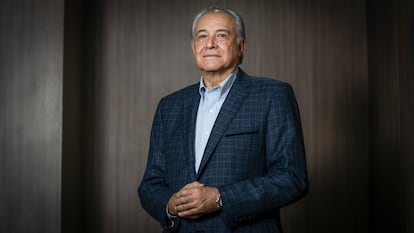
For more than four decades, General Óscar Naranjo has been one of the most authoritative voices on understanding the anatomy of violence in Latin America. His career is, in itself, a map of both the transformation and the limitations of states in the face of organized crime: he played a key role in the downfall of Colombia’s major cartels in the 1990s; led the intelligence services during the moments of greatest threat to his country; spearheaded police reforms that professionalized criminal investigations; and, as vice president, participated in the construction of peace agreements that marked a turning point in Colombia’s recent history. This combination of operational experience, strategic vision, and political skill made him an authority in the hemisphere, consulted by governments, international organizations, and academic centers seeking to understand why, despite years of effort, Latin America remains the most violent region in the world.
Naranjo, 68, views the present with a mix of concern and analytical clarity. The current situation, he warns, is the result of a prolonged cycle of failures: the fragmentation of organized crime into highly disruptive territorial structures; the hijacking of public debate by ideological positions that prevent evidence-based policymaking; the growing militarization of security as a populist response; the failure to strengthen intelligence, judicial investigation, and accountability; and the emergence of organizations that, after the pandemic, no longer seek merely to enrich themselves but to compete with the state for social legitimacy.
From that perspective, Naranjo, in a video call of more than an hour with EL PAÍS, argues that the region is facing a greater challenge than in the past: understanding that it is no longer enough to neutralize kingpins or deploy troops, but that one must rebuild institutional capacities, recover territories and restore meaning to the rule of law.
Question. What particular challenges do you see in Latin America’s current security situation?
Answer. We are experiencing a series of failures in a region that has been considered the most violent in the world for the last 40 years. Latin America is experiencing a high degree of fragmentation of organized crime structures, with the capacity to have an impact locally, regionally, and even nationally. They are no longer pursuing the goal of the large cartels to accumulate economic power to influence politics — as when Pablo Escobar sought to turn Colombia into a narco-state —; they have left behind centralized and vertical command structures and have implemented a process of territorial criminal governance. They seek to control territories to impose rules of behavior on citizens, co-opt local authorities through corruption or intimidation, and protect the source of their criminal economies.
These organizations are proving to be highly disruptive. I often cite the Tren de Aragua as an example: it was unthinkable that an organization founded by a former union leader in a Venezuelan prison, which did not traffic on a large scale, would manage to penetrate 11 countries in the region with very different objectives: extortion, contract killings, micro-trafficking, migration, and human trafficking. This is happening in a region that thought this was a problem only for Mexico, Central America and Colombia, but today sees equal alarm in Uruguay, Chile and Argentina.
Q. How should this new ecosystem of violence be addressed?
A. To begin achieving sustainable results over time, we need to free our understanding of security, drug trafficking, and organized crime from a kind of ideological hijacking. While criminal organizations are becoming more integrated, the region is fragmenting into three camps, politically speaking. One sector advocates for a hardline approach as if it were a silver bullet to solve the problem. At the other extreme, the left asserts that as long as there is poverty and inequality, there will be violence. The third sector, which is largely absent, proposes evidence-based public policy formulas.
I believe that the two extremes have ultimately hijacked the issue. What we observe in the region is that public security policies are heavily influenced by drug trafficking. We need to better understand the phenomenon we are facing. On the other hand, there is something that has not been sufficiently studied: after the pandemic, we saw an evolution and a reconfiguration of crime. In the absence of an effective state that provides solutions, they understood that they could gain social acceptance and initiate a process to try to legitimize crime. This post-pandemic phenomenon confronts us with a reality that is no longer simply based on the greed of a criminal economy; it puts us face to face with a competitor to the state.
Q. To what do you attribute those failures?
A. The backdrop is a debate we’ve been embroiled in for over 50 years, between prohibitionist and libertarian or liberationist views on drug use and production. Now, the failed so-called war on drugs has two sides. I maintain that if we hadn’t waged this fight, Colombia would be a narco-state. A second issue is the increasingly populist response from governments, who believe that militarizing the fight against drug trafficking leads to sustainable results. In a way, these announcements are more aimed at shaping public opinion than achieving results. What worries me most these days is this growing militarization of the fight against crime, when it should be done with investigation, intelligence, forensic science, and judicial capacity to prosecute and convict those responsible and to combat impunity.
Q. You’ve talked about extortion. How can it be fought?
A. This wave of post-pandemic organized crime has highlighted the weakening of three fundamental elements of the rule of law: the principle of the state’s monopoly on weapons; the state’s monopoly on the administration of justice; and the state’s monopoly on taxation. The third has been lost with extortion, which has been present for 15 to 20 years under what classical literature calls Sicilian-style extortion.
What does this mean? It means that the victim initially considers the extortionist not as a perpetrator, but as someone providing a service, and only later understands that it is a crime. In Latin America, we have settled for asking citizens to file a formal complaint with institutions, but this cannot be asked of someone who is afraid of being killed and who does not know what institutional response will follow the capture of their aggressor. We have taken few steps to make such reporting more collective, more anonymous, and to ensure authorities ex officio.
Q. It seems that there is a lack of preventive capacity, independent of the state. What is the state of intelligence in the fight against crime?
A. I worked in intelligence; I was the director of that service in the Colombian National Police, and I believe that intelligence will always be insufficient as long as governments consider it the sole and exclusive responsibility of those teams. Intelligence should be an accumulation of knowledge from academia, citizens, the business sector, and victims. It’s normal for state institutions to tend to downplay problems to avoid negative, apocalyptic messages that the battle against crime is being lost. They tend to be triumphalist, and we must ensure that intelligence incorporates other perspectives.
On the other hand, intelligence, and security institutions in general, have only cosmetic — if not nonexistent — accountability. There’s a great deal of fear about facing the public and explaining what works and what fails. Without accountability, political responsibility disappears, a topic that is rarely discussed. For example, it’s incredible that the number of violent deaths during Andrés Manuel López Obrador’s six-year term in Mexico has been so high, but nobody talks about it, nobody has held anyone accountable for those deaths.
Q. Why has Latin America failed to improve these services?
A. Because intelligence was deeply intertwined with totalitarian or dictatorial regimes in the past, there are currents of political opinion in Latin America that view it with fear. Governments and states have failed to explain that a good intelligence service can prevent repression. What’s more, our criminal procedure laws have not allowed the results of intelligence gathering to be easily incorporated into judicial investigations, and therefore, intelligence often knows things that it does not bring to court. And third, in many parts of Latin America, and even in the United States, many people who work in judicial investigations or intelligence end up in uniform, on the streets, carrying a rifle, which is contradictory.
Q. Does a hardline approach solve the problem of crime, or does it only displace it geographically and temporarily? Is it popular because it’s effective, or because of social desperation in the absence of credible alternatives?
A. Hardline strategies are not sustainable in the long run and end up opening the floodgates to abuse, arbitrariness, and human rights violations. However, faced with crises of insecurity and violence, politicians readily resort to them as an electoral tactic, even though they devalue democratic values. Ultimately, we are facing a false dilemma between those who advocate for a strong state to guarantee the enjoyment of citizens’ rights and freedoms, and those who say that we must first ensure rights and freedoms, and then build a strong state. It is possible to work simultaneously on strengthening the capacities of a competent and effective state without affecting the enjoyment of rights and freedoms, but a candidate with this rhetoric will not be elected in Latin America.
Q. Amid this negative outlook, is anyone making progress in security thanks to evidence-based policies?
A. We are facing what I call the “Bukele fascination,” as he is achieving a sharp decrease in the homicide rate and a very significant drop in extortion. It is a highly contagious example, which creates new difficulties in warning that such policies end in authoritarianism and are not sustainable.
Furthermore, we have been very incompetent in documenting the lessons learned. What we did in Colombia between 1989 — the terrible year when three presidential candidates were assassinated —, and 2016, when we signed the peace agreement [with Colombian guerilla groups], is admirable. There was institutional strengthening, the state’s supremacy over crime was demonstrated, and a climate of acceptance regarding security issues was created.
Excuse me for speaking in the first person, but when I retired from the police force in 2012, I wondered how it was possible for a police officer to leave with an 82% approval rating, higher than [former Colombian presidents] Álvaro Uribe or Juan Manuel Santos. After all, a police officer isn’t popular because they regulate rights and freedoms, so something was done right in my country.
Another factor is that the dilemma between a large state and a small state has left us without sufficient technocracy for national security policies, meaning each government has to start from scratch to implement a policy. And I’ll end with a reflection: when we think about the lessons learned, many of us who were in charge feel a sense of nostalgia that prevents us from saying, “I was wrong. We did this badly.”
Q. From that attempt to push back against nostalgia, what is something you implemented that is no longer viable today?
A. We faced organizations of a very broad national or regional scope, with a centralized and vertical chain of command. It was legitimate to think that attacking high-value targets would seriously damage a structure. The evidence proved that this was correct. Although it is true that for every kingpin captured, four more mini-kingpins appear, those who emerged were not Pablo Escobar or the Rodríguez Orejuela brothers. Today, a similar policy may be misguided. Across the region many arrests are made, but they have less impact — even when the people detained are in charge of the organization — because they do not have the power that others had in the past.
On another note, I think Colombia offered a lesson when it changed its approach: moving from the massive force deployment used against the Medellín cartel to using intelligence for high-precision operations against the Cali cartel. That worked. But today, countries like Ecuador are resorting to massive deployments, when putting soldiers on the streets makes little difference. It is likely that this type of military deterrence will have some effect in international waters, but not within countries.
And a third element is something we didn’t do strongly enough: accountability. I would be more open to scrutiny from citizens, the media, and international agencies, without fear.
Q. Let’s think about specific cases. In Mexico, Claudia Sheinbaum is overhauling security policy. What are your thoughts on this?
A. With President Sheinbaum, Mexico opened a window of opportunity that materialized when it assumed the political cost of appointing Omar García Harfuch — a man who is not a military officer and is more of a technocrat than a politician — as secretary of the public security. This is very valuable, and I hope it will serve to rectify the long-running legacy of the López Obrador, Peña Nieto, and Calderón administrations.
They have been taking steps that have gradually broken with López Obrador’s appeasement approach: although “hugs, not bullets” was stronger as a saying than it was in reality, it took root in the minds of citizens and criminals alike. Now they have managed the strengthening of judicial capabilities quite intelligently, although they face the structural challenge of a federal country with more than 3,000 police forces that have not yet standardized their procedures.
At the heart of the matter is how to transform the National Guard into a competent body that is neither a military police force nor a typical citizen security police force, but a public security force, in charge of intelligence, counterintelligence, and organized crime.
Q. Let’s turn to Colombia, where President Gustavo Petro has prioritized his peace policy over security. In what direction should the country go to avoid a new cycle of violence?
A. Rethinking territorial security must be a priority. Faced with the fragmentation and proliferation of groups, and the multitude of affected territories, a territorial approach is necessary to understand each phenomenon and propose a solution for each. On another front, an effort must be made to ensure that the failure of a total peace agreement [Petro’s plan to negotiate peace with all armed groups] does not lead to the abandonment of the implementation of the 2016 agreement, which has been severely hampered.
Furthermore, Colombia had learned that ceasefires at the beginning of negotiations often proved ineffective, as happened in El Caguán, but this approach changed with the pursuit of a total peace agreement. Because the military operates in binary terms — war or peace, victory or defeat, life or death — they found it confusing to be authorized to pursue some criminals and not others, despite being in the same territory and having such similar modus operandi. We must return to the clarity of ceasefires, and restore the capabilities of all security institutions, from the military and police to the Attorney General’s Office.
And finally, we must overcome the paradox of a left-wing government, coming to the end of its administration, resorting to such harsh tools as bombings or recipes from the past such as offering rewards for each violent act, when there is no proof of their effectiveness.
Q. Finally, what can the United States contribute to the fight against crime, when all countries in the region inevitably work hand in hand with U.S. agencies?
A. The first effort we should make — governments, societies, and institutions — is to understand President Trump’s political logic. I conclude that it is based on deterrence, hard deterrence. If he wants trade agreements, he threatens tariffs and achieves negotiations. If he wants to reduce migration, he launches a hardline policy that includes raids and achieves reverse migration. In the area of drug trafficking, his deterrence policy is manifesting itself in several dimensions. The most notable is the naval deployment in the Caribbean and the Pacific, but he also characterizes these groups as terrorists or increases the number of cases for extradition purposes.
If one understands that hard deterrence is at the heart of his political logic, one can know how to respond. Moreover, experience has shown that the relationship between U.S. agencies and some countries in the region transcends governments and has a technical dynamic. We must make an effort to preserve this more horizontal relationship in which, of course, each country defends its sovereignty and its interests, but understands that there are common adversaries and objectives.
And finally, the way to respond to the growing militaristic approach to tackling the drug problem is to demonstrate that better results are achieved through intelligence gathering, prosecution, and the conviction of drug traffickers. We cannot abandon this task. On the contrary, the more the idea of militarization gains traction, the more we must emphasize that a state governed by the rule of law consists of bringing criminals to justice and that this is effective.
Sign up for our weekly newsletter to get more English-language news coverage from EL PAÍS USA Edition









































