
Wounded Hezbollah has no response to Israel’s escalation in Lebanon
The assassination of Haytham Ali Tabatabai, the militia’s number two, exacerbates the group’s weakness and leaves it paralyzed over how to respond

With a curious air, a man and a woman on a motorcycle with two small children stop the vehicle when they see the wall that has dominated the country’s news broadcasts since the previous day. When the children finish counting the six holes that Israeli missiles left in an apartment building on the fourth and fifth floors, the adults smile at them in approval and continue on their way. In the suburbs of Beirut, where one can travel for miles without finding any streets untouched after last year’s Israeli offensive during the war with the Lebanese militant group Hezbollah, the scar left on Sunday by the assassination of the group’s military chief, Haytham Ali Tabatabai, is indistinguishable from the others.
Dozens of men dressed in black T-shirts, members of the fundamentalist movement that acts as the de facto authority in the area, nervously secured the site of the attack on Monday. The bombing in Haret Hreik, one of the municipalities on the outskirts of Beirut, raises questions to which Hezbollah has no answers.
Despite a ceasefire that has been in place since November 2024, Israel bombs southern and eastern Lebanon daily as punishment for Hezbollah’s refusal to disarm under the deal. This is happening even though Hezbollah has not ordered a single attack in 12 months. The pro-Iranian organization maintains its commitment to its interpretation of the ceasefire, which only requires it to disarm in the border area with Israel, while leaving the country’s defense in the hands of the Lebanese authorities. This situation places the focus on Lebanese institutions and buys time, easing the suffering of its vast community of followers, who were brutally affected during last year’s conflict in the Shia-majority areas.
Now, the political assassination of one of the organization’s leading figures, something unheard of during the 12-month ceasefire, suggests an Israeli military escalation that has caught the militia off guard, without a prepared response, forcing it to choose between standing idly by in the face of a latent offensive, such as the current one, or taking action and facing a devastating retaliation, such as that which killed more than 4,000 people before the ceasefire.
“Both decisions are very difficult,” reflects 31-year-old Layla Tarhini. She strives for a sense of normalcy during her workday at the Philosophy Bookstore, while men in black maintain order on the other side of the storefront. The shop is in the building next to the one that was bombed, killing Tabatabai and four others, and wounding 28. She lives on the parallel street.
The novels of Carlos Ruiz Zafón and Louisa May Alcott, displayed on the shelves, trembled during the strike along with the walls of the premises, which, like the rest of the suburbs of Beirut, are full of images of Hassan Nasrallah, who led Hezbollah for 30 years — half of them spent in hiding — until an Israeli attack killed him in September 2024.
“The Resistance will make the best decision,” the young woman says, using the term its followers employ to refer to Hezbollah and the group of actors hostile to Israel. “But I don’t think they’ll respond right now. They’re thinking about the civilians, who are our greatest strength against the enemy.”
According to Tarhini, Hezbollah is aware of the difficult situation its supporters are facing, with the Lebanese press “turning against them.” “They blame us for starting the conflict,” she says, referring to October 8, 2023, when Hezbollah fired on Israel in supposed solidarity with Gaza, linking Lebanon’s fate to that of the Gaza Strip. “But the conflict began long before Hezbollah was founded [in 1982], which is merely a reaction to it.”
Despite her convictions, Tarhini is “scared all the time.” She says she burst into tears the night before, and she is frustrated that “many Lebanese don’t understand” what it means to live in communities that Israel could bomb at any moment. Far from the Shia-majority areas, where destruction and portraits of Hezbollah fighters killed in combat abound, the Lebanese municipalities where other social groups predominate, such as Christians, Sunni Muslims, or Druze, remain largely untouched by the worst of the Israeli hostilities.
This unequal treatment leads some Lebanese in undisturbed areas to disagree about seeing Israel as a threat, and some even embrace the idea of normalization with the Jewish state. But for many Shias, this prospect is threatening.
“If you give them an inch, they’ll take a mile,” warns 30-year-old Hussein Rayshouni. An engineer, he speaks to EL PAÍS from a half-ruined building in Ghobeiri, another of Beirut’s outlying municipalities. Rayshouni is leading the reconstruction of the block, which was damaged by an Israeli bombing last year. The surrounding streets are teeming with people attending Tabatabai’s funeral, held just a few meters away.
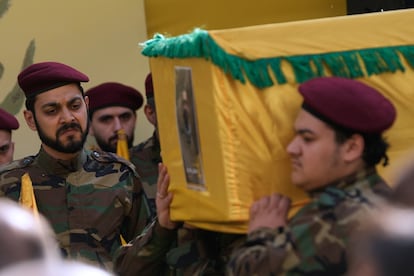
Funerals, at a time when there is speculation about the organization’s weakness, are Hezbollah’s only remaining opportunity to demonstrate its strength, projecting an image that maintains its hegemony over the country. On Monday, thousands of supporters joined a gathering whose main representative was the head of Hezbollah’s Executive Council, Shekh Ali Daamoush, whose speech did little to dispel the doubts surrounding the militia. However, the organization’s secretary general, Naim Qassem, who has been in hiding since assuming the position after Nasrallah’s death, was not present.
“There is frustration and anger,” the engineer laments. He claims that Israel “bombs Lebanon daily” and that “it seems as if the Lebanese government can do nothing about it.” “We are losing our loved ones, our homes, and our sense of security in our own country,” the young man says, expressing a sense of helplessness present in the militia, seen by analysts as a prelude to a violent reaction. “We are being marginalized,” he concludes.
Sign up for our weekly newsletter to get more English-language news coverage from EL PAÍS USA Edition









































