
He hijacked a plane in Cuba, made it to Florida and was deported to Mexico: The life in the shadows of Adermis Wilson González
After being incarcerated for two decades in the United States, the Cuban man was released in 2021 — only to be grabbed by ICE and deported last month
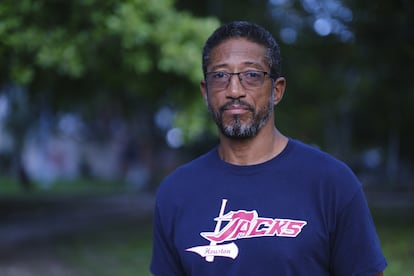

You can’t say Adermis Wilson González doesn’t know fear. Nor that he scares easily. On March 31, 2003 he knocked on the door to the cockpit of a Russian Antonov-24 plane on which he was traveling from Cuba’s Isla de Juventud to Havana with his wife and son. He showed the pilot two grenades and asked, “Do you know what these are?” The pilot replied, “Grenades?” Wilson didn’t beat around the bush: “It’s a fragmentation grenade. If the plane lands in Havana, the only thing touching down will be ashes.” The pilot looked at him intently and replied, “What do you want?” This time, Wilson was even more direct: “That this plane not stop until it gets to Florida.”
More than 22 years later, Wilson answers a phone call somewhere in Mexico (he doesn’t want to reveal his exact location), where he arrived after being deported on September 14, 2025 by the U.S. government. “I don’t feel too bad,” he says in a resigned voice. “I don’t have any money, but I have a little bit of freedom.”
At 56 years old, he’s still the “very astute individual” that Fidel Castro said he was. He gets up at six in the morning, does a few exercises — planks and parallel bars — and watches what he eats. But amid all that order, the same fear he has felt for more than 20 years remains: ending up in the hands of the Cuban government.
“The fear is still latent, it’s there. The fear is like my underwear, my socks, my shirts, the water I use to wash my face every day when I wake up, because the future really is uncertain,” he says. “If the Mexican authorities decide that they don’t want to have me here, they’re going to put me on a plane to Cuba.”
He has rented an apartment with three other Cubans who were likewise deported to Mexico in the last few weeks. His life seldom goes beyond these walls. He goes out in the morning to do some paperwork, comes home and prepares something to eat. He also answers multiple phone calls from his mother, Melkis González, who is 87 years, suffers from Alzheimer’s, lives with his sister in Texas and believes that Wilson went to California to do contract work.
In the world of Señora Melkis, Wilson is not, and never has been, the “criminal” who hijacked an airplane under the nose of the Castros and wound up deported from the country where he arrived looking for asylum. His mother doesn’t remember much, but every once in a while, her brain alights upon a memory of her young son, a civil construction technician — a son who, looking back on it, would change one part of his story. “I’d leave Cuba another way, not by taking an airplane,” says Wilson.
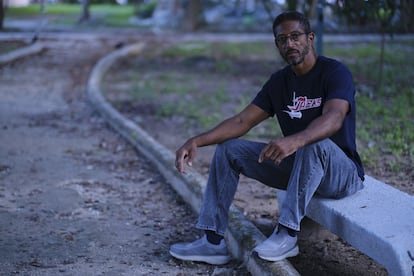
The hijacking
On one of his trips to Havana as the representative of a fibre cement company, Wilson met a pilot. They chatted. Wilson was curious to know how airplanes worked. The man asked, “Did you ever want to be a pilot?” Wilson, a civil engineer, let him think that in another life he would have gone into medicine or aviation. “It was a lie,” he confesses. “I had never considered it, but I told him that so he’d keep talking.”
Wilson paid attention to every detail of the airplanes he flew on for his work trips. More than once, he counted the steps it took for a flight attendant to go from the cockpit to the curtain in the back section of the cabin. He had already considered the idea of leaving Cuba by hijacking one of the catamarans that connects Nueva Gerona, on the Isla de la Juventud, with Batabanó, a southern municipality close to Havana. But that plan dissolved. It was around this time in March 2003 that his wife began to notice he was acting strangely. “She told me, ‘What are you doing? Are you with another woman or are you drinking?’ And I told her, calmly, that I was preparing my future and that of my family.”
On the 31st of that month, his wife and son accompanied him to Havana. Wilson put their names on the waitlist for the last commercial flight leaving from Rafael Cabrera Mustelier airport. Then, Wilson told his wife that he wanted to fix her hair. She found that strange, but he insisted. “She didn’t know absolutely anything,” says Wilson. He inserted the grenade pins into a rose-shaped ornamental comb. He had put the grenade rings in the zipper of his briefcase and the rest of the device inside his underwear. When they passed through the metal detector, the noise alerted the officers, who thought it was due to coins the child was carrying in his pockets.
At nine o’clock that night, they boarded the airplane. Everything was going well. Wilson took the window seat, took out the pins and rings and the rest of the device. He positioned his son so that his wife couldn’t see that little by little, he was assembling the grenades. Then he told her, “Hold onto the boy, don’t get up, don’t cry and trust me.” “Then I stood up, but as soon as she saw the grenade, she started to scream,” he remembers.
They were 20 minutes into a nearly 30-minute flight. Wilson asked the 46 passengers to stay quiet, for no one to get up from their seats. Then he asked them if they recognized the objects he was holding. People began to panic. He tried to maintain control of the situation. “I told them, ‘No one panic, sometimes thing happen in the most unexpected moments, but I don’t want anybody to stand up, I don’t want any commotion, nothing out of the ordinary. I just need to get to the United States.”
He headed to the cockpit and told the pilot to redirect the flight to Florida, but they only had enough fuel to get to Havana. “If it had kept going, it could have been fatal. I didn’t lose hope, I’d studied all the possibilities.” Minutes later, they landed on the runway at the José Martí airport in the Cuban capital. That’s when the negotiations began that would last for 15 hours, involving Fidel Castro and the chief of U.S. special interests in Cuba at the time, James Cason.
Castro himself made calls at several points to the cockpit to convince Wilson to abandon the operation. “I barely gave him the opportunity to speak, to get started on his monologue, because hearing Fidel Castro at that moment might have convinced me,” he remembers. The hours passed. The plane was surrounded by a military cordon. Wilson demanded that the airplane be fueled up in order to continue the trip to Florida. “I picked up the telephone and asked them, ‘Is the gasoline there?’ Fidel said, ‘We are working to provide it as soon as possible.’ But he wanted to keep talking, and I hung up on him.”
At the same time, Wilson was trying to calm down the passengers. He gave them water, or cups with ice cubes, allowed them to go to the bathroom, offered them food. After they had been waiting for several hours, oxygen became scarce on the plane. There were seven children on board who were nearly fainting, it was hard to breathe. Wilson pried open an emergency window in the flight attendants’ cabin. “I couldn’t allow anyone to die on me. I called all the children over to the window,” he says.
Outside, Cuban authorities continued evaluating what to do about the hijacked flight. At one point, Wilson told them that he wanted to make a deal. “I need to let some people off, but I want something in return,” he told officials. He let a woman who had recently undergone surgery get off, along with 22 passengers, in exchange for $2,500. “They gave me a hard time, but in the end, they brought me the money.”
By the time they’d been on the airplane for more than 14 hours, Wilson asked the passengers to start screaming, to pretend that there was no oxygen left, and to even say that there had been deaths on board. “I held up the headset and they shouted while I demanded the fuel,” he remembers. Castro was on the other end of the call. “I told him, ‘You know what? If in 15 minutes I don’t see any results, this story ends here.’ And I hung up.” Soon after, a tanker truck supplied them with gasoline, which helped them land in Key West shortly after noon on April 1, 2003, escorted by two U.S. Air Force F-15 fighter jets and a Black Hawk helicopter.
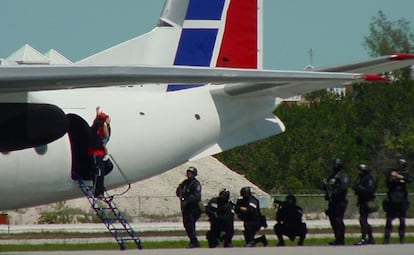
A photo from the Monroe County Sheriff’s Office shows the moment in which Wilson descended the stairs of the airplane with his son attached to his body. He raised his arms as law enforcement officers pointed their guns at him. They took him to an isolated part of the runway, took out pliers and an armored box to remove and deactivate the grenades. Wilson handed them over and told them they were fake, contrary to what he had led Castro to believe. He had made them himself at his home on Isla de la Juventud, using a plaster mold and bicycle spokes.
There have been other hijacking cases involving flights between Cuba and Florida. That same year, a DC-3 airplane belonging to the company Aerotaxi, with 36 passengers on board, also left Nueva Gerona and was re-routed to Key West by a group of six Cubans armed with knives. In 1991, a pilot named Orestes Lorenzo re-routed a Cuban Air Force MIG-23 fighter jet and landed at the Boca Chica naval air station. In 2022, the Cuban Civil Aviation Institute reported that a small plane stolen in Sancti Spíritus had landed in Florida, piloted by a Cuban named Rubén Martínez Machado.
Among the passengers who arrived to the United States along with Wilson, 15 applied for political asylum from authorities. Asylum was granted to all of them except for Wilson himself, who was founded guilty of aircraft piracy three months later by a federal court. He was sentenced to 20 years in prison. The Cuban American lawyer Willy Allen, who won an aircraft hijacking case in 1995, says that people involved in similar incidents in the past had won their “criminal case.” Wilson was the only known case of such individuals not receiving any protection in the United States.
Prison and deportations
In the various federal prisons in which he did time, and which Wilson describes as “hell”, some people called him “Cuba”, and others, “pilot”. He would quickly correct them, “No, not pilot, I’m not a pilot.”
Wilson was an odd prisoner. He didn’t smoke. He wouldn’t accept drugs or do business on the inside. He didn’t get into trouble. They were 20 long years, during which he perfected his English, graduated as a civil engineer from the University of Pennsylvania and finished a master’s degree in logistics from the University of North Carolina.
When he’d been imprisoned for six years, his mother was able to travel from Cuba on a tourist visa to visit him. Wilson remembers those encounters as being “incredibly painful.” “She had to go through pat-downs, intense revisions. And when it came time to leave it was always difficult. Those places aren’t designed for people with a mother’s heart.”
In 2021, he was transferred to an immigration detention center in Stewart, Georgia, en route to being deported back to Cuba. When Havana refused to accept him, Wilson was not granted asylum, though he was allowed to remain in the country. After five months in the custody of ICE, he was set free due to health problems. After two decades, Wilson set foot on the streets of the United States for the first time.
It was his nephew who picked him up at the detention center and brought him to a Burlington store. “He told me ‘Look, these thousand dollars are your first thousand dollars in this country.” After that, he dedicated himself to work, to building, little by little, a life that, it would turn out, only lasted four years. On June 29, 2025, around six in the morning, he prepared a coffee with condensed milk and went to get into his Ford truck, which was parked in front of his house. When he get into the vehicle, he felt a hand on his right shoulder. He turned to see two masked ICE agents. “What is happening? What is this about?” he asked.
They asked him for identification and Wilson showed them an expired Cuban ID card, the only identification he’d ever had. “In the United States, it had been four years in the shadows,” he says about his brief period of time outside of jail. “The only time that I truly lived in this country were those 20 years, because in prison I was a number, I existed there.”
Wilson wound up at Montgomery Processing Center in Texas, like so many other migrants in the Trump era. Then he was sent to another center in Houston. “I never thought I’d go through another process like that. When I found myself in there I said, ‘Well, at least you’re not being sentenced.’ It’s not like they’re going to leave you in here for 20 more years, even if every day feels like five years.”
On September 14, 2025, he was driven in a bus to the border with Reynosa along with 44 other migrants. ICE officials turned him over to Mexican authorities. “I don’t understand how the American government, knowing that my life is in danger, didn’t give me an opportunity, just to work like I was already doing. I didn’t finish what I went to do in the United States, I thought I was going to get papers like any other person, after serving a 20-year sentence. There was a time that I asked myself, what do I have to do to get [legal] status? What else do I have to give? Now, I trust that the Mexican government will allow me to form part of its community. I’m not going to feel safe until I have papers.”
“Do you still think about Cuba?”
“Ay mija, I wish I had the chance to breathe the air of my homeland for even three minutes.”
Sign up for our weekly newsletter to get more English-language news coverage from EL PAÍS USA Edition









































