
US claims Mexican criminal organizations are offering rewards to attack, kidnap, or kill federal agents
Homeland Security says it has intelligence indicating that up to $50,000 is being offered for actions against immigration officers in Chicago
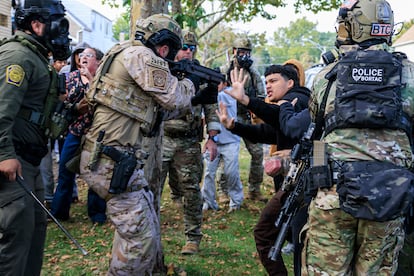

The U.S. Department of Homeland Security (DHS) has released a statement to the effect that it has obtained credible intelligence indicating Mexican criminal organizations — unspecified by name — have begun offering bounties for the assault, kidnapping, or killing of federal ICE or Customs and Border Patrol (CBP) agents. According to U.S. authorities, the instructions have been given specifically in the city of Chicago, where DHS has been conducting Operation Midway Blitz for over a month to search for and detain undocumented migrants in the country’s third-largest city.
According to the brief press release, Mexican criminal networks have directed collaborators in the United States to monitor, harass, and even assassinate deployed federal agents. They detail a structured reward system to incentivize violence against federal personnel, with payments increasing based on rank and the action taken: $2,000 for gathering information or disclosing personal data about agents, including photos and family details; between $5,000 and $10,000 for kidnapping or non-lethal assaults on ICE or CBP agents; and up to $50,000 for the assassination of high-ranking officials.
In Chicago’s predominantly Mexican neighborhoods of Pilsen and Little Village, alleged gang members from groups like the so-called Latin Kings have posted lookouts on neighborhood rooftops, equipped with firearms and radios, DHS says. They add that this surveillance has led to ambushes and disturbances during routine police operations and immigration raids.
Criminal organizations in Mexico have begun offering thousands of dollars for the MURDER of federal law enforcement—with payouts escalating based on rank and action taken:
— Homeland Security (@DHSgov) October 14, 2025
-$2,000 for gathering intelligence or doxxing agents (including photos and family details).
-$5,000–$10,000…
Most of the accusations are focused on Chicago, but DHS is also targeting groups allegedly affiliated with Antifa — recently designated a terrorist group by the Trump administration, despite no clear evidence of its existence as an organized entity — in Portland, Oregon, another city where federal agents have been deployed in recent weeks. It accuses them of providing logistical support for protests, disclosing agents’ private information, and directly interfering in operations to protect individuals allegedly linked to cartels from deportation proceedings.
“These criminal networks are not just resisting the rule of law, they are waging an organized campaign of terror against the brave men and women who protect our borders and communities,” Secretary Kristi Noem said in the official statement. “Our agents are facing ambushes, drone surveillance, and death threats, all because they dare to enforce the laws passed by Congress. We will not back down from these threats, and every criminal, terrorist, and illegal alien will face American justice.”
The DHS accusations bring together two declared enemies of Trumpism who have occasionally clashed, though generally remained separate targets: on the one hand, migrants and their defenders, such as sanctuary cities, and on the other, Latin American drug cartels. The Trump administration has devoted virtually all the domestic force the federal government can deploy to the former — it has recruited thousands of agents from agencies like the DEA and FBI for immigration duties and has sent National Guard troops to so-called sanctuary cities like Chicago and Portland — inflaming the atmosphere despite presenting themselves as peacekeepers. And the latter have been categorized as terrorist groups, which allows the White House to legally attack them directly, even abroad, as it has done with the alleged drug boats it has sunk in Caribbean waters near Venezuela in recent weeks.
If in each previous case the accusatory statements presented without evidence by the government were the preamble to military action — alleged riots led by Antifa to justify the deployment of the National Guard, so far denied by two judges who have halted the internal military mobilization — this new escalation could have unforeseeable consequences.
Sign up for our weekly newsletter to get more English-language news coverage from EL PAÍS USA Edition









































