
Self-deportation or detention, the crossroads of 1.4 million couples in the Trump era
US citizen Julie Moreno supported her Mexican husband, Nefatlí Juárez, in self-deporting for fear of being detained by ICE: ‘We were completely cornered’


Julie Moreno returned from a trip to Mexico on October 7. On the outbound journey, four days earlier, she had been accompanied by her husband, Neftalí Juárez. But on the return home, she traveled alone. Neftalí remained in Mexico to avoid falling into the hands of Immigration and Customs Enforcement (ICE). Theirs is a love story cut short by the Donald Trump administration’s campaign of mass deportations. This is not an isolated case, because like this marriage, in which one spouse is undocumented and the other is a U.S. citizen, there are 1.4 million mixed-nationality couples who live in fear of being separated.
Separation, however, has become a lesser evil in many cases, given the treatment received by those who end up in ICE custody. Many couples prefer to continue their relationship long-distance rather than enter the uncertain process of detention and deportation. Neftalí made the difficult decision to self-deport because the prospect of being detained was more frightening than returning to the country he left more than two decades ago.
“Before this administration, our greatest fear was deportation and separation. But last year, based on what we were told, it became clear that detention would be the real, most serious, and most terrifying problem,” explains his wife, Julie, in a video call with EL PAÍS. The numerous complaints about poor conditions in ICE centers, which reveal the overcrowding and mistreatment detainees are subjected to, were not a promising prospect. Nor was the fact that people have disappeared after falling into the hands of the immigration agency.
Julie, 47, is an American citizen from New Jersey and has been married to Neftalí, 45, since 2017. They met in New York in 2008, when Julie went to visit a friend who worked as a waitress. That’s where she met Neftalí. She smiles when she remembers her feelings upon meeting him: “When you’re attracted to someone who makes you laugh with everything they say, because they’re funny and bright, that’s who they are. They have a beautiful spirit.”
Neftalí had a job as a construction worker, and although they considered regularizing his immigration status before getting married, they decided against it because of the costs. “The process is very expensive. It’s not guaranteed. When we researched it before getting married, I thought, ‘Let’s leave it for another time. It’s a huge investment,’” she recalls.
At that time, living undocumented in the United States wasn’t equivalent to being arrested on the street, sent to a detention center where detainees’ rights aren’t respected, and deported to a country that, in many cases, they have never set foot in before, as has been the case since Trump returned to the White House.

“It wasn’t a problem then. There are a lot of immigrants in our area, and no one cared. Our city (Newark, New Jersey) gave him the opportunity to have an ID that didn’t display his immigration status, and a driver’s license. For a while, we felt like we were fine. But since 2016, the walls have slowly closed in, and now we were completely cornered,” Julie says.
That year, when Trump assumed office for his first term, the Republican’s determination to wage a crusade against migrants was revealed. The courts halted some controversial measures, but his first tenure in the White House served to foreshadow that migrants would remain a target if he returned to the presidency.
Julie recalls that, upon learning the results of last November’s election, which the Republican won by a landslide, she suffered an “emotional breakdown.” She had already anticipated what was coming, because the largest deportation in history was one of the magnate’s main campaign promises. “When we found out who had won, I said, ‘I’m going to get him out of here the first week of January, right before the inauguration,’ because I knew this was going to happen,” she recalls.
For her, it was especially frustrating that people believed Trump’s rhetoric that he would only deport criminals. That fallacy was soon exposed. ICE detention centers are filled with migrants with no criminal records, and most of those who have been deported were not criminals either. According to ICE data, 319,980 deportations were carried out from October 1, 2024, to September 20, 2025, a number still far from the president’s goal of one million deportations per year.
To encourage people to leave of their own volition, the government promoted self-deportations, which are cheaper and more convenient for the administration. In addition to offering a $1,000 reward for voluntary departure — which is not always received — the appalling conditions in which ICE detainees are held have been a successful tactic to encourage these deportations. According to the Department of Justice, there were 15,241 voluntary departures in the fiscal year ending September 30.
Last fiscal year, there were 8,663. The figures, however, do not reflect the full picture, as many people — as in Neftalí’s case — leave without informing the authorities.
He could no longer resist arrest
Ramón Rodríguez Vázquez couldn’t hold out any longer. For 16 years, he worked in the fields of southeastern Washington State, where he and his wife of 40 years raised four children and 10 grandchildren. On February 5, immigration agents who came to his home looking for someone else arrested him. He was denied bail, despite letters of support from friends, relatives, his employer, and a doctor who claimed the family needed him because he was the only one who could take his sick granddaughter to her appointments.
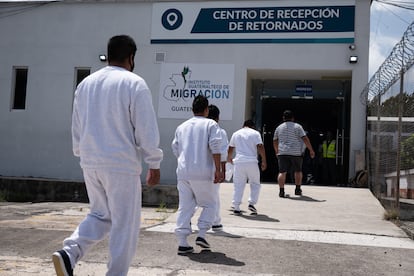
He was sent to a detention center in Tacoma, Washington, where his health deteriorated rapidly, in part because he was not provided with medication for various conditions, including high blood pressure. The judge granted his request to leave without a formal deportation order being placed on his record, and he left, alone, for Mexico. He had never committed a crime.
Like Ramón, Neftalí is not a criminal, but he entered the United States illegally twice, which further complicated his attempt to regularize his immigration status. The first time he crossed the border, he was very young, but he wanted to help his family financially because his father had passed away. He spent three years working, but the distance from his loved ones became unbearable in a potentially hostile environment, and he returned to Mexico.
In 2004, he re-entered the United States. He worked in New York in various places with the same determination to help his family: a bagel shop, a dry cleaner, restaurants... Thanks to his jobs, he achieved one of his goals, which fills him with pride: paying for his niece’s education, who is only one year away from graduating in architecture and becoming the first university degree-holder in her family.

“I don’t recognize my country”
The anguish his loved ones in Mexico felt at the prospect of Neftalí’s arrest was one of the factors that led Julie to reaffirm her decision to separate from her husband. After a phone call in which she heard the concerns of his family, she thought: “This isn’t just about him and me. There are many people who love him and are suffering with worry and anxiety, and we are lucky that he has a place to go.” Neftalí’s family, who live in the state of Puebla, Mexico, welcomed him with open arms.
Across the border, Julie laments the current reality of the United States. “This government has turned my country into something I don’t recognize. It’s not what we American citizens valued; it’s the opposite.”
Long gone are the days when she thought they could make a life together in a country that she now feels ashamed of. The last time she had hope was when the Joe Biden administration approved the Keeping Families Together program in August 2024, which would allow some 500,000 undocumented spouses married to U.S. citizens to regularize their immigration status. Julie and Neftalí applied, but their hope lasted only a few days — the time it took a judge in Texas, at the request of prosecutors in several Republican-governed states, to declare the program, also known as Parole in Place, illegal.
The impossibility of offering a legal path to undocumented immigrants who have been in the country for decades, who have formed families and businesses, and who have made the United States their only home, is one of the reasons why political circles agree that the immigration system “is broken.” The question is whether there is a willingness to fix it. “This problem has existed for 30 years. Many Republicans and Democrats have controlled the White House. In Congress, neither party has done anything to fix it. No effort has been invested in solving it, and families are being separated,” says Ashley DeAzevedo, executive director of American Families United, an organization that advocates for mixed-status families.
“We’re no longer talking about border security. Now we’re talking about domestic enforcement. And with that should come a solution to this immigration system. The one thing we all agree on is that this system is broken,” he adds.
In addition to the 1.4 million mixed-status couples living in the United States, there are approximately 300,000 whose spouses have already left the country and are trying to regularize their status remotely. But under current law, they have to wait 10 years before re-entering the country, a penalty for having entered the U.S. illegally in the past that means those who do so lose valuable years in their relationship with their partner or in raising their children, if they have any.

Julie acknowledges that not having children is an advantage in their case. Also, the fact that Neftalí has a welcoming family in Mexico. His brother has even found him a job at a construction company with real estate projects in Baja California, near the tourist destination of Los Cabos. His fluency in English is a significant asset.
But nothing changes the fact that this couple’s happiness has been cut short. Every night they meet via video call and have long conversations that help them overcome the drama they’re experiencing. “We talk until late at night and laugh together. But I can’t reach out to touch him anymore, like I could when we used to sit together on the couch every night,” Julie laments. “It feels like I’ve lost a limb.”
Sign up for our weekly newsletter to get more English-language news coverage from EL PAÍS USA Edition









































