
Deportation Depot: How Florida is repeating Alligator Alcatraz’s ‘recipe’ for abusing migrants
Complaints about poor conditions at the new detention center indicate that detainees lack adequate medical care, food, and water
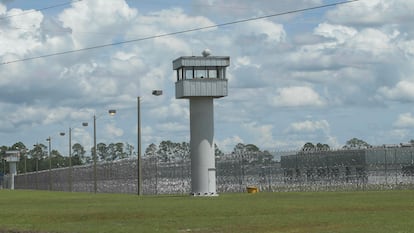

Less than a month after the start of operations at Deportation Depot, the new immigrant detention center set up in a former men’s prison in Baker County, northern Florida, complaints have started to emerge about the poor conditions and treatment at the facility — very similar to those reported at Alligator Alcatraz, the infamous tented jail west of Miami. Detainees at Deportation Depot (as it was dubbed by Republican Governor Ron DeSantis) have complained of limited access to medical care, including emergencies, poor and insufficient food, lack of drinking water, and no privacy to speak with their lawyers, according to testimonies collected by the legal network Sanctuary of the South (SOS).
They have also reported having no mechanisms to file complaints or store legal documents or religious items, that staff threaten them with solitary confinement as retaliation, and that, because there are multiple contractors, it’s unclear who is in charge — raising questions about oversight, due process, and basic standards of care at the facility.
Immigrant detention centers in Florida have been criticized in human rights reports for “dehumanizing” overcrowding and blatant violations of immigration detention standards. Nearly half a dozen people have died in immigration custody in Florida so far this year — half of the total nationwide. The state has sought to position itself at the forefront of the anti-immigrant measures pushed by the Trump administration, which include mass deportations and detention quotas, and leads the nation in the number of agreements with local authorities to detain immigrants.
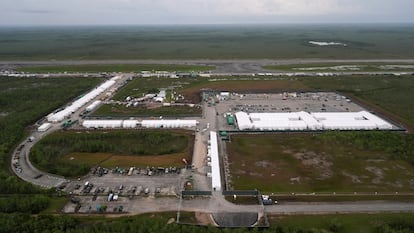
Katie Blankenship, director of SOS, says that authorities are repeating the same “recipe” used at Alligator Alcatraz at Deportation Depot. “It’s being repeated in the detention centers they’re opening over and over again throughout the country, and you see the same problems.”
Authorities want to detain a “crushing amount of people” because “it’s very profitable, and so they rush to create these detention centers without any thought if, whether they’re actually able, capable, set up to humanely house human beings,” Blankenship charges. “It’s quite literally the same recipe over and over again,” she adds, describing the detention centers as “basically cages with no postal service, no reliable air conditioning, no reliable medical care, no reliable food, or anything like that set up.”
No water, scarce food, and no privacy
A man previously detained at the Krome processing center, southwest of Miami — flagged in a Human Rights Watch report for poor conditions and where at least two people have died in recent months — said Deportation Depot is far worse, according to Alejandra Puerto, an SOS legal assistant who spoke with the detainee by phone. “He was transferred to this facility two weeks ago and says he’s almost ready to sign a deportation order. The conditions are unbearable,” she notes.
Another detainee reported losing 10 pounds (4.5 kilos) in the two weeks he’s been there. Another said he has a restricted diet but has not been provided with appropriate food. The tap water at the facility is undrinkable, and detainees are only allowed to drink from a dispenser.
Puerto has also received complaints that “they’re taken out at 5 a.m. with no jackets or anything to keep warm. They’re forced to walk outside in those conditions and wait to enter the dining hall, with nothing to protect them from the cold, because of overcrowding — since not everyone fits in the cafeteria at the same time.”
There is no place or system to file complaints: “They are not allowed to have pens. They haven’t been able to write their requests or complaints, which is exactly the procedure officials tell them to follow. They’re told, ‘Write your complaints,’ but then they aren’t given pens or paper,” Puerto explains. “In addition, their legal documents are being withheld.”
Images from inside the facility show rooms with long rows of bunk beds, no other furniture, and no place to store personal belongings. One detainee said his only possession is a Bible, which he is forced to place on the floor, Puerto says.
SOS has tried to determine whether detainees can send or receive legal mail, but authorities at the site said they don’t know. Because multiple companies operate on-site — one for laundry, another for the kitchen, three or four security firms, a medical company — “it’s not clear who’s in charge, and no one has any answers. There’s no one person in charge,” Puerto says.
Clients can communicate with their lawyers in conference rooms, where “they are placed in a space with a laptop. But some are cautious because they don’t trust how secure the communication is. They lower their voices when officers pass by,” Puerto adds.

SOS is aware that at least two of its clients were transferred to Deportation Depot from other detention centers. Hundreds of detainees do not appear in the online database of the Immigration and Customs Enforcement (ICE), and these transfers — along with the opacity in record-keeping — have raised alarms about potential violations of immigrants’ constitutional rights and due process.
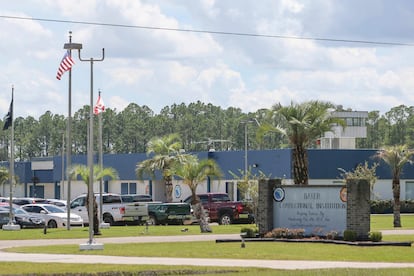
Deportation Depot was previously a state prison west of Jacksonville, near the border with neighboring Georgia, which closed five years ago due to staffing shortages. Blankenship, director of SOS, says her clients have complained that the facility “was not fit for use” and “they did nothing” did nothing to address the situation. “They just threw people in there. It hasn’t been cleaned at all and there’s mold and filth everywhere. It’s really cruel, terrible treatment,” she adds.
Stephanie Hartman, communications director for Florida’s Division of Emergency Management (FDEM), which oversees the facility, said these allegations “are false” and that “detainees receive three meals a day, have access to indoor and outdoor recreational facilities, continuous access to a fully staffed medical clinic with an on-site pharmacy,” as well as clean facilities and the ability to schedule appointments with their lawyers, “both in person and virtually.”
FDEM did not respond to questions about how many detainees are at the center or how many have been deported. The Department of Homeland Security and ICE also did not respond to this newspaper’s inquiries. Authorities have said the facility has a capacity of 1,300 detainees, which could be expanded to 2,000.
The deportation machine
When announcing at the end of last month that he would repurpose the prison to detain immigrants, Florida Governor DeSantis highlighted its proximity to Lake City airport, just minutes from Baker, as a strategic point, and said the goal was not to “hold people indefinitely” at the site, “but to process and deport them.” The former prison required fewer resources — around $6 million — to operate as a detention center than the other option considered by the state, a military base southwest of Jacksonville.
Immigrant advocates have claimed that poor conditions and long periods of detention are part of a strategy to pressure people into accepting deportation. Authorities insist that those who agree to voluntary deportation are given a plane ticket and $1,000. But Blankenship says the real reason they want to keep people detained is money.
In July, President Trump signed his tax reform law, which allocated more than $100 billion to ICE, including around $45 billion to expand detention center capacity.
“That’s the reason. I don’t think Trump or the people behind this care at all about immigrants. It’s a political move. That’s where there’s a lot of money and political power. So what do you do? You start talking about immigrants, you set up the whole anti-immigrant propaganda machinery that’s been running in this country for years, and suddenly you have billions pouring out of Congress,” she says.
“So it’s money first. Like that old saying: ‘It’s the money, stupid.’ Look at that, and everything else fall from there,” she concludes.
Sign up for our weekly newsletter to get more English-language news coverage from EL PAÍS USA Edition









































