
Trump announces meeting with Putin in Budapest to ‘end’ the war in Ukraine
The call between the presidents of the United States and Russia comes on the eve of a summit in Washington with Volodymyr Zelenskiy to discuss sending Tomahawk missiles to Kyiv
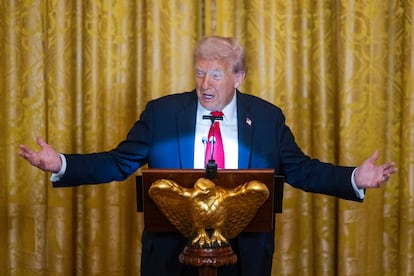

U.S. President Donald Trump announced Thursday after a “very productive” phone call with his counterpart, Vladimir Putin, that both have agreed to meet at an “agreed upon location, Budapest, Hungary, to see if we can bring this ‘inglorious’ war between Russia and Ukraine, to an end.”
Trump spoke with Putin a day before Ukrainian President Volodymyr Zelenskiy’s visit to the White House on Friday. The Republican confirmed this on his social media platform, Truth. On that same forum, he gave details about the outcome of the conversation with the Russian president.
Trump said that Putin had “congratulated me and the United States on the Great Accomplishment of Peace in the Middle East.” “I actually believe that the Success in the Middle East will help in our negotiation in attaining an end to the War with Russia/Ukraine,” the U.S. president wrote. “We also spent a great deal of time talking about Trade between Russia and the United States when the War with Ukraine is over. At the conclusion of the call, we agreed that there will be a meeting of our High Level Advisors, next week. The United States’ initial meetings will be led by Secretary of State Marco Rubio, together with various other people, to be designated. A meeting location is to be determined,“ he clarified. ”I believe great progress was made with today’s telephone conversation.”
The meeting in Washington with Zelenskiy — in which, Trump said, they will discuss Thursday’s conversation with Putin “and much more” — is a working lunch in which, according to plans, both leaders will discuss the possibility of a new shipment of weapons for Kyiv’s defense. Trump and Zelenskiy spoke on the phone twice last weekend. Throughout this week, a Ukrainian delegation led by Prime Minister Yulia Svyrydenko and the head of the Presidential Office, Andriy Yermak, has held preparatory meetings at various levels in Washington, including with Rubio.
“The leadership of the United States and personally President Donald Trump made peace in the Middle East possible. This is the kind of vision the world — and Ukraine in particular — needs today,” Yermak said on social media.
Trump said last Sunday during his trip to the Middle East to attend the signing of the first phase of the peace plan between Israel and Hamas that he had told Zelenskiy he was ready for a new ultimatum to Putin: either Russia commits to serious peace talks or Ukraine will receive subsonic Tomahawk cruise missiles from the U.S. “I might have to speak to Russia, to be honest with you, about Tomahawks. Do they want to have Tomahawks going in their direction? I don’t think so,” he told reporters accompanying him on board the presidential plane.
The idea that Trump is ready to move on to Ukraine following last week’s diplomatic achievement in Gaza — the outcome of which is still uncertain — is gaining momentum in Washington. The Republican won the election on the back of a campaign during which he promised, among other things, to end the Russian invasion on his first day back in the Oval Office. It has now been 269 days since his inauguration, and the war is far from abating in intensity as it heads into its fourth winter.
Trump has issued several ultimatums to Putin in the last nine months, with the announcement of more sanctions that never materialized. The two leaders met in Alaska on August 15, in a meeting from which the Russian president emerged stronger.
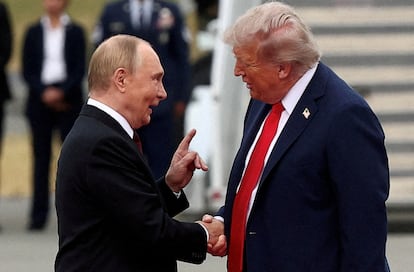
At that summit in Anchorage, the U.S. president not only brought his counterpart out of international isolation and shelved the imposition of fresh sanctions to force the Kremlin’s hand, but he also accepted Putin’s main demands to start talking about ending the war. In total, Russia has occupied about 20% of its neighbor’s territory.
The Republican then tried a new strategy, also with limited results: putting pressure on Moscow through third countries, mainly China and India, which still buy oil from Russia. Trump also maneuvered to get NATO to stop buying Russian crude oil.
Last Friday, in another demonstration of Washington’s unpredictable vacillations on this issue, First Lady Melania Trump said she maintains an “open channel of communication” with Putin. The goal: to repatriate Ukrainian children forcibly transferred to Russia. Some, the first lady said, have already been returned. On Thursday, Trump wrote on Truth Social that his wife’s gesture had also been part of the conversation with Putin.
Intense week
The announcement of the call between Trump and Putin comes during an intense week in White House foreign policy, in which the U.S. president has continued to pressure Nicolás Maduro’s regime with a fifth extrajudicial operation against an alleged drug smuggling boat in international waters in the Caribbean. In that action, the U.S. military killed all six crew members without providing evidence of their identity or the cargo they were carrying. This was followed by confirmation that the Republican had authorized the CIA to carry out covert actions in Venezuela.
Trump has also threatened Spain with tariffs for not increasing defense spending to 5% of GDP, as the U.S. leader has requested of NATO partners. He did so during a visit by Argentine President Javier Milei, during which the United States sealed its commitment to handing Buenos Aires a lifeline by granting a $20 billion currency swap to shore up the South American country’s economy. In an attempt to interfere in the internal politics of another country, the Republican made this aid conditional on Argentines voting for Milei in the October 26 legislative elections.
Sign up for our weekly newsletter to get more English-language news coverage from EL PAÍS USA Edition









































