
Paul Laverty, arrested for denouncing the genocide in Gaza: ‘Civil liberties are shrinking before our eyes’
The screenwriter and Ken Loach collaborator faces trial for his alleged support for the Palestine Action organization
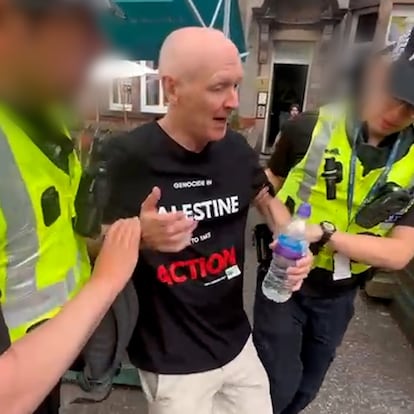

It was never about him, but about denouncing what stirred in his blood. That’s why Paul Laverty (Calcutta, 68), the screenwriter and filmmaker who, over three decades of collaboration with director Ken Loach, has contributed like no other to keeping alive in the United Kingdom and around the world a rebellious leftist consciousness against injustice, refuses to focus the conversation on his arrest for denouncing the genocide in Gaza.
It was on August 25 that Laverty attended a protest in Edinburgh wearing a T-shirt that read Genocide in PALESTINE. Time to Take ACTION. The play with the font led police to conclude that Laverty was publicly supporting the Palestine Action organization, which Keir Starmer’s government has decided to designate as a terrorist organization. Those who support its acts of sabotage can be sentenced to up to 14 years in prison. Public figures such as Laverty and the writer Sally Rooney have expressed their rebellion against this decision, along with thousands of anonymous citizens. Police arrested more than 700 people during a demonstration in Parliament Square on August 9, and new protests in support of Palestine Action are already being announced.
Laverty, who knows Spain well and has long been the partner of director Icíar Bollaín, spoke to EL PAÍS by phone from Edinburgh. He asked not to begin the interview by talking about his shirt, but rather by discussing the statements of one of the right-wing ministers in the current Israeli government.
“I think what actually burns in my ears every morning is the statement by Bezalel Smotrich. He’s been the Minister of Finance since 2022 and this is what he said. ‘We are disassembling Gaza, and leaving it as piles of rubble, with total destruction [which has] no precedent globally. And the world isn’t stopping us.’ Now, to me, that is just absolutely chilling. He not only shows clear genocidal intent, but he’s actually mocking the world."
Question. And do you see an awakening of citizens’ consciousness?
Answer. I think there are many, many people around the world who, like me, wake up and see the execution of the starving [Gazan population] every morning over the last 24 hours, and ask ourselves, are we actually seeing what is happening in front of our eyes. I think there’s still a sense of just almost disbelief that this is playing out in front of our eyes. It’s a stunning turning point in our lives. In the past, there have been genocides, but never with such impunity. I think that’s why so many people feel kind of helpless because they see their governments colluding with the Israeli state.
Q. But not all countries have shown the same degree of complicity.
A. I think the UK and Germany have been particularly terrible in this episode of our history. Others have very good rhetoric on it, which was interesting to see, because the devil is always in the detail. The grassroots in Spain, the grassroots in Ireland, the grassroots here in the UK, are against the genocide, but these contractual, corporate contracts are what gives life to the apartheid state of Israel.
Q. Did you find such a pro-Israeli stance in Starmer’s new Labour government surprising?
A. No, not in the slightest. [Look what] happened to Jeremy Corbyn (the party’s previous leader), he was absolutely crucified, and it was right-wing Labour who used antisemitism as a battering ram to bring him down. Starmer, as I understand, has always been a Zionist, and forever he will be shamed by his first public interview after the terrible events of October 7, when he justified that Israel had the right to cut off food and water and electricity in collective punishment to the people of Gaza. He later tried to explain that he had been misunderstood, but everybody understood the nod and the wink to the Israeli government.
Q. I remember Starmer’s battle against alleged internal antisemitism within the party. And the more conservative media applauded him.
A. I think now that that has been shown to be an enormous lie, but it terrified and frightened people. For example, Ken [Loach] has been accused of antisemitism by right-wing Labour and Israelis for decades. I know for a fact — I’ve worked with Ken my whole life — there’s not an antisemitic molecule in his entire body. He’s even been accused of contributing to an atmosphere in which Holocaust denial is possible. That’s total bollocks.
Q. Don’t you think there has been some evolution, when the Starmer government embargoed the sale of certain weapons to Israel, or when it now announces that it will recognize the Palestinian state?
A. Right here where I live, in Edinburgh, the Leonardo UK factory continues to supply weapons to a pool of which Israel is a member. There’s a pool of arms that goes to NATO, and the Labour government tries to pretend that they can’t separate Israel from that pool because it would jeopardize national security.
It’s absolute bullshit. Leonardo UK continues to supply Israel with components for the F-35 fighter jets that bomb Gaza. There’s enormous public pressure. More and more people are saying that they are colluding with a genocidal state in terms of Articles One and Three of the Genocide Convention of 1951.
And in relation to the whole question of recognition, when you look at international law, the Palestinian people have the right to self-determination. This isn’t something that Britain should recognize or not. This is something that should be implicit. It’s not a favor to them. [Britain has a] historical responsibility under the Balfour Declaration; we started all of this off and totally undermined the rights of Palestinians. The idea that we’re doing something positive as an unconditional favor to them is a great big smokescreen.
Q: Do you fear a curtailment of freedoms in the UK, with decisions such as the designation of Palestine Action as a terrorist organization?
A. I just spoke to an emeritus professor of health in a senior university in the UK. She’s a friend of mine. She went to a print shop for t-shirts, because she’s going to go to the march, and she tried to get a t-shirt printed with “I oppose genocide” on one side and “I oppose the proscription of Palestine Action” on the other. The first shop refused to do it. The second, the same. The third told her they were too scared. There’s nothing illegal about that at all, a senior figure, a professor at a university, expressing her opinion. This is how civil liberties shrink before our eyes, people become scared; people at work, in institutions, in the legal profession, at universities.
Q. But there are voices, even within the moderate right, that have expressed their displeasure at the arrests of peaceful protesters…
A. Although there is no definitive definition of terrorism, all legal experts have linked it to murder, injury, mutilation, hostage-taking… in other words, true terror. To equate people throwing paint at a war plane in a time of genocide with that type of terrorism is an absolute disgrace. I have been charged under Section 15 of the Terrorism Act 2000. I’m due in court on September 18 for wearing a t-shirt which said the following: “Genocide in Palestine, time to take action.” I will continue to justify and defend each of those seven words.
Q. Have you felt supported?
A. I’ve got a close circle of many political friends, but it’s the ordinary people, in a normal supermarket conversation, who tell me they’re completely disgusted. “We just can’t believe this is taking place in front of our eyes” they tell me. I’ve been actually overwhelmed with support. I‘ve been massively touched by the support coming from Spain. Even the San Sebastian Film Festival made a statement on it.
Sign up for our weekly newsletter to get more English-language news coverage from EL PAÍS USA Edition









































