
Maksim Butkevich, victim of Russian torture: ‘I told my interrogator he was going to break my shoulder, but he said he knew what he was doing’
The UN and OSCE accuse Moscow of systematic mistreatment of Ukrainian prisoners of war. Putin is considering withdrawing the country from the European anti-torture treaty
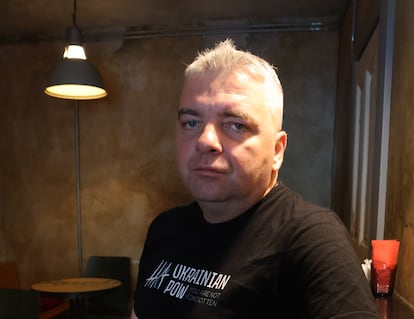

Cynicism is a weapon of war, and Russia is a sharpshooter. Its president, Vladimir Putin, is considering withdrawing from the European Convention for the Prevention of Torture (ECPT), to which it has been a party since 1998. A political mockery that deepens the open wound of thousands of Ukrainian soldiers and civilians in Russian prisons, victims of terrible abuse. Maksim Butkevich, 48, is one of them. His story is measured but devastating. He was released in a POW exchange on October 18, after two years and four months of captivity. He admits that it may sound strange to say that one is afraid of fear — a play on words — but it’s understandable. “I remember the fear in prison when the guards were nearby, in the cells next door,” he explains. “I remember how I anticipated the pain; that’s what scared me the most.”
The story of Butkevich — a Kyiv native who, before taking up arms, was a journalist and human rights defender with the BBC and Amnesty International on his resume — is similar to that of so many Ukrainians who have passed through Russian detention centers. With one peculiarity and frustration: he got out, others didn’t, and he doesn’t know why. “I’m an anti-fascist, and perhaps I was the least suitable prisoner to be accused of being a Nazi,” he says.
A trap
Although Butkevich had not been a fan of war, on the night of February 24, 2022, a few hours after the Kremlin sent its troops into Ukraine, he volunteered to defend his country. He successfully participated in the resistance and expulsion of the enemy from the outskirts of Kyiv. From there, he jumped to the eastern front commanding a platoon of 20 men. “We weren’t aware of how different the war was there,” he admits. On June 21 of that year, he was captured along with eight of his recruits near the village of Myrna Dolyna, in Luhansk province. He recalls the irony of fighting in a place that, translated, means “Peaceful Valley.”
A trap had been set for them. Butkevich and his men had been ordered to an observation point. The Russians were close by. Communications had been lost, but the sound of oncoming vehicles made them consider withdrawing. A comrade from another unit informed them that they were surrounded and that if they wanted to save themselves, they had to follow his instructions. The interlocutor, a prisoner of the Russian army at the time, led them under threat into open country. “They will kill you if you don’t throw down your weapons,” he warned them in a new communication. They were an easy target, so Butkevich ordered his men to surrender.
“They took everything we had,” he recalls, “but they didn’t treat us badly at first.” They were taken to an unmarked location on the outskirts of Luhansk. There, the tone changed. Handcuffed, they were visited by high-ranking military personnel and special forces. The beatings and threats began. Butkevich recalls something one of the Russian commanders said: “You are not prisoners of war [protected by international law], no one knows where you are, if you don’t behave, you will die.”
Systematic harassment
The United Nations accuses the Russian military of torturing Ukrainian prisoners of war. These practices range from ill-treatment to extreme conditions of detention and even sexual violence. In a report published last June, the UN claimed to have credible evidence of the execution of 35 Ukrainian soldiers. It also noted that Russian prisoners had reported ill-treatment in transit centers in Ukraine.
The Office for Democratic Institutions and Human Rights of the Organization for Security and Cooperation in Europe (OSCE) has detailed the Russian authorities’ modus operandi with prisoners: sham trials on charges of terrorism, espionage, sabotage, destruction of property, or war crimes. In total, the OSCE has documented 1,472 of these fabricated cases.
Russian Prime Minister Mikhail Mishustin urged Putin last week to submit to parliament Russia’s withdrawal from the European Convention for the Prevention of Torture and Inhuman or Degrading Treatment or Punishment, adopted in 1987 by the Council of Europe, an organization of which Russia is no longer a party after being expelled following its invasion of Ukraine. Moscow, however, remains a signatory to that anti-torture treaty, as well as to the UN Convention against Torture.
Confession
Butkevich continues his story. The next person to interrogate the platoon of prisoners made them kneel. He wanted them to recite anti-Ukrainian propaganda with him, probably excerpts from Putin’s texts or speeches. “He grabbed a wooden stick and threatened to use it on me if anyone got confused,” Butkevich says. He believes they wanted to humiliate him for being the platoon leader. “He started hitting me on a specific spot on my back, behind my shoulder. I told him he was going to break it; he was making me dizzy, and he replied that he knew what he was doing.” His hands were immobilized for weeks.
Others came and continued hitting him. One of them made him raise his arms up to punch him in the stomach. With his limbs in that position, the pain is worse. They were transferred to another prison in Luhansk, where they received a poor mattress, insufficient food, and a towel. There was no toilet paper. The mistreatment continued over the following months; more interrogations by various security forces and the self-proclaimed Russian authorities in Luhansk. Until August of that first year of the war arrived. Then began the fabrication of the case that would end in a conviction.
In August, a couple of months after his capture, Buktevich was interrogated without being able to see his interlocutors. While they beat him with a baton and gloved hands, they gave him three options: either he plead guilty to war crimes or they would send him to where, according to the accusation, he had committed his crime, let him escape, and shoot him; or they would lock him up with common prisoners, giving them free rein to do whatever they wanted to him. “I’ll confess,” he told them. He signed the paper without even knowing what it said because they covered it with their hands. What he could see was an electrified stick that, he was warned, could be used to rape him. This didn’t happen, although he did hear his jailers describe this type of abuse on occasion.
He was the only one of those captured at Myrna Dolyna on June 21, 2022, who was forced to sign a confession. Five of his men were exchanged for Russian prisoners; three remain in captivity. In March 2023, Butkevich was sentenced to 13 years in prison for war crimes. He later learned that the guilty verdict listed him as responsible for the deaths of two civilians in a town he had never been to. In fact, at the time of the incident, he was still in Kyiv. The victims were real, but they had perished under Russian fire.
His destination was a strict-regime prison where he was finally able to walk and see the light, where he exercised and taught English to other inmates; where he listened to music he remembered in his head, created dystopian stories, or reminisced about all the good people he had met. “My interrogators couldn’t take that inner world away from me,” he says with a certain pride. By then, an international campaign for his release had already been launched. He was released 10 months ago, along with 189 other prisoners of war.
Sign up for our weekly newsletter to get more English-language news coverage from EL PAÍS USA Edition









































