
Trump imposes new tariffs of between 10% and 12.5% on 60 countries to preserve his trade wall
The move replaces the universal tariff approved after the Supreme Court curtailed his earlier plan
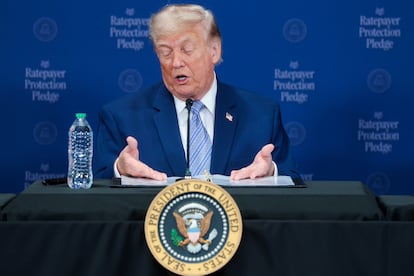

U.S. President Donald Trump is set to sign an executive order on Thursday imposing tariffs of between 10% and 12.5% on 60 countries, including Spain and the rest of the European Union, the United Kingdom, China, India, Japan and Mexico, for allegedly failing to take sufficient measures to curb imports produced with forced labor. The White House estimates that the new trade measure will affect 99% of U.S. trade.
A senior administration official described the measure as “the most sweeping international labor rights action the United States has ever taken, that any country has ever taken.”
The new tariffs are scheduled to take effect at midnight. The White House is introducing this latest round of import duties in an effort to preserve the tariff wall erected by the Republican president in April of last year. The new levies will replace the universal 10% tariff that Trump approved after a Supreme Court setback and is due to expire on Friday.
With this new trade salvo, Trump is reigniting the trade war he launched on April 2, 2025, a date he dubbed “Liberation Day.” On that day, he upended the global geopolitical landscape and cast aside years of globalization, diplomacy and trade relations. He ushered in a new era of world commerce by imposing sweeping tariffs on imports from around the globe. The U.S. Supreme Court, however, later ruled those tariffs unconstitutional, concluding that Trump had exceeded his authority by relying on the International Emergency Economic Powers Act (IEEPA), a 1977 law enacted for entirely different purposes.
To avoid the humiliation of seeing his tariff wall collapse, Trump announced a new round of duties a few days later. He invoked Section 122 of the Trade Act of 1974 to establish a universal 10% tariff. But the measure was valid for only 150 days unless approved by Congress, something that has not happened in a deeply divided country heading into crucial midterm elections in just four months, elections that will help define both Trump’s legacy and the limits of presidential power.
Section 122 also required investigations to justify trade measures against countries engaged in “unjustifiable, unreasonable, or discriminatory” practices. U.S. Trade Representative Jamieson Greer opened two inquiries: one targeting trading partners allegedly failing to do enough to prevent imports produced with forced labor, and another aimed at countries accused of overproduction. It is the first of those investigations that now serves as the basis for the new tariffs of between 10% and 12.5% on 60 countries.
Sign up for our weekly newsletter to get more English-language news coverage from EL PAÍS USA Edition









































