
Trump set to escalate trade war with new tariffs on dozens of countries
The United States is preparing to approve a new round of import duties to replace the tariffs introduced after the Supreme Court ruling, which expire this week
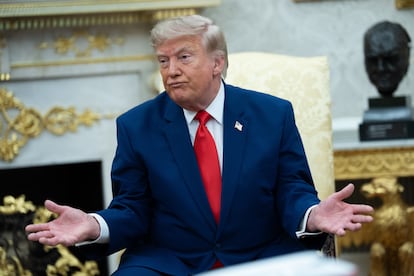

At his most difficult moment, Donald Trump has turned once again to tariffs. The U.S. president has dusted off import duties just as he has become bogged down in the Iran conflict and public dissatisfaction with his policies has reached its highest level of his second term in the White House.
In less than a week, he has imposed 25% tariffs on a broad range of Brazilian imports and duties of up to 50% on goods from Canada. The Republican president is now preparing a fresh trade offensive: new country-specific tariffs targeting around 60 nations ahead of the expiry this Friday of the universal tariffs introduced after the Supreme Court struck down much of his original tariff regime.
“The specific authorities this administration is using have changed, but the trade strategy has not,” said U.S. Trade Representative Jamieson Greer during a congressional hearing on Thursday. “We are committed to continuing to use tariffs and to negotiate deals to support the reindustrialization of our economy, protect American workers and increase their wages and shrink our trade deficit.”
A day earlier, in a television interview, he predicted: “We expect to see some action soon.”
The U.S. leader has thus reignited the trade war he launched at the start of his presidency. On April 2, 2025, a day he dubbed “Liberation Day,” he imposed sweeping tariffs on imports from around the world. But less than a year later, in early January, the U.S. Supreme Court ruled those tariffs unconstitutional. The Court concluded that Trump had exceeded his authority by relying on the International Emergency Economic Powers Act (IEEPA), a 1977 law enacted for entirely different purposes, and dismantled the tariff wall the Republican president had erected.
A few days later, furious over the Supreme Court’s ruling, Trump approved a new round of tariffs in an attempt to soften the blow. He invoked Section 122 of the Trade Act of 1974 to introduce a universal 10% tariff, a lower average rate than in his first, unsuccessful attempt. The provision allows a president to impose temporary tariffs when “fundamental international payments problems require special import measures to increase imports,” but it comes with a significant constraint: it must be approved by Congress within 150 days, a deadline that falls this Friday.
The political polarization that has gripped the United States made it virtually impossible for Trump to secure congressional approval. With the midterm elections just four months away, lawmakers in both the House and Senate have also been reluctant to endorse new duties that could hurt the economies of their home states and districts.
Not only that. U.S. companies that had already been hit by the first wave of tariffs challenged this second attempt in court. Last May, the U.S. Court of International Trade ruled against the universal 10% tariff, but a federal appeals court allowed it to remain in force while it considers the White House’s appeal.
Meanwhile, the Commerce Department opened a new avenue for establishing a tariff framework under Section 301 of the Trade Act, which allows duties to be imposed on countries found to engage in “unjustifiable, unreasonable, or discriminatory” practices. This mechanism will provide the legal basis for the new tariffs Trump is expected to approve in the coming days. The approach does, however, require the U.S. Trade Representative (USTR) to substantiate such claims through formal investigations. It also entails a lengthy process of hearings and public submissions.
To set the process in motion, Trade Representative Jamieson Greer launched investigations in June into 60 countries, including China, Mexico, the United Kingdom, EU member states, India and Japan, accusing them of failing to take sufficient measures to curb imports produced with forced labor.
At the same time, Greer opened a separate inquiry into whether 16 trading partners, among them the European Union and China, are engaging in overproduction, a practice that can depress global prices and harm U.S. manufacturers.
In June, Greer revealed that tariffs of between 10% and 12.5% would be imposed on the 60 countries under investigation for failing to comply with forced-labor regulations. As for the overproduction case, the U.S. Trade Representative’s office is still conducting its inquiry. Through these two channels, the White House hopes to rebuild its tariff wall.
Washington has signed several agreements with its trading partners, modifying tariff terms and establishing a number of exemptions, but the new framework Trump is preparing could reopen those agreements and effectively render them meaningless.
But there is more. The Trump administration is exploring other legal avenues that would allow the president to impose even higher tariffs. One such loophole was used on Monday to impose duties of up to 50% on Canadian automotive materials, dairy products and alcoholic beverages. The U.S. government invoked a provision that had never previously been used: Section 338 of the Smoot-Hawley Tariff Act of 1930, the legislation widely associated with deepening the Great Depression. Relying on that provision, Washington imposed the maximum 50% tariff rate on its northern neighbor.
Several of Trump’s advisers have tried to persuade him to preserve trade stability, avoid reigniting the tariff war and uphold the trade agreements reached with U.S. partners after Liberation Day, the Financial Times reported this week.
Trump could use Section 338 to impose higher tariffs on European countries that adopt a digital services tax, which would hit U.S. technology giants particularly hard. Trump has already threatened to levy duties of up to 100% on countries that implement the tax.
“There is still plenty of time for Trump to revoke or modify the tariffs on Canada, or to change his mind entirely, as we have seen before,” said Anjali V. Bhatt, a researcher at the Peterson Institute for International Economics (PIIE). “But announcing 50% tariffs on one of the United States’ closest trading partners, even if they do not take effect, is a serious escalation. It is also an example of how the Trump administration is trying every possible route to restore the tariff wall that the Supreme Court struck down earlier this year.”
Sign up for our weekly newsletter to get more English-language news coverage from EL PAÍS USA Edition









































