
Chaos, fear and disappointment: Trump’s tariffs turn one year old
The shift in US trade policy leaves winners and losers: American families bear the burden of spending; the economy holds firm while global alliances are reshaped
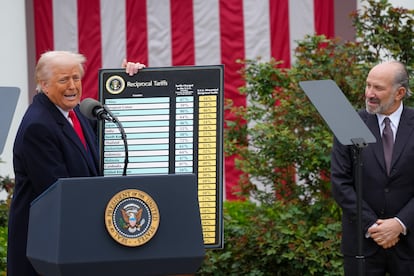

In an era overflowing with historical events, few dates are etched in the annals of history. April 2, 2025, is one of them. On that day, Donald Trump shook the global geopolitical landscape, altered trade rules built through carefully cultivated diplomatic relationships since World War II, and triggered a shift in global supply chains. The president of the United States rattled the world with across-the-board tariffs of 10%, and up to 50% for those countries with which the United States had the largest trade deficits. “For decades, our country has been looted, pillaged, raped and plundered by nations near and far, both friend and foe alike,” the Republican leader declared to justify the trade policy shift. The day dubbed Liberation Day changed the world, but not in the way the head of the world’s leading power had anticipated.
With all the trappings of Trumpian style, in the White House Rose Garden, holding up a cardboard sign, the president announced a paradigm shift in trade policy, raising tariffs to their highest level since 1939. Beside him stood Brian Pannebecke, a retired auto worker: “My entire life I have watched plant after plant after plant in Detroit and in the Metro Detroit area close,” said the Republican activist, sporting a yellow vest, a long, wrestling-style mustache, and a Trump hat. “We support Donald Trump’s policies on tariffs 100%,” he proclaimed from the White House garden. “We are deeply grateful to him, and in six months or a year, we’re going to begin to see the benefits,” he asserted.
Twelve months later, Pannebecke has shaved his mustache, taken off his cap and vest, and put on glasses. Meanwhile, the Supreme Court has declared the so-called reciprocal tariffs illegal. Washington has collected some $264 billion from the tariffs, but has failed to reduce the trade deficit. Nor have the tariffs spurred the opening of factories or attracted, so far, the increased foreign investment that Trump predicted that day. A year later, the United States buys fewer products from China, but Beijing isn’t selling any less because it has found other markets. A year later, Europe has distanced itself from the United States. The EU has signed the Mercosur trade agreement with part of Latin America, which had been stalled in Brussels offices for decades; it has moved closer to China and signed preferential trade agreements with India, Australia, and other countries.
The U.S. economy, which was the envy of the world before Trump’s crackdown on trade relations, is experiencing weaker growth (2.1% last year, compared to 2.8% in 2024) and is more isolated. Jobs are stagnant and an affordability crisis is affecting millions of families.
The world has changed, but not as Trump expected. The truth is that his trade policy has been chaotic, confusing, and arbitrary. It has created winners and losers. But despite everything, it hasn’t caused a cataclysm in the global economy as some had predicted. “President Trump’s unprecedented tariff increases last year raised U.S. trade protectionism to its highest level in at least 80 years, but so far it has had only a small effect on the overall economy,” note Janice Eberly and Jón Steinsson, researchers at the Brookings Institution, an economic think tank.
“Although the tariff increase was larger than the Smoot-Hawley Tariffs of 1930, which many economists blame for deepening the Great Depression, the overall impact on the U.S. economy appears small: between 0.1% of GDP and -0.13%,” the Brookings researchers argue. They explain that the revenue generated by the tariffs and the profits of U.S. manufacturers largely offset the tariffs paid by U.S. importing companies.
After Liberation Day, financial markets panicked. Stock exchanges around the world plunged into the red, and investors began demanding higher yields from the U.S. Treasury on its debt. Trump backed down and granted a 90-day grace period for renegotiation. It was during this time that he acquired the nickname TACO (an acronym for “Trump Always Chickens Out”). For months, he negotiated with major powers and countries. He threatened some with exorbitant tariffs—he threatened to impose a 145% tariff on China—and granted exemptions and preferential treatment to others. “Countries are kissing my ass,” he infamously said.
Effective trade rates rose from 2.4% at the beginning of 2025 to 28% after Liberation Day, before moderating to 14.3% in September after the trade agreements were signed, according to calculations by the Yale Budget Lab, which has been analyzing the evolution of Trump’s trade policy. That import tariff was the highest since 1939.
Among those initially expected to benefit most were Latin American countries and Australia, with lower tariffs than the rest. Other countries that seemingly had higher tariffs, such as Vietnam (46%), Thailand (36%), and Taiwan (34%), ended up gaining due to the shift of trade from China to these countries and the numerous exemptions for electronic components and computers.
The countries most affected initially were Canada, Brazil and Switzerland, which Trump punished with the highest import tariffs. Trump has not only used tariffs for trade purposes, but also to pursue his diplomatic objectives or out of sheer irritation. He threatened Canada with more tariffs because it sponsored an ad featuring a Ronald Reagan speech against tariffs, and Brazil for imprisoning former president Jair Bolsonaro. In the fall, when inflation remained a threat and was impacting the polls, he approved tariff reductions for food from Latin America. The truth is that, after months of threats, negotiations, and changes, tariffs became a tangled web of exemptions and preferential treatment that made it difficult to understand the overall tariff landscape.
Despite everything, two facts help contextualize import tariffs. According to Bloomberg, 43% of U.S. imports avoided tariffs during Trump’s second term due to numerous loopholes in the trade system. Foreign direct investment in the United States last year totaled $288.4 billion, according to the Bureau of Economic Analysis (BEA). This amount is less than the previous year, before the tariff wall was erected, and almost half of what it was in 2016, when Trump first entered the White House as president, Bloomberg notes.
Last February, the Supreme Court dismantled the trade wall erected by Trump. It declared the tariffs approved on Liberation Day illegal. The Republican president had based his actions on the 1977 Emergency Economic Powers Act, intended for wartime situations, to justify the tariffs, but the Court justices ruled that he lacked the authority to approve such a measure without congressional approval and under a law designed for other purposes.
An enraged Trump reacted with a global tariff of 10% and threatened to raise it to 15%, though nearly two months have passed and he has yet to do so. These new tariffs are temporary and must be approved by Congress within two months. The Supreme Court’s setback once again reshaped the trade landscape. And it paved the way for American consumers and businesses to claim refunds of approximately $170 billion. “Immediately after the Supreme Court’s decision, the tariff fell to 7.3%. After the imposition of the Section 122 tariffs, it rose to its current level of 10.5%, the highest since 1943 (excluding 2025),” estimates the Yale Budget Lab. The Trump Administration has launched trade investigations into about 100 countries to explore legal alternatives, since the 10% tariffs must be approved by a deeply divided Congress with little chance of passing them.
The president always justified the tariffs as making the country richer, but now he has to pay back the revenue. “A year after Liberation Day, the damage to small American businesses goes far beyond what any tariff data can reflect. These companies have spent the last twelve months without growth, hiring, or innovation—simply surviving. They have depleted their savings, incurred debt, laid off employees, and reduced product lines just to stay afloat,” says Dan Anthony, head of We Pay The Tariffs, an organization created by hundreds of businesses hit by the trade tariffs.
Over the months, studies have emerged that have shed light on the impact of tariffs. A recently published study by the Federal Reserve Bank of New York concludes that Americans are bearing almost the entire burden of increased import tariffs. The report states that 90% of the tariffs are being passed on to consumers and businesses in the country.
The Bank of New York concludes that “higher tariffs directly increase the cost of imported goods, raising prices for American consumers and businesses.” The Congressional Budget Office (CBO) also analyzed the phenomenon. Its findings indicate that “foreign exporters will absorb 5% of the cost; and, in the short term, U.S. businesses will absorb 30% of the increase in import prices by reducing their profit margins; the remaining 70% will be passed on to consumers through higher prices.”
Economists at the nonprofit Tax Foundation have calculated that “Trump’s tariffs represent the equivalent of a $1,000 tax for every American household.” They add, “We estimate that the new tariffs taking effect in 2026 will increase taxes per American household by $600.”
“The current tariff regime has reduced GDP and slightly increased unemployment. While the level of output in 2026 is lower than it would have been had the pre-2025 tariff regime been maintained, tariffs are increasing the rate of output growth in 2026 as the economy partially recovers from the severe impact of 2025,” Brookings argues, noting: “In the long run, tariffs reduce the overall size of the U.S. economy, but, in addition to aggregate GDP, they also cause a reallocation of resources among different sectors of the country.”
Sign up for our weekly newsletter to get more English-language news coverage from EL PAÍS USA Edition









































