
Trump and his allies use White House Correspondents’ Dinner attack to push for ballroom construction
Republicans in Congress cite ‘national security’ reasons to clear the project, which has been blocked by a judge
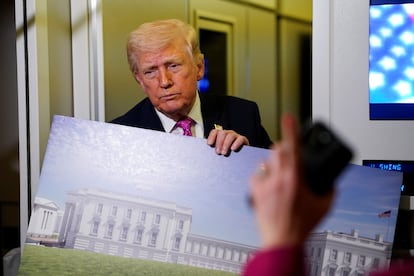

U.S. presidents typically leave their mark on the White House. And then there’s Donald Trump. A builder at heart, he has filled the Oval Office with gilded moldings, just like the Mar-a-Lago-style lettering he’s placed throughout his Palm Beach, Florida, mansion. He has paved the Rose Garden, installed a dark granite walkway that contrasts sharply with the pristine white building, and created a presidential gallery filled with insults and lies about his predecessors. However, his greatest interest and political capital have gone into the ballroom he wants to build on the site of the former East Wing, which he himself decided to demolish a year ago without permission.
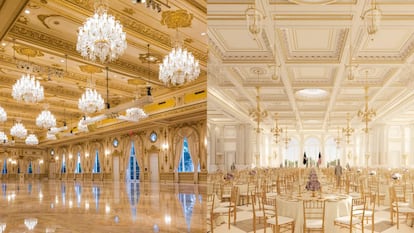
The importance he places on building a space larger than the White House itself, with a capacity for a thousand people and a budget that has grown to $400 million, was demonstrated once again this weekend. After escaping unharmed from the foiled attack by a gunman at the White House Correspondents’ Dinner, which Trump was hosting in another enormous ballroom at the Hilton Hotel, the largest in Washington, the president told the press in an impromptu appearance that, had his own ballroom existed—which, he promised, would have the best security measures—something like this would never have happened.
On Monday, a chorus of Republican politicians, MAGA figures and commentators from the conservative Fox News network echoed Trump’s wishes. Speaker of the House Mike Johnson told the network that the ballroom would be the “solution” to threats like the one this past weekend. Senator Lindsey Graham, for his part, promised to introduce legislation to “accelerate what America needs: A secure facility for the president and others to meet in, to have a good time, to enjoy themselves without putting the nation at risk.”
They all seemed to take up the challenge issued by Trump, who on Sunday was conspicuously absent from his social media account, Truth. He posted five messages in total, the most substantial of which concerned the construction of the ballroom, whose work would not be completed before 2028 in any case. In that year, Trump will cease to be president; the law does not allow him to run for a third term.
In his message, Trump also lashed out against “the ridiculous lawsuit” that managed to halt construction last March and which, according to the president, was filed by “woman walking her dog, who has absolutely No Standing to bring such a suit.”
It was actually a Washington-based nonprofit organization called the National Trust for Historic Preservation that filed a lawsuit in December to force Trump to submit his plans to Congress for review, something he hadn’t done before with the East Wing, which was demolished in October. “No president has the legal authority to build a ballroom without giving the public an opportunity to comment on it,” the lawsuit states.
White House lawyers argue that the land falls outside the scope of the National Historic Preservation Act. Lawyers for the foundation, established by Congress, argue that Trump is violating other laws.
Precautionary measure
In March, District Judge Richard Leon in Washington sided with the plaintiffs, granting an injunction to halt construction. On April 16, he upheld that decision after an appeals court asked him to do so in light of the White House’s national security arguments.
That second ruling unleashed a storm of anger from the U.S. president on social media. That day, he posted eight messages, some of them repeated, describing Leon as a “Trump-hating judge.” The president insists that the money for construction will not come from taxpayer money, but rather from billionaire donors. Some of these donors are personal friends of the president. It is still unclear what those who contribute funds will receive in return.
This Sunday, Acting Attorney General Todd Blanche posted on his Twitter account a letter that the Justice Department, which he is leading until further notice, had sent to the National Trust for Historic Preservation. The letter calls the lawsuit “frivolous” and asks for its withdrawal.
The foundation’s president responded with a statement warning that “we are not planning to voluntarily dismiss our lawsuit, which endangers no one and which respectfully asks the Administration to follow the law.”
Blanche reiterated her request on Monday in a joint appearance with the FBI director Kash Patel to provide details about the investigation into the attacker, Cole Tomas Allen, whom the Justice Department has charged with three crimes, including attempted assassination of the president of the United States, which carries a maximum sentence of life imprisonment.
Sign up for our weekly newsletter to get more English-language news coverage from EL PAÍS USA Edition









































