
Mexico navigates USMCA review amid threat of new US tariffs
Mexican President Claudia Sheinbaum is set to meet on Thursday with Trade Representative Jamieson Greer, who says provisional agreements could be reached this year
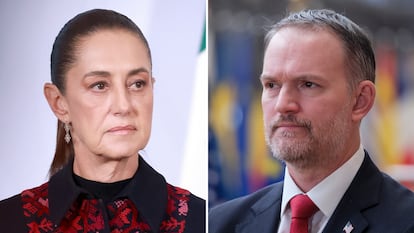

The first annual review of the USMCA is set to be tested by U.S. President Donald Trump’s renewed determination to revive his global tariff war. The launch of the agreement’s review process between Mexico and the United States this week in Mexico City comes against the backdrop of the Republican’s threats to impose an additional wave of tariffs on more than 60 countries, including Mexico, on top of the steep duties already announced against Brazil and Canada.
Amid this uncertainty, Mexican President Claudia Sheinbaum said on Wednesday that her team had attended a hearing in Washington last week to present the case against imposing new tariffs on Mexican goods. Ultimately, however, the final decision rests with the White House.
Mexico is trying to defuse any further tariff threats from the United States while simultaneously undertaking a comprehensive review of the USMCA. On Thursday, Sheinbaum is due to receive U.S. Trade Representative Jamieson Greer at the National Palace.
The outlook, however, has become more complicated in recent days because of the series of tariff announcements issued by the White House. Trump has turned import duties into one of his principal economic weapons and, despite setbacks in the U.S. Supreme Court, he does not appear ready to give them up.
The bilateral round, which began on Tuesday with technical teams from both countries, marks the first face-to-face meeting since President Trump declined to renew the USMCA for another 16 years, a decision that has triggered annual reviews of the North American trade pact over the coming decade.
Testifying before the U.S. Senate on Wednesday, Greer said he expects to reach provisional agreements on the USMCA before the end of 2026. However, he signalled that more complex issues, such as rules of origin and labor and environmental commitments, will continue to be negotiated through 2027.
“We want USMCA rules of origin to be very strong to incentivize production in North America,” he said. “We need to make sure that the goods are actually from the U.S. and Mexico and not some third country using Mexico as an export hub to get into the U.S. without any obligations of the agreement.”
The U.S. official acknowledged that the review of the trade agreement would be difficult if Mexico does not cooperate across all areas of the bilateral relationship, from border security to water-sharing obligations under the 1944 Water Treaty.
“The president is going to have a hard time agreeing to renewal or even revisions if Mexico isn’t playing ball in all areas — and the water treaty is one of them,” Greer said.
No details have yet emerged about the progress made by the technical teams in the talks between Mexico and the United States. However, Mexico’s economy minister, Marcelo Ebrard, expressed confidence that the negotiations would be productive and reiterated that the country’s priority is to preserve the tariff advantage it enjoys over other nations. The meetings will cover tariffs on steel, aluminium and the automotive sector, as well as economic security, agriculture, electronic payment services, critical minerals and labor issues.
For Mexico, the USMCA has served as a shield against Washington’s recurring tariff threats. In April 2025, during the so-called “Liberation Day” tariff announcement, exports that complied with the agreement’s rules of origin were exempted from the new duties. The same principle was applied again this February, when Trump introduced a blanket 10% tariff on imports. Under the current framework, more than 85% of Mexican exports qualify under the treaty and therefore enter the U.S. market duty-free. Even so, the country continues to face tariffs on strategic sectors such as automotive manufacturing, steel and mining.
Sheinbaum’s government is once again trying to avoid Trump’s protectionist barrier while seeking to expand the preferential treatment granted under the USMCA. Although Mexico had hoped the agreement would be renewed for another 16 years, it now faces a new reality in its relationship with its largest trading partner, one defined by annual reviews of the pact and constant negotiations aimed at warding off future tariffs. For now, the White House’s final decision on the future of trade relations with Mexico remains up in the air.
Sign up for our weekly newsletter to get more English-language news coverage from EL PAÍS USA Edition









































