
US pressures Mexico for violating the 1944 Water Treaty
The State Department, the governor of Texas, and South Texas farmers are demanding that the Mexican government deliver on an accumulated water debt that has been growing since the 1990s

Water has become a source of internal and external dispute for the Mexican government in recent months. On November 25, the U.S. State Department reported on a meeting between Mexican and U.S. officials in which, it claims, it “pressed” Mexico to comply with its obligation—stipulated in the 1944 Water Treaty—and supply “the maximum possible amount” of water to users in Texas. “The shortfall in water deliveries has exacerbated the shortage in Texas and contributed to hundreds of millions of dollars in crop losses,” they warned.
The demand echoes months of complaints made by farmers in the southern United States, Texas Governor Greg Abbott, Agriculture Secretary Brooke Rollins, and Republican Senator Ted Cruz, some of the voices that have most pressured Mexico to comply with what was agreed in 1944, in the bilateral treaty that manages the distribution of water from three rivers: the Colorado River, the Rio Grande, and the Conchos River, for the population of both countries.
According to the 1944 treaty, the United States is required to send 1.5 million acre-feet of water (1.85 billion cubic meters) annually from the Colorado River to Mexico, and Mexico is required to deliver 1.75 million acre-feet (2.2 billion cubic meters) from the Rio Grande in five-year cycles. The most recent cycle (2020-2025) ended last October with less than half of the quota delivered.
For Rodrigo Israel González Velázquez, a water management specialist at the Colegio de la Frontera Norte (Colef), the bilateral treaty is a benchmark because it was one of the first agreements in the world to manage water distribution between two countries. However, internal differences have become complex: “Legally, given the signed agreements, Mexico does have a deficit in its deliveries, although the U.S. has delivered less water in the Colorado River basin, but this was prior to an agreement between the two countries. It has been easier for the stakeholders in the Colorado River basin to reach an agreement, and there are signed agreements from the International Boundary and Water Commission (IBWC), which is like an extension of the treaty, that has facilitated it. But in the Rio Grande basin, it has been very complicated; they have been trying to reach an agreement for years, since the 1990s, to see who has to cede water,” he says.
The general conditions in northern Mexico also complicate negotiations with the outside world. Experts on the subject assert that the overexploitation of aquifers, excessive water concessions, urban growth, and a decrease in rainfall in the region of up to 20%, in addition to other climate variations, create a worrisome situation within Mexican territory itself. This makes it difficult for Mexico to respond to the United States with more efficient measures to deliver its allocated water.
María del Socorro Marquina Sánchez, an academic and legal scholar at the UNAM Faculty of Law, points out that “if Mexico fails to meet its obligations in a five-year cycle, as has happened since the 1990s, when there have been delays, the treaty stipulates that it can be compensated for in the following five-year period. This has generated controversy, especially this latest time around, when we are in a very critical situation because we haven’t even reached half of the required delivery. In other words, we are getting worse and worse in complying with the agreement,” she notes.
The Trump administration is well aware of this, having threatened to sanction Mexico last April if it failed to comply with the treaty. The Republican leader, through his Truth Social network, demanded the delivery of more than 1.3 million acre-feet of water (1.52 billion cubic meters) for farmers in South Texas. ““I will make sure Mexico doesn’t violate our Treaties, and doesn’t hurt our Texas Farmers. [...] we will keep escalating consequences, including TARIFFS and, maybe even SANCTIONS, until Mexico honors the Treaty, and GIVES TEXAS THE WATER THEY ARE OWED!,” he wrote on April 10.
Experts acknowledge that Mexico has mismanaged its resources at various times, and that the current situation is further complicated by demands from domestic farmers and other political issues that ultimately hinder progress. González Velázquez adds to the equation a lack of continuity in agreements and internal work at the National Water Commission (Conagua), the federal agency responsible for making decisions on the Mexican side. “There is a lot of staff turnover. Sometimes people come in and make agreements, but then they’re replaced, someone else is put in, and those agreements that were already made aren’t respected,” he says.
Pressure from Mexican farmers
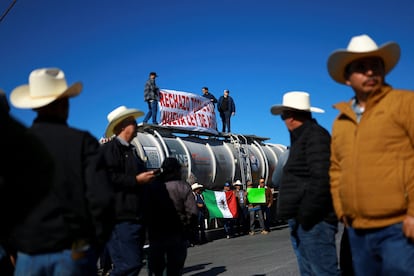
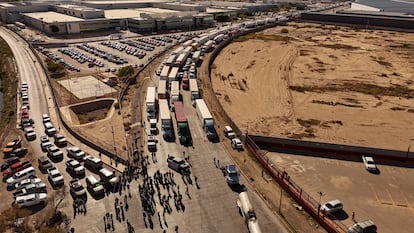
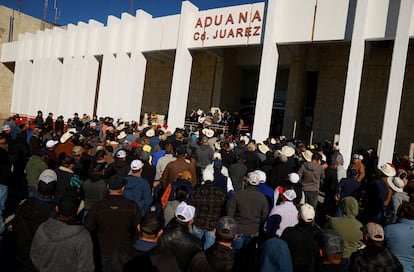
Amidst the United States’ demands for Mexico’s compliance, President Claudia Sheinbaum’s government faced weeks of pressure from Mexican farmers who rejected its proposed reform to the National Water Law. The protests, which included the closure of roads and federal highways in more than 20 states, along with other demonstrations, rejected the changes proposed by the executive branch, which would significantly alter the transfer and renewal of agricultural water concessions.
After several days of blockades and public disputes, Morena legislators in the Chamber of Deputies began to finalize changes to the bill with the farmers, which include adjustments to water use concessions.
Dr. Marquina Sánchez points out that the water problem on the various fronts that the Mexican government is currently facing is even more serious because a solution for deliveries to the U.S. could involve cutting off the water supply to several communities in the north of Mexico.
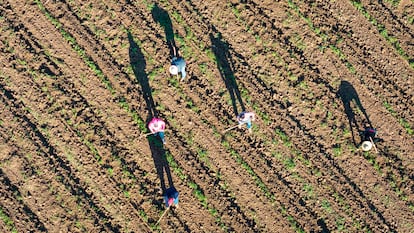
“Undoubtedly, without good internal coordination in Mexico, it will be difficult for it to meet its international obligations. If things are bad at home, then obviously we won’t be able to fulfill them satisfactorily abroad.” Marquina also points out that Mexico has “deficient water management” with structural problems, obsolete infrastructure, and a lack of proper maintenance of dams and other water equipment. He also says that there is an over-allocation of permits to farmers, without any measurement of the water that flows. “We tend to focus too much on the good years, hoping that next year will be better and rainier, and that’s not the point,” he says.
President Sheinbaum said on October 30 that Mexico will comply with the treaty: “There will be a delivery of water now that there are more resources, without putting human consumption and agriculture at risk,” she said.
The U.S. State Department, in its statement of November 25, responded: “We remain committed to working with Mexico to resolve this issue through diplomatic channels as we continue to evaluate all available options to ensure Mexico complies with its water delivery obligations.”
Sign up for our weekly newsletter to get more English-language news coverage from EL PAÍS USA Edition









































