
SpaceX makes history with stock market debut and is poised for sharp gains
The company’s valuation is approaching two trillion dollars. SpaceX is trying to ‘take the fiction out of science fiction’ and create an exciting future, said Elon Musk
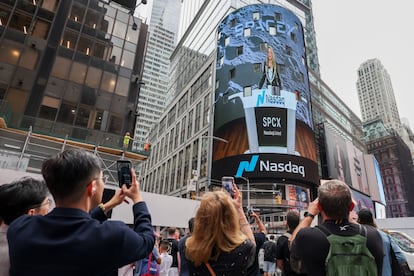

SpaceX, the company founded in 2002 by Elon Musk with the utopian dream of sending humans to Mars, became one of the world’s leading tech giants on Friday. The company, which specializes in launching rockets into space, communications satellites, and artificial intelligence, has made the biggest stock market debut in history. In the absence of an official listing, trading on the Nasdaq suggests a price of between $170 and $175 per share, up to 30% above the $135 at which the shares were sold. This valuation places the company at approximately $2.25 trillion, making it the sixth-largest company in the world by market capitalization. It was the largest initial public offering in history, ahead of Saudi oil giant Aramco’s 2019 debut, which raised about $29 billion.
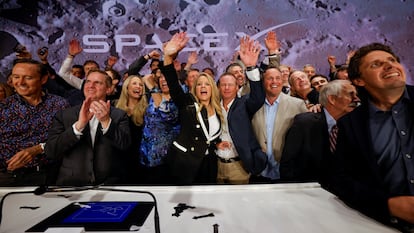
SpaceX has made its Wall Street debut amid great anticipation. Its debut has attracted demand from institutional and retail investors totaling more than $350 billion—more than four times the amount offered, according to Bloomberg. Large funds and investment banks have snapped up just over 70% of the shares offered. Elon Musk fans and SpaceX employees (some of whom became millionaires overnight) gathered at the Nasdaq headquarters in Times Square, New York. Musk himself, along with his mother, Maya Musk, and Gwynne Shotwell, the company’s president, participated in the traditional bell-ringing ceremony that marks the start of the trading session, even though the shares were not yet trading.
“If someone had told me this was going to happen, I would have said ‘Man, you must be smoking some really good crack’,” said Musk, adding that he thought the project had less than a 10% chance of success, but nevertheless defended the importance of giving it a try. If no new company ventures into space, we will never be a truly spacefaring civilization, he said, referring to the possibility of fostering multiplanetary life and turn the science-fiction futures into reality. “That’s what SpaceX is all about: taking the fiction out of science fiction and creating an exciting future. A future for everyone.”
Musk’s legion of followers and retail investors’ enormous appetite for SpaceX have played a crucial role in this initial public offering (IPO), which has seen overwhelming demand. The U.S. retail tranche, for which the company allocated $15 billion in new shares (20% of the offering), received orders totaling $100 billion, far exceeding the company’s initial projections as outlined in the prospectus filed with the U.S. Securities and Exchange Commission (SEC).
The deal has made Elon Musk the first trillionaire in history. The tech mogul was already the richest man in the world thanks to his stakes in SpaceX, Tesla, Neuralink, and The Boring Company, but the rocket company’s surge in value following its Wall Street debut has propelled his fortune past the $1 trillion mark. Never before in history has a single person amassed such power. This concentration of wealth has sparked concern among some sectors that warn of growing inequality.
With the increase in the value of his company, Musk will hold wealth that doubles the GDP of the economy where he was born, South Africa; it is also larger than the annual output of countries such as Sweden or Ireland, for example. The well-known virtual assistant ChatPGT says that if he spent $1 million a day, it would take him about 2,740 years to spend a trillion.
Musk will maintain tight control. The tech mogul, who studied physics and economics at the University of Pennsylvania and graduated from the prestigious Wharton School of Business, plans to retain control of SpaceX by keeping 84.4% of the voting shares in his possession. This is partly because he is retaining the shares with the most political clout, but also because the offering—the largest in history—is bringing less than 5% of the company’s shares to market. This also explains why demand for the shares has been so high relative to supply: more than six times the supply for the U.S. retail tranche.
Musk, who has always been reluctant to take his companies public, has really gone all out on this deal. SpaceX needs more resources to fund the frenzied race in artificial intelligence. The company has a complex and somewhat unbalanced structure. It makes a lot of money from its space activities, launching rockets into space to deploy satellites and through government contracts with NASA. It also generates revenue from Starlink, the constellation of satellites it has deployed in low Earth orbit to provide communications and internet access in remote parts of the world.
Musk’s main source of wealth is his space project. He founded SpaceX in 2002 with the goal of launching rockets more cheaply by using reusable components. He soon won a NASA contract to resupply the International Space Station. He quickly saw another business opportunity: those rockets could serve as a launch platform for satellites. He then created a constellation of transmitters in low Earth orbit to provide telecommunications services to the planet’s most remote and inaccessible locations. That became Starlink.
He later bought the social network Twitter for about $44 billion, renamed it X and merged it with xAI, his artificial intelligence subsidiary. Last February he carried out a merger between SpaceX and xAI in a move questioned by investors, who warned it would divert resources from the rocket and telecommunications business to the loss-making AI unit. But the merger gave SpaceX a valuation of $1.25 trillion.
The son of an engineer and a nutritionist, Musk was precocious: he left home at 17 to try to avoid military service in apartheid-era South Africa. His wealth comes from his investments in the tech companies he has created. Although Musk has been an entrepreneur since his youth — he founded an online publishing platform called Zip2, helped create PayPal with Peter Thiel, founded X.com, an online payments system, and was involved in the founding of OpenAI and many other ventures — he really became widely known with Tesla, the electric car maker, where he has a 13% stake but holds options that could easily be converted to reach 20%. Bloomberg values that stake at about $160 billion, but as a listed company it could fluctuate. Tesla has ambitious growth plans: it intends to manufacture humanoid robots of its Optimus model, unsettling human-shaped machines that it wants to mass-produce. It is also pushing for the construction of data centers and the production of microprocessors. Analysts have begun to speculate about a merger between Tesla and SpaceX because their businesses are complementary.
Adding to this fortune is his stake in Neuralink, a tech company focused on implanting devices and software in the human brain to accelerate some abilities. Although this business is still in its infancy, it has reached a value of about $3.5 billion. Musk is also the founder of The Boring Company, a firm dedicated to building tunnels and infrastructure for super-high-speed vehicles, valued at about $3.3 billion.
Not bad for a guy whose statement of intent for the IPO reads: “You want to wake up in the morning and think the future is going to be great—and that’s what being a space-faring civilization is all about. It’s about believing in the future and thinking that the future will be better than the past. And I can’t think of anything more exciting than going out there and being among the stars.”
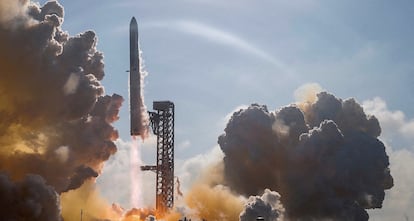
The company and the tycoon who made history by reusing a space rocket for the first time are now setting new milestones—this time of a financial nature—largely driven by market confidence that Musk and SpaceX’s next goals are not science fiction. Although they may seem so, since the establishment of technology centers on the Moon and a colony of one million people on Mars (who would, strictly speaking, be Martians) are elements that, in another era, would be closer to a science fiction novel than to an investment analysis.
Sign up for our weekly newsletter to get more English-language news coverage from EL PAÍS USA Edition









































