
Maye Musk, mother of the world’s richest man: ‘There’s nothing a Musk can’t do’
When she started modeling, she was told her career would be over at 18. Today, at 77, she’s still going strong and embodies a new standard of mature, real beauty. She’s also the mother of Elon Musk, the feared Silicon Valley mogul. To her, he’s just her son. ‘He’s very sweet, very good,’ she says
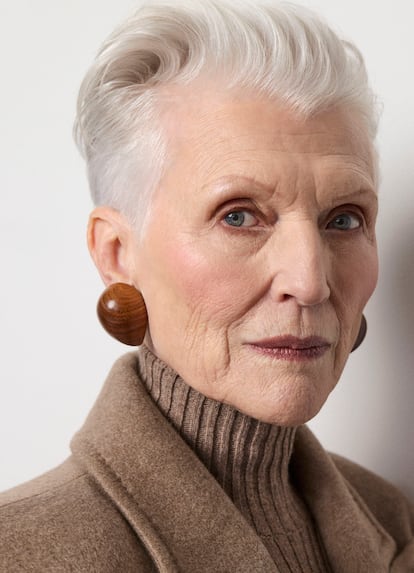

There isn’t a soul on the streets of Chelsea on a Sunday in summer. The residents of this New York neighborhood — once an industrial area in lower Manhattan, now transformed into a haven for bohemian bourgeois — have abandoned their luxurious lofts overlooking the High Line to retreat to their beach houses in the Hamptons. Maye Musk, 77, could be in Cape Cod, Palm Beach, or wherever she pleases. But the mother of Elon Musk, the world’s richest man, is about to enter the Wolf Building, an old printing house between 10th Avenue and the Hudson River, for a photoshoot with EL PAÍS.
She arrives 30 minutes early in a ride-share car, accompanied by her agent. “I like to be early to things. I call it the surprise factor. To succeed, you have to be ahead of schedule,” Musk says with a soft South African accent — a legacy of her childhood and youth in that country. She is dressed entirely in white: pants, shirt, and blazer matching her silver hair. She carries a bag embroidered with the phrase: “A woman makes a plan.” A nod to an African proverb: “A farmer makes a plan.” It’s also the title of her memoir, published in 2019. The book has sold nearly two million copies in over 100 countries and has been translated into 32 languages.
“Maye could be one of those Upper East Side ladies who don’t work, but she loves her job,” explains Italian hairdresser Gianluca Mandelli, who will style her for the shoot. Mandelli has worked with stars such as Lenny Kravitz and supermodel Karolina Kurkova, and has known Musk for six years. “She’s sensational, you’ll see. She’s not from this planet.”
At 5’8”, with striking white hair, an angular face, and piercing blue eyes, Maye Musk looks like an extraterrestrial who has accidentally landed in the streets of New York. When she was 15, a friend of her parents noticed her icy beauty and signed her with her modeling agency. “They told me my career would end when I turned 18,” she recalls. They were wrong. She has never stopped working. At 67, she walked for the first time at New York Fashion Week. At 69, cosmetic brand Covergirl signed her to be the face of the brand. At 74, she became the oldest model to feature in Sports Illustrated’s swimsuit issue. Today, at 77, she is still working. The day after this interview, she will rise early to catch a flight to Scotland for a clothing campaign alongside Eliza and Amelia Spencer, Lady Di’s nieces.

The secret to her current success with fashion brands and magazines is her look: a sophisticated yet relatable grandmother. She discovered it at 59, when she stopped dyeing her hair. It didn’t take long for gray hair to appear. Her agency didn’t call her for six months — until an art director spotted her walking down the street with her new look and hired her for a Time magazine special on longevity. Two years later, in 2011, she landed the cover of New York magazine, posing Demi Moore–style —nude and “pregnant” — for a feature on the boom of older women choosing motherhood. She doesn’t plan to dye her hair again. Nor does she intend to inject anything into her face. “I’m hired as a model because I haven’t done anything. I’ve never had Botox injections or cosmetic surgery. I’m afraid of needles,” she explains.
U.S. journalist Walter Isaacson describes her as a fearless woman in his 2023 biography of Elon Musk. Isaacson writes that Maye inherited her taste for danger from her father, Joshua Haldeman, an adventurous American chiropractor. The Haldemans emigrated from Canada to Pretoria, South Africa, in 1950, in the early days of apartheid. According to The Atlantic (2023), Maye’s father supported racial segregation. (Her agent has denied this accusation after the publication of this feature in the Spanish edition of EL PAÍS on September 28).
The model’s childhood was somewhat strange and lonely. “We were a pretty isolated family. I was a science nerd. I was very good at math and physics. I had some friends, but not many. While the other kids went on vacation to the beach, we went to the desert,” she recalls. Her father, an aviation and conspiracy theory enthusiast, was obsessed with finding the lost city of the Kalahari. Maye and her family accompanied him on eight trips aboard an old Bellanca plane without GPS or radio. Haldeman died on a flight in 1974.
Maye met Errol Musk in high school in Pretoria. He was a popular guy and a womanizer. “He was pretty mean, so I didn’t want to date him. But when you’re a nerd, you don’t get many dates. So we started dating.” After graduating, she enrolled in a nutrition course at university. In her third year, a classmate signed her up for a beauty pageant. She landed a contract with a Johannesburg modeling agency. She finished as a finalist in the Miss South Africa competition in 1969.
At 20, tired of Musk’s infidelities and jealousy, she broke off the relationship. She then moved to Cape Town to start working as a nutritionist. One day, he showed up unannounced with an engagement ring. “He swore that he was still in love with me and that he wouldn’t cheat on me again. I told him no, but he insisted I keep the ring. ‘If you don’t keep it, I’ll kill myself,’ he said.”
She kept the ring. Musk returned to Pretoria to speak with the Haldemans. He told them that Maye had agreed to marry him. “My father was fine with it, and they arranged everything together. I was thousands of miles away, alone, in a new city. I didn’t know anyone, I’d gained 30 kilos, and I was in a miserable state. So I said, ‘Getting married can’t be any worse than all of this.’”

It was much worse. On their honeymoon, Errol Musk started hitting her. “I was shocked when I saw that he had no remorse and that he wouldn’t stop hitting me whenever he wanted,” the model recounts in her memoirs. She returned from the trip pregnant with her first child, Elon. She didn’t tell her family about the domestic violence she was experiencing. She was ashamed to admit that she had made a mistake with Errol. “At that time, being a victim of domestic violence was taboo. People didn’t talk about it,” she says.
She was late in getting to the hospital to give birth to Elon because of her husband. They couldn’t give her an epidural, and she had to have a natural birth. It was difficult and painful because the baby weighed four kilos and had a large head. As soon as she became a mother, she stopped working as a model. “At that time, I wouldn’t have been able to take any work because I had bruises all over my body,” she recalls. At 23, she was trapped in a violent marriage. After Elon came Kimbal and Tosca.
Errol Musk had economic power and political influence. He threatened to ruin his wife’s face with a knife and shoot the children in the kneecaps if she dared to divorce him. He also hit her in front of the children. In her memoirs, the model recalls how Elon, when he was just five years old, would punch his father in the back of the knees to try to get him to stop. “I’ve talked to the kids about this. Fortunately, they don’t remember anything. They were two, three, and five years old.” She endured this for almost a decade, until one day she gathered the strength and filed for divorce. She didn’t demand money, only custody of her children. The process was long and terrifying. She still didn’t have the judge’s ruling in her hands when her husband showed up unannounced at her house and chased her down the street with a knife. After that, she filed for a restraining order.
— Why didn’t you change your last name after the divorce?
— My children were Musk. That’s why I kept it. And look, now I’m famous for that last name.
At 31, she moved to Durban, where she opened her nutrition practice and resumed her modeling career. She lived with her children in a tiny apartment. They were so poor that they ate sandwiches and had bean soup for dinner every day. Her ex-husband, on the other hand, had become very rich. He owned businesses and an emerald mine, two houses, a yacht, a plane, and five luxury cars.
“But I was happy. When I got divorced, I didn’t care about money because I no longer had a husband yelling at me all the time. It’s better to suffer financial hardship than to put up with a violent man,” she says. She never thought about marriage again: “Getting married is easy, but getting divorced is harder.” (An investigation published by The New York Times recently revealed that Errol Musk has been accused of sexually abusing five of his children and stepchildren since 1993, allegations he denies.)

According to Maye, her son Elon was always “insatiable.” At five months old, he was already eating cereal, pureed fruit, and vegetable purées. At one year old, he was eating the same food as her. Elon became a restless child, “with his nose always in a book.” He memorized books. At home, they called him “the walking encyclopedia” or “the genius,” but at school, he was bullied. “Two years after the divorce, he wanted to go live with his father because he had a computer and lots of books at home. I couldn’t do anything because I didn’t have the money to buy him a computer. So, at 10 years old, he went to live with my ex-husband. That’s Elon...”
At 12, Elon Musk started his first business venture. He created a computer program, a game called Blastar, and sold it to PC Magazine for around $500. Maye moved to Johannesburg to be near him. She began earning money as a nutritionist and giving talks and lectures on healthy eating. Elon was determined to move to Canada because he was convinced North America was the perfect place to pursue his passion for computing. He begged her on his knees to move. The model agreed, and the whole family ended up settling in Toronto.
In her native Canada, Maye became something of a nutrition guru. She was appointed president of the Consulting Dietitians of Ontario and then of the Consulting Dietitians of Canada. She gave her $10,000 savings to Elon and his brother Kimbal to cover the costs of their first software company, Zip2, founded in 1995. “I had a Canadian credit card, and they didn’t. So I would visit them every six weeks. I bought their groceries, paid their rent and for their printing… They worked and slept in the same place, it was disgusting. They won’t admit it, but it was tough,” she says.
Zip2 was the genesis of Elon Musk’s fortune. In 1999, he sold it to Compaq for $307 million. That same year, he co-founded the online bank X.com, which later merged with Confinity and became PayPal, a company that was sold in 2002 for $1.5 billion. That year, he founded the aerospace company SpaceX, and in 2003, he joined the electric vehicle manufacturer Tesla. As CEO of Tesla and SpaceX, he has become the richest man in the world. According to Forbes, he is worth nearly $500 billion. A few weeks ago, Larry Ellison, the co-founder of Oracle, surpassed him for a few hours, but at the end of the day, Musk had reclaimed the top spot. The tycoon’s entire life is shrouded in mystery, from his two-bedroom prefabricated house in Boca Chica, Texas, near the SpaceX base, to the number of children he has — some media outlets claim it’s 14.
— What is Elon like in person?
— He’s very sweet, very good. He loves being with his children. My three children are sweeter than I am. I once accompanied Elon to an event in Paris. He was giving a talk, and there was a dinner afterward. He didn’t have a chance to eat all evening because people kept coming up to him and telling him their stories. He listened patiently. He listened to at least 100 people. He doesn’t say “no” to anyone. Afterward, we went to get something to eat because we were starving.
— How does it feel to be known as the mother of the richest man in the world?
— I’m very proud of him. But I’m the mother of Elon, Kimbal, and Tosca. I have three children. What Elon is doing is out of this world. It’s literally out of this world. My three children are extraordinary.

Elon builds electric cars and launches rockets. Kimbal studied business and owns a restaurant chain that serves only organic and locally sourced products. Tosca trained in film and runs an entertainment company, producing films based on bestsellers. In this family, there seems to be no room for failure. “I believe there is room for failure. I fail every time I don’t get a modeling job. We all have difficult moments,” Maye notes.
It’s hard for a mother to speak ill of her child. The model still refers to her firstborn as “the genius.” “I’m not as smart as Elon. No one is,” she says. She sees him as a misunderstood messiah: “Whenever he has an idea, people say, ‘How ridiculous.’ When he created Zip2, people said, ‘How ridiculous.’ When he invented what is now PayPal, they said, ‘How ridiculous.’ When he said electric cars were going to be the future, people said, ‘How ridiculous.’ Now that he makes rockets and wants to go into space, they say the same thing.”
This summer, a Gallup poll identified Elon Musk as the least popular public figure in the United States. Sixty-one percent of respondents had an unfavorable opinion of the entrepreneur, while 33% had a favorable opinion. Musk has become the paradigm of the new Silicon Valley techno-caste, a class of super-rich people who have veered to the far right and are more obsessed with immortality or conquering Mars than with helping to solve humanity’s everyday problems.
In 2022, Maye’s son acquired the social network Twitter (now X) for $44 billion. One of the first steps he took was to remove filters against fake news. Now the network is a major source of misinformation. Hate speech on the platform has increased by 50% since Musk took over, according to a recent study by the University of California. This summer, an update to Grok, X’s chatbot, caused a controversy after posting antisemitic comments in response to user questions. “I love using Grok; I use it every day. It’s very useful and, honestly, a lot of fun,” says the model. “As for fake news, it’s everywhere these days. People can say what they want and make things up, but if you try to spread lies on X, the crowd will call you out on it and provide evidence from different sources,” she adds.
She supports her eldest son in all his ventures. In her interviews, she always defends him. Last year, she appeared on the set of the conservative network Fox News several times to discuss the friendship between Elon Musk and Donald Trump. She confessed to being a repentant Democrat and said that she had stopped watching CNN; she praised Trump and defended his cuts to the public service, and predicted a long-term alliance between her son and the U.S. president. Now that their “friendship” has ended, she prefers not to comment on politics. “Politics is disgusting. You can’t trust anyone,” is all she says. Her son has announced that he will found his own political party.

The Musks are scattered across North America: Maye, who has lived in nine cities and on three different continents, has a home in New York; Kimbal resides in Colorado; Tosca in Atlanta; and Elon, between Texas and Silicon Valley. Once a year, they all take a trip together. One year, they reunited on Spain’s Costa Brava. “I’m available for my children when they need me. I have 17 grandchildren, and I try to be useful. That’s a lot of grandchildren, but not all of them ask to see me,” explains the model. From time to time, she spends three or four days with Elon. “We meet at his offices, and I go with him to some of his meetings. I leave at 11 p.m. for my hotel, and he continues working. I think he works every day until 2 a.m.,” she says. At 77, she also shows signs of being a workaholic. She is writing a new book, which she plans to publish in 2026, and has no plans to retire from modeling.
The photoshoot ends at dusk. Maye Musk has to leave. She grabs some food from the caterer before leaving. “For dinner. Since I’m leaving early tomorrow, I have an empty fridge,” she explains. Her son is a multibillionaire, but she doesn’t mind having to get up early for work at 77. “My father always told us, ‘There’s nothing a Haldeman can’t do.’ I’ve always believed that and passed it on to my children. Now there’s nothing a Musk can’t do.”
CREDITS
Sign up for our weekly newsletter to get more English-language news coverage from EL PAÍS USA Edition









































