
A divided Federal Reserve cuts interest rates by 0.25 points amid fears of a deteriorating labor market
The Fed expects to continue cutting rates in January amid pressure from the White House
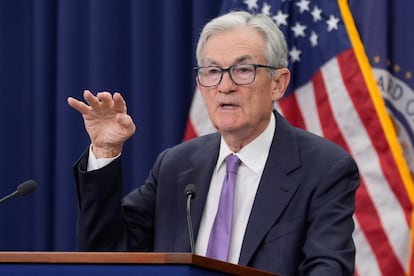

In a tense and unusually divided meeting, the U.S. Federal Reserve decided to cut interest rates by 0.25 percentage points to a range of 3.5% to 3.75%. This is the third consecutive rate cut since September, as concerns about a deteriorating labor market outweigh fears of rising inflation. The final meeting of the year also yielded new economic forecasts and offered some clues about the Fed’s roadmap for 2026.
Federal Reserve Chairman Jerome Powell has had to work hard to calm the waters and reach a consensus that would allow for further rate cuts and minimize disagreements. Nearly half of the Fed’s board members preferred a pause before the meeting began, and at least one other, Stephen Miran, Trump’s Trojan horse, advocated for a steeper rate cut.
The Fed is going through a turbulent period. On the one hand, its independence is under attack from U.S. President Donald Trump, who is harassing Powell, accusing him of being too slow to cut interest rates. Trump has insulted the Fed chairman and called for his resignation. He has also placed a couple of his allies within the central bank to force deeper rate cuts. The Republican’s move has exacerbated the lack of consensus and internal divisions within the Federal Reserve.
On the other hand, the institution faces a difficult dilemma. It must decide between two opposing forces: persistent inflation that refuses to fall to the 2% target and a labor market showing signs of weakness.
Trump’s aggressive tariff policy does little to illuminate an economy that, despite everything, is growing at a healthy pace, but which still raises some questions. Economists are beginning to talk about K-shaped growth, suggesting that the dazzling investments in artificial intelligence by the technology sector, along with the booming markets and record-breaking stock exchanges, may be masking another, troubled side of the economy.
Inflation, moreover, shows no signs of easing, with growing pressure on energy and utility prices. The latest official figure showed a slight increase to 3%, a trend that moves it further away from the Fed’s desired 2% target.
Amid this situation, the Trump administration is rushing to name a replacement for Powell, whose term ends in May 2026. The president says he already has a shortlist of candidates, including Kevin Hassett, director of the White House National Economic Council, and Kevin Warsh, former governor of the Federal Reserve.
“We’re going to be looking at a couple different people, but I have a pretty good idea of who I want,” Trump said Tuesday night aboard Air Force One, where he often chats informally with reporters. Investors are eyeing Hassett, the favorite in analysts’ betting odds, according to Polymarket, which gives him a 70% chance.
When reporters asked Trump last week if Hassett would be the chosen successor, and he offered a complacent smile, the markets reacted with distrust. They fear that the frontrunner might be too accommodating to the Republican and prioritize the president’s short-term desires over the real needs of the economy; they believe he could support a sharp interest rate cut and damage the Treasury and fixed-income markets. To try to allay these concerns, Hassett asserted Tuesday that he would not be pressured by anyone. The market reaction and Trump’s hesitation have reopened the question of Powell’s successor, just when it seemed that everything had been decided.
The Federal Open Market Committee (FOMC), the grandiose name of the body that decides on the direction of monetary policy, has acted almost blindly. It cut interest rates with less data than usual to conduct a rigorous analysis due to the government shutdown, which for 42 days — the longest in history — paralyzed hundreds of public agencies across the country between October and November. The federal shutdown prevented data collection and delayed the publication of essential statistics for gauging inflation and the state of the labor market. The federal agencies responsible for these statistics will publish the final batch next week with incomplete data due to the shutdown.
The Fed is deepening its interest rate cuts, even though just a few weeks ago it seemed it might pause at this December meeting. At that time, Powell used an analogy to suggest he might pause the rate cuts: “What do you do if you’re driving in the fog? You slow down.” But in just two weeks, the feeling has changed.
The affordability crisis, or the cost of living crisis, has permeated American politics. And the labor market is showing symptoms consistent with the flu. The unemployment rate rose in September to 4.4%, a historically low level but a trend reversal that worries monetary policymakers. And although job creation that month was positive, with 119,000 new jobs, it was the lowest for a September since the pandemic.
Sign up for our weekly newsletter to get more English-language news coverage from EL PAÍS USA Edition









































