
Fed prepares for another rate cut amid growing pressure from Trump
The market is pricing in a quarter-point cut as the debate intensifies over Jerome Powell’s successor at an institution that is more divided than ever
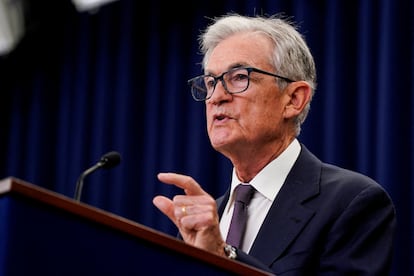

When Wall Street is talking more about Jerome Powell’s successor at the head of the Federal Reserve than about the central bank’s actions at its meeting this Wednesday, it’s a sign of an anomaly in the market. The White House makes no secret of its desire to replace Powell — who has been insulted, harassed, and denigrated by Trump — with a loyal, compliant, and docile man like Kevin Hassett, the top White House economic adviser.
Meanwhile, the Fed is experiencing its biggest internal division in decades as Trump and his team increase pressure for another interest rate cut. Questions are emerging about the independence of an organization where the Republican leader has already placed some pawns and is threatening a full takeover.
Last summer, the billionaire president appointed his chief economist, 42-year-old Stephen Miran, to the Fed board. In the two meetings held since September by the Fed’s Federal Open Market Committee (FOMC), the body that decides on interest rates, Miran voted for more aggressive cuts of half a percentage point.
At the other end of the spectrum is the president of the Kansas City Fed, Jeff Schmid, who has opposed further rate cuts because he believes they could contribute to entrenching higher inflation instead of supporting the labor market.
Other members are aligning themselves with these “hawks” and “doves,” creating the biggest division in the U.S. central bank’s recent history. Powell’s task of seeking a consensus is not an easy one. As many as five of the 12 voting members have publicly stated that they do not see sufficient grounds for cutting rates. Fed officials have been unusually divided on which decision will be least harmful to the economy.
Trump wants cheaper loans to stimulate the economy ahead of next year’s midterm elections, where polls are predicting a Democratic victory. Lower interest rates also mean cheaper mortgages, which benefits the housing market and helps alleviate the cost-of-living crisis that has dominated public debate in the United States for weeks.
Therefore, despite a certain consensus among analysts a month ago that the Fed would take a breather in December, investor sentiment now indicates that there is almost a 90% chance that the Fed will cut rates again at Wednesday’s meeting, according to the CME Group’s FedWatch indicator.
So one of the key points of interest this Wednesday will be seeing what visibility the Federal Reserve offers regarding its next moves. Observers will be paying close attention to the tone of Powell’s remarks and the new projections to try to interpret whether there will be further rate cuts. Analysts expect at least two more cuts next year.
The market is already pricing in the third consecutive rate cut since September, which would leave the price of money in a range of between 3.5% and 3.75%, even though the Fed’s two objectives, price stability and job creation, are subject to opposing forces.
“The labor market is showing slower job growth, but this slowdown is not due to lower demand for labor, but rather to lower labor supply due to immigration restrictions,” says Torsten Slock, chief economist at Apollo, who believes the Fed “should not cut interest rates this week.”
The minutes from the Fed’s October meeting revealed a deep internal division, but also suggested a pause due to a lack of clarity regarding the immediate future of the U.S. economy. Economists explained that the 42-day federal government shutdown between October and November, the longest in history, had hampered data collection and, therefore, made it more difficult to predict which of two forces would weigh more heavily in a decision: rising inflation or the deteriorating labor market.
“A widely expected 25-basis-point interest rate cut will not have a significant impact on the markets,” reflects Andrew Hollenhorst, chief economist at Citi. “Divisions within the committee are likely to emerge, with at least one vote against the cut.”
What has happened in the past two weeks to make analysts go from practically ruling out a rate cut to now considering it a given? Two things: increased concern about the state of the labor market, and increased pressure from the White House.
The last official Consumer Price Index (CPI) data was released a month and a half ago and reflects data from September, when prices rose by up to 3%, raising concerns about persistent inflation. The government shutdown has delayed the release of new data, which is expected next week. Trump has approved several measures amid growing concerns about the rising cost of living, an issue that is hurting his approval ratings. He has also reduced tariffs on a wide range of products in the average American household’s shopping basket, such as coffee, beef, fruits and vegetables, which is easing the pressure on prices.
On the other hand, the latest official job creation figures reveal that there were 119,000 more workers in September than the previous month. This is good news, but with some caveats, as it is the worst September since the Covid pandemic. Furthermore, the unemployment rate rose to 4.4%. And although it remains at historically low levels, its upward trend is beginning to cause concern, along with the increase in layoff data compiled by Challenger.
“This meeting is shaping up to be a very close call within a deeply divided Federal Reserve,” notes Michael Krautzberger, CIO of Public Markets at Allianz Global Investors. “Limited visibility on the economic outlook and a more resilient economy than anticipated have reinforced their caution.”
In a recent article about the Fed, Deborah Cunningham, chief analyst at Federated Hermes, wrote that “investors listen to comments by all Federal Reserve policy leaders, but their ears prick up for only a few.” One of these few, she says, is the New York Fed president, who is “a permanent voter and traditionally an influential figure. So, when its current head, the veteran John Williams, said he essentially would be in favor of a rate cut at December’s policy-setting meeting, investors took notice.”
Sign up for our weekly newsletter to get more English-language news coverage from EL PAÍS USA Edition









































