
‘Only America was rich enough to satisfy my hypertrophied self’: Florida exhibition explores how Salvador Dalí transformed US culture
As part of America’s 250th anniversary celebrations, the Dalí Museum in St. Petersburg brings together a collection covering the artist’s life and work in New York and California
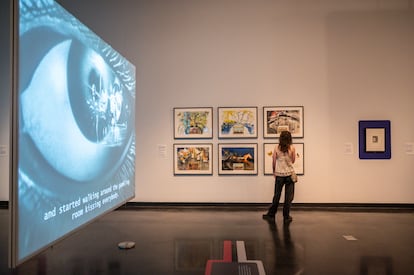

Since he first docked in New York in 1934, Salvador Dalí was more than just a painter in the United States. Here he designed stained glass, staged the surrealist party of the decade, worked in Hollywood without making it to the big screen, designed jewelry, wrote his memoirs and became a late-night show celebrity.
“Dalí transformed the United States simply by being part of its culture,” says curator Peter Tush, who assembled a collection that tells the story of four decades of the Catalan artist’s life and work in the United States for the exhibition Dalí in America, on view at the Dalí Museum in St. Petersburg, Florida, through October.
“He brought a mix of lightness and vision the United States had never seen. Over time, he offered a new model of what an artist could be: entertaining, witty, utterly eccentric,” Tush says in a video call interview with EL PAÍS. The paintings, videos, photographs and objects gathered in this show chronicle Dalí’s first four trips to the United States between 1934 and 1939, and the eight years he lived as a refugee in Pebble Beach, California. They also cover his work in the 1940s film industry, his frustrated collaborations with Walt Disney and Alfred Hitchcock, and how Hollywood reshaped his work despite his lack of success in cinema.
The centerpiece is the museum’s painting titled The Discovery of America, in which Dalí places himself as a friar accompanying Christopher Columbus, an explorer discovering a new world surrounded by references to his own homeland: the Spanish mystic Saint John of the Cross, Saint Narcissus and the miracle of the flies of Girona, in Catalonia. “It’s a painting that also celebrates the idea of Dalí’s transformation, because the American experience made him who he is. With that painting he found a way to bring together these three parts of his identity: Spanish, Catalan and also American,” Tush notes. The exhibition then traces the mutual fascination between Salvador Dalí and the big screen.
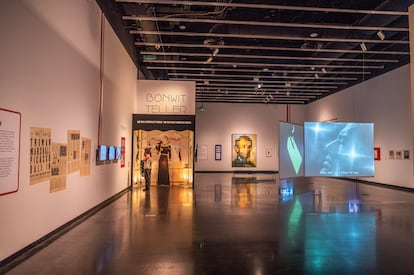
“I am in Hollywood, where I have come into contact with the three American surrealists: Harpo Marx, Walt Disney and Cecil B. DeMille. I believe I have intoxicated them enough and I hope the possibilities of surrealism will come to pass,” Dalí wrote in a letter to André Breton, the French founder and principal theorist of surrealism. “Dalí was always fascinated by the idea of Hollywood. His aim was not only to connect with those figures but to create something grand with that kind of dream machine. His great tragedy was that he was unprepared for the enormous bureaucratic difficulty of bringing a vision to the screen,” the curator says.
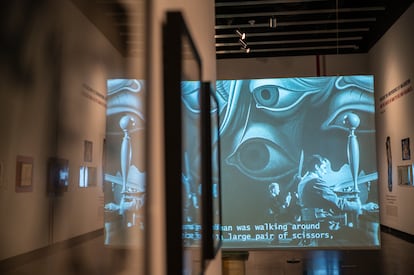
At the time, the painter’s visions for the big screen ended in frustration. In 1945 Dalí was hired by Alfred Hitchcock to create a dream sequence for the film Spellbound, a thriller starring Ingrid Bergman and Gregory Peck in which a murder takes place and two psychoanalysts use Freudian dream analysis to solve the crime. But only two minutes of a twenty-minute sequence he had animated—featuring hanging eyes and melting clocks—were used.
The same happened later with Walt Disney, who in 1946 invited him to work on a short meant to follow Fantasia that would tell the tragic love story of Chronos, the god of time, and a mortal woman named Dahlia. For eight months Dalí worked eight to five at the Burbank studios, but the final product never saw the light of day. Despite these failures, Tush believes Dalí’s entire approach to being an artist was forged there: “The idea of celebrity, the idea of using imagination to create something, a spectacle that went beyond what we’d imagined. Even the way he approached his paintings seems largely built on a model Hollywood provided him.”
In 1941, when the artist was living at the Del Monte Hotel in Pebble Beach and just beginning to pursue his cinematic ambitions, he and his partner Gala persuaded the hotel owner to host a fundraiser for artists who had taken refuge in the United States to escape the war. They called it “A surreal night in the enchanted forest,” and everything about it was extravagant.
Dalí’s request list included a baby giraffe, three goats, nearly five pounds of newsprint, a crashed car and 2,000 pine trees. The San Diego Zoo sent more than 20 species of animals, from monkeys roaming the salon to lions. About 1,000 people attended, some flying in from New York—figures such as Gloria Vanderbilt, Clark Gable and Bob Hope—a mix of high society and entertainment elite. But the event cost so much it raised not a cent. “Everything was enormous, excessive. But everyone was willing to make it happen. Whatever Dalí wanted, he got,” Tush concludes.
The museum exhibition includes videos of Dalí’s appearances on American talk shows: What’s My Line in January 1957; The Ed Sullivan Show in January 1961; and The Dick Cavett Show in February 1973. It also briefly walks through photographs from the period when Dalí and Gala were invited by a patron to a Virginia plantation, where he wrote the autofiction The Secret Life of Salvador Dalí, and rubbed elbows with writers Anaïs Nin and Henry Miller and one of Coco Chanel’s jewelers. Later, in Confessions Unconfessed, the painter wrote about his time in the United States: “Only America was rich enough to satisfy my hypertrophied self and support my whims.”
Sign up for our weekly newsletter to get more English-language news coverage from EL PAÍS USA Edition









































