
From Cajal to Dalí and Lorca: The drawings that revealed the substance of the human mind and inspired Surrealism
A new documentary explores how the Nobel-winning scientist who discovered neurons in 1888 had a decisive impact on giant figures of the arts

In 1888, a former shoemaker’s apprentice, forced by his father to study medicine, peered into a tiny world that very few had contemplated and in which no one had seen what he saw. Santiago Ramón y Cajal, armed with a microscope and chicken cerebellums, discovered that the nervous system — the substance of thought — was composed of independent cells that communicated with each other through “kisses.”
The 35-year-old researcher was then able to apply what had been his true childhood passion: painting. He drew those astonishing forests of neurons with intricate and stylized strokes, and ended up winning the Nobel Prize in Medicine in 1906. A new documentary now reminds us that the scientist did something more. “Consciously or not, Cajal is a cornerstone of our surrealism,” proclaims the art historian Jaime Brihuega in the film, which joins a wave of projects undertaken to mark the Year of Cajal, declared by the Spanish government to honor the Nobel laureate.
The scientist’s life is unbelievable, as he himself recounted in his memoirs. He was born in 1852 in Petilla de Aragón, a “sad and humble village” in northeastern Spain, into a family of farmers. From childhood, Cajal would pick up a pencil as if it were a “magic wand,” and secretly draw other worlds with Greek heroes, apocalyptic landscapes, and wars with catapults. His father, who had learned the trade of barber-surgeon, abhorred this passion for drawing, which he considered the domain of layabouts. After constant beatings from his father, Cajal ended up studying medicine in Zaragoza, and later as a professor in Barcelona, he discovered the individuality of brain cells, the “butterflies of the soul.” The documentary Ramón y Cajal: Dibujos en la retina (Drawings on the Retina), which premieres in Spanish theaters on April 9, follows the Nobel laureate’s footsteps in Spain and attempts to answer the question: How are images formed in the brain?
It is difficult to overstate Cajal’s impact on science. “Historians place him alongside Darwin and Pasteur as one of the greatest biologists of the 19th century, and among Copernicus, Galileo and Newton as one of the greatest scientists of all time,” states one of his biographers, the American writer Benjamin Ehrlich, in The Brain in Search of Itself: Santiago Ramón y Cajal and the Story of the Neuron. The new documentary highlights that Cajal traveled to Sweden to accept the Nobel Prize in December 1906. Upon his return in January 1907, he immediately took charge of a new institution, the Junta de Ampliación de Estudios (Board for the Extension of Studies), created to promote scientific research in Spain. One of his first initiatives was the construction of the Residencia de Estudiantes (Student Residence) in Madrid, where it became a magnet for intellectual life. It was there, between 1922 and 1925, that the poet Federico García Lorca and the painter Salvador Dalí first met.
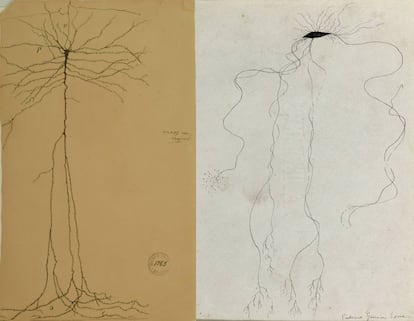
Jaime Brihuega, professor emeritus of art history at the Complutense University of Madrid, highlights the “sensational triangle” formed by Cajal, Lorca, and Dalí, “because from there arose nothing less than the birth of Spanish Surrealism.” The documentary, directed by Luis Gómez Juanes, juxtaposes two seemingly related drawings: one of a human neuron painted by Cajal in 1899 and another one that appears to be by the same artist but was executed by Lorca in 1927, at the dawn of Surrealism. “Both Dalí and Lorca began to use a series of root-like elements in their drawings. They saw all of this in Cajal’s drawings,” Brihuega explains.
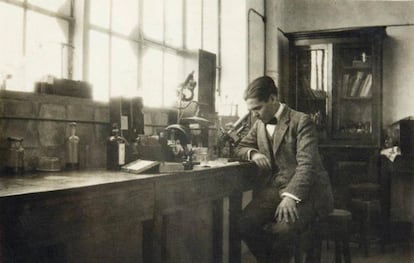
At the Residencia de Estudiantes, art and science coexisted side by side. Pío del Río Hortega, a disciple of Cajal, had his laboratory there. Together they discovered three of the four fundamental types of brain cells. While Cajal first described neurons in 1888, and the Hungarian anatomist Mihály Lenhossék coined the word astrocyte in 1895 to refer to other star-shaped cells that acted as support, around 1919 Del Río Hortega identified microglia, which are responsible for clearing waste products from the nervous system, and also oligodendrocytes, a kind of insulating layer for the neurons’ “wires.” An anonymous photograph, taken around 1923, shows Lorca in Pío del Río Hortega’s laboratory, looking through a microscope. “He who, after being overwhelmed with emotion at the sight of a perfect microscopic picture, does not seek out someone with a similar sensitivity to show it to, is not a true histologist,” wrote Del Río Hortega.
Cajal, half a century older, was not a friend of either the painter or the poet, but his influence was pervasive. Another resident of the Residencia was the future filmmaker Luis Buñuel, who was then studying natural sciences and had dissected fly corneas for the scientist. As Benjamin Ehrlich recalls in his biography of the Nobel laureate, in 1929 Buñuel and Dalí presented their short film Un Chien Andalou, an icon of Surrealism that opens with a scene in which a man mutilates a woman’s eye with a razor blade. “One of the most indelible images in the history of cinema evokes the dissection of a fly’s cornea in Cajal’s laboratory,” in Ehrlich’s words.
The Nobel laureate, in fact, detested what those young artists were doing, and spoke of “Picasso’s deliberate idiocies.” In his book El mundo visto a los 80 años (The World Seen at the Age of 80), published in 1934, Cajal dedicates an entire chapter to the “degeneration” of the arts. “During these last twenty-five years, we have been invaded by barbarians, almost all of them born in France, Germany, Holland and Scandinavia. Disregarding the lessons accumulated over 2,000 years of experimentation and progress, they have tried to debase our museums and exhibitions with the most absurd and insincere monstrosities,” the scientist lamented. In his opinion, those works, executed in a “schematic and puerile” manner, were “grotesque caricatures.”
Brihuega reflects on this paradox in the documentary. “Cajal vehemently rejected it, but the idea of neurons as the foundation where everything that Surrealism wanted to resurrect is hidden, becomes fundamental. And that hidden world, those backrooms of consciousness, are what Surrealism wanted to open and bring to light,” he argues. A French poet, Louis Aragon, gave a talk on April 18, 1925, at the Residencia de Estudiantes, where he presented the Surrealist movement, which had already been promoting the irrational and the dreamlike in France for a year.
A 2015 exhibition at the University of Zaragoza, curated by Brihuega himself, already highlighted the visual links between Cajal’s drawings and the works of Lorca and Dalí. The latter published a text in 1927 demonstrating his knowledge of the microscope: “I brought my eye close to the lens [...]. Each drop of water, a number. Each drop of blood, a geometry.” His drawings Decapitation of the Innocents and The Donkey with Numbers resemble structures of the nervous system. And an oil painting by Dalí at the age of 24, Inaugural Gooseflesh (1928), includes a human body with its nerves exposed, with letters like those Cajal used in his own neurological drawings. The poet Lorca christened the style “physiological aesthetics.”
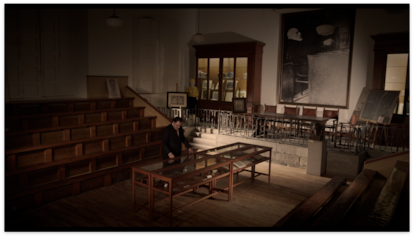
The Year of Cajal, which ended on May 31, 2025, was to culminate with the opening of “a museum dedicated to the workings of the brain,” as announced by Prime Minister Pedro Sánchez in October 2022. The Ministry of Science proposed locating it in the former School of Medicine in Madrid, a building dating from 1834, where Cajal conceived his magnum opus: Texture of the Nervous System of Man and the Vertebrates, considered the Don Quixote of science. Almost a year after the end of the Year of Cajal, the drawings that illuminated the human brain and inspired Spanish Surrealism await the promised museum to become a reality.
Sign up for our weekly newsletter to get more English-language news coverage from EL PAÍS USA Edition









































