Feds raise to 37,000 the number of alleged noncitizen voters in California, while the accused deny the charges
The Los Angeles County elections office determined, after reviewing a sample, that at least 40% are US citizens. Suspicions that the federal administration’s actions are politically motivated have intensified

With midterm elections right around the corner, prosecutors from the Donald Trump administration are pulling out all the stops in California. In a new court filing they say they suspect another 17,000 registered voters in the state are not U.S. citizens. That figure is in addition to more than 20,000 people they said they had identified days earlier.
The response from the L.A. County’s top election official was blunt: it is impossible to verify those records before the election. Moreover, a preliminary review of a subset of those voters found evidence that nearly 40% were born in the United States.
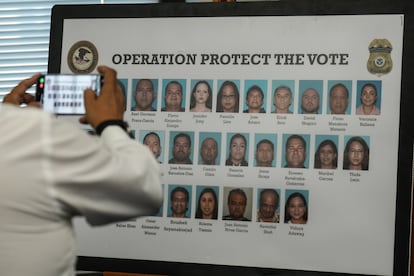
Suspicions that the federal administration’s actions are politically motivated have intensified after statements from some of the 28 immigrants who are lawful permanent residents but were charged on Monday with having improperly registered in California’s voter rolls and even with voting in multiple elections.
While a 72-year-old man says he was detained during a law enforcement operation he considers excessive, other defendants claim to be victims of identity theft and fear that may be what dragged them into the legal trouble they now face.
The sworn affidavit that has added fuel to the debate was submitted to a federal court in Los Angeles by Nicolas Bartell, an official at the Department of Homeland Security (DHS). In it he says his agency has identified a “separate batch of more than 17,000 voting records potentially tied to noncitizens.” The figure raises to more than 37,000 the number of voter records under scrutiny in California, although initial estimates had been much higher.
The response was swift. On Tuesday, Mónica Flores, an official in the L.A. County Registrar-Recorder/County Clerk’s office, said in an affidavit that the agency reviewed a sample of 200 registrations. In cases where the place of birth was “meaningfully reported, 38.9% indicate that they were born in the United States, which is strong evidence of citizenship,” she stressed.
Flores warned that verifying thousands of records would be “administratively impossible” and would divert key staff from their essential election duties.
The figures released have failed to intimidate California officials. In July, Secretary of Homeland Security Markwayne Mullin warned in a letter that there could be up to 190,832 noncitizens registered to vote in the state. Now that there are far fewer suspects, no one hides their skepticism. “What happened to the 170,000? You just got those wrong?” asked the state attorney general, Rob Bonta, at a press conference.
“It’s not about me”
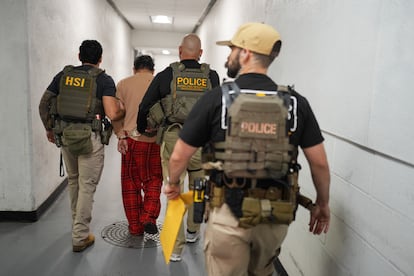
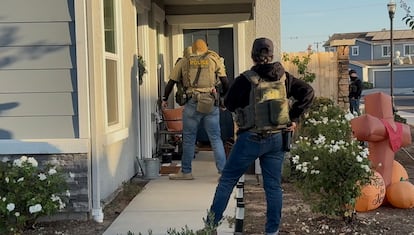
Omar Alexander Muñoz, a 72-year-old Belizean, became the best-known face of the so-called Operation Protect the Vote. On Monday, a large group of federal agents arrived at his home in the city of Commerce, a predominantly Hispanic suburb about seven miles from downtown Los Angeles. Journalists followed the agents and documented how Muñoz, despite his age and condition, was handcuffed and taken out of his home in his pajamas. “They said, ‘Open the door or we’ll break it down, and you’ll be sorry,’” Muñoz told ABC7. “I told them, ‘I’ve had six surgeries, I’m at risk of falling.’ But they didn’t care,” he recounted.
Muñoz, who legally emigrated to the U.S. in 1975, considers the operation mounted to arrest him disproportionate. He says he saw helicopters flying over his neighborhood and at least eight vehicles full of police that surrounded his house and cordoned off the whole block. He thought he was in a movie.
“I think one vehicle would have been enough to arrest me, instead of so many people. Later, when I heard the news, I said to myself: this is not about me. It’s a fight between Trump and the Democrats,” he told the same outlet. He also said he was given little food during the 10 hours he spent in a small cell.
OPERATION PROTECT THE VOTE
— U.S. Department of Justice (@TheJusticeDept) October 20, 2026
28 foreign nationals were charged in criminal complaints with federal crimes, including that they fraudulently registered to vote in U.S. elections, electoral contests in which most of them cast illegal and fraudulently obtained ballots.
This was a… pic.twitter.com/JeW3yMG6yd
Prosecutors allege Muñoz registered fraudulently to vote in September 2019 by claiming he was a U.S. citizen. According to the indictment, he then voted in the 2020 election, voted twice in the 2022 elections and again in November 2024. He is also accused of lying under oath on his naturalization application by falsely stating he had never claimed to be a U.S. citizen.
However, his family fears authorities may have confused him with a relative who shares his name, was born in the United States and appears on the voter rolls. Lliani Orantes, Muñoz’s daughter, complained to the Los Angeles Times that her father was taken from his home “like a dog.”
Muñoz and three other defendants appeared Monday before a federal court in Los Angeles. The four were released after prosecutors said they would not seek to keep them detained while the cases proceed. The next hearing is scheduled for November 9, six days after the midterms. Prosecutors warn that if the 28 defendants are convicted, they could face up to one year in prison, an additional year of supervised release and a $100,000 fine.
It is an amount Muñoz could hardly pay. In April 2020, he and his wife, Esmeralda, filed for bankruptcy. At that time they had accumulated debts of more than $61,000, including bank loans and car financing, according to documents they filed in federal court in Los Angeles. By contrast, the couple had only $300 combined in two bank accounts and another $50 in cash.
Agents say they compared signatures
EL PAÍS reviewed documents related to seven of the 28 indictments for alleged electoral fraud. In those files, agents from the Federal Bureau of Investigation (FBI) and Homeland Security Investigations (HSI) describe how, under court orders, they obtained documents from the defendants provided by the elections offices and the California Department of Motor Vehicles (DMV). With that information, they cross-checked personal data and photographs, and compared signatures.
One of the defendants, Maricela Nazarín González, a Mexican immigrant with permanent resident status who lives in California’s Central Valley, said in an interview with immigration agents in September 2025 as part of her naturalization process that she had received a document to register to vote, but denied having filled it out.
“She also stated that her personal documents were stolen in 2011, that she did not report the theft, and that her Social Security card and her matrícula consular (an identification issued by the Mexican government) were in the purse that was stolen,” reads an affidavit prepared by Britton Wallace, an FBI agent who took the case in early September.
Nazarín González is accused of having registered to vote in 2020 and of having participated in four elections between 2022 and 2024. Prosecutors say she even changed her address on the rolls. According to the FBI, her most recent vote was for president and for seats in the Senate and House of Representatives.
“I can barely walk or speak”
Another defendant, Kamlesh Shah, 68, an immigrant from India, believes he ended up embroiled in this mess through a mix-up. Interested in voting for Democratic presidential candidate Kamala Harris, Shah, a permanent resident, went to a polling place in Sacramento County in November 2024, showed his ID, a poll worker cleared him to vote and gave him a ballot on which he voted for Harris and candidates for vice president, the Senate and the House of Representatives. “I can barely walk or speak,” Shah told the Sacramento Bee. “Now I have to face these charges.”
Ana Domínguez, a 60-year-old Salvadoran who lives in Los Angeles, says she does not know how her name ended up on the voter roll. She was arrested on Monday morning at her home as she was about to leave for work. Domínguez works as an administrative assistant and obtained permanent residency in the late 1980s. This year she began her naturalization process. The Trump administration asserts she registered in July 2006.
“If I had committed all these frauds related to registering to vote and whatever else they’re saying, since 2006, do you think I would have voted in all these years?” she told the Los Angeles Times.
In an affidavit, Alfredo Rossi, an agent with Homeland Security Investigations, says Domínguez’s signature on the voter registration matches the one in her immigration file and on her driver’s license.
In mid-September, federal officers called Domínguez “and explained they were trying to find out if she had voted in previous elections,” Rossi detailed. The woman agreed to meet them at her Long Beach home to answer questions. Investigators arrived at the agreed time, but, according to the report, she was not at home.
Sign up for our weekly newsletter to get more English-language news coverage from EL PAÍS USA Edition