A windowless ground-floor unit for $4,750: the AI boom pushes San Francisco rents skyward
As six-figure-salary engineers arrive to work in Silicon Valley, Latino families and workers are forced to leave. The mayor has declared a ‘rent emergency’
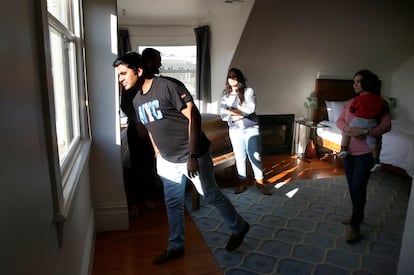
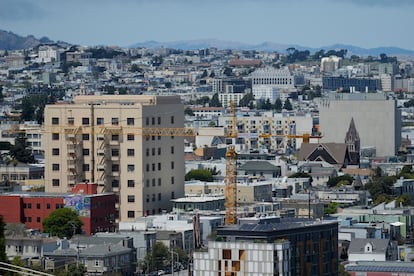
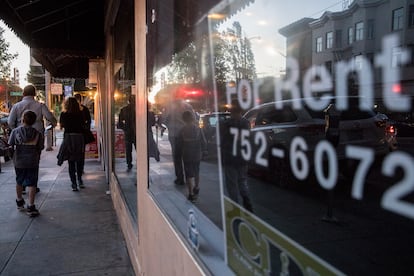
In the heart of the historic working-class and Latino Mission district in San Francisco, the door of a ground-floor unit next to a trendy coffee shop keeps opening. A private shuttle that ferries tech workers to their Silicon Valley headquarters farther south passes by every morning. The 796 sq.ft. (74-square-meter) apartment, recently renovated and furnished, is thoughtfully laid out, from the small open kitchen to the built-in closets. But it gets very little light. Of its two bedrooms, one has no windows. And it costs $4,750 a month.
Still, the line is endless. Visitors stream through without pause, mostly young engineers fresh out of California universities, many of Asian descent. Each tries to win over the landlord in their own way, boasting of a high credit score. Many end up staring at their phones, filling out on the spot the long online form the owner requires.
Scenes like this one are repeated every weekend. Some applicants offer more than the listing price to secure the unit. The mayor, Democrat Daniel Lurie, declared a ‘rent emergency’ on September 10. He chose Alamo Square—the park framed by the postcard Victorian houses—as the backdrop, an area that has become one of the least affordable neighborhoods in the city.
Behind these scenes is an unrelenting calculation. In one year the median rent has risen 25.7%, according to Apartment List, double the increase for the metropolitan area as a whole. San Francisco is now the most expensive big city in the United States for renting: the median one-bedroom apartment costs $3,915 a month. To spend no more than 30% of gross income—the federal government’s affordability threshold—you must earn about $157,000 a year. A Bay Area software developer, with a median salary of $186,640 according to the Bureau of Labor Statistics, would spend a quarter of their income on that apartment. A household earning the city’s median income of $140,970 would spend a third of its earnings. A janitor, with $44,180 a year, could not afford it even with their entire salary.
Those who leave
In the opposite direction, the AI boom is pushing large swaths of the city’s population out of central San Francisco. Néstor, a Venezuelan refugee who asked that his surname not be published, lived in the Mission area with his wife and teenage son. Like many Latino families, he ended up moving to Daly City, farther south. He paid $2,650 for a studio and $250 for the parking space for the car he uses to work for Uber, on top of night shifts at Amazon warehouses. “Overnight, the landlord wanted to raise my rent by $100 and another $100 for the garage. I couldn’t take it anymore. I worked every day from 1 a.m. to 6 p.m.,” he says.
At least Néstor chose to leave. Other families are being evicted. According to the mayor’s office, more than 1,000 eviction notices have been filed so far this year, the highest pace in nearly a decade. Longstanding tenants protected by rent control are also being offered money to move. Notices preceding these buyout negotiations rose 17% in the first half of the year, according to the Rent Board. “We are in a classic boom cycle in San Francisco,” warns Tuesday Rose Thornton, a lawyer with the Eviction Defense Collaborative. For the San Francisco Tenants Union, which has defended renters since 1970, these agreements reduce the supply of affordable housing, enrich owners who are already wealthy and, above all, “destroy the city’s diversity.”
The exodus hits the Mission especially hard. The phenomenon has deep roots, although it has accelerated recently. In 2000, half of its residents were Latino; in 2022, the last year for which there is data, just 32% were Latinos, according to the Department of Planning.
Violeta (a pseudonym) is Nicaraguan. She ended up sleeping on the street after the city evicted her from a home on land where it plans to build new housing. For a year she has lived in her car with her husband and two children, who still attend school. “I’m exhausted; my mental health is suffering. I have to stay whole and well dressed for my children, but I can’t do it anymore. I’m in a lawsuit and I’m defending myself alone, without a lawyer,” she says in a downtown San Francisco soup kitchen.
Those who arrive
Just five years ago San Francisco seemed like a dead city, with offices emptied by remote work and falling rent. Today the newcomers are mainly young engineers drawn by the AI boom. Real estate agents describe an influx of well-paid twenty-somethings who aren’t yet thinking about buying and can afford rents of $10,000 a month. On Zillow, the large U.S. real estate website, a six-bedroom house with city views is listed at about $38,000 a month, and a three-bedroom apartment in a SoMa tower downtown at $29,900.
“It’s an escalation. People are so afraid of finding nothing that it’s a bidding race to secure an apartment,” says Camille Le Gall, a French woman in her thirties whose husband works in the semiconductor sector, the microchips that enable AI development. To stand out, she admits, “you have to accept certain rules of the game”: react instantly on platforms, have a motivation letter and reference letters ready. The couple ruled out a building where visits were done via an app with no one present, as already happens in some cases.
And the pressure could increase. Anthropic and OpenAI, each reportedly valued at nearly $1 trillion by the U.S. media, are preparing public offerings. Anthropic plans to go public this year, and OpenAI not before 2027. Their employees, who receive much of their pay in stock, would then be able to convert shares into cash and spend it on housing.
A symbolic emergency
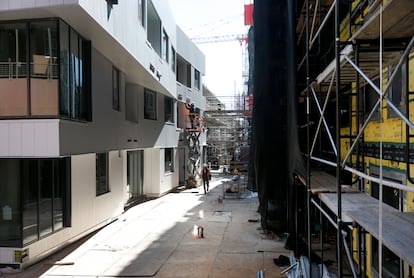
The emergency declaration does not allow the mayor to bypass laws the way a disaster declaration would. The proposed measures would bar evictions for tenants who owe less than one month’s rent and cap cumulative annual increases at 10% for units under rent control. But the underlying problem is supply: San Francisco has completed only 489 housing units so far this year, and in June just 2.2% of the rental stock was available.
The mayor is receiving criticism from the left. During the 2024 campaign, Lurie disappointed tenant advocates by refusing to support expanded rent control. His detractors compare him with New York Mayor Zohran Mamdani, who this year froze rents for a million New Yorkers. Lurie defends his two-pronged strategy: “We are building more housing to make San Francisco more affordable in the future, and we are keeping people in their homes today.”
Sign up for our weekly newsletter to get more English-language news coverage from EL PAÍS USA Edition