Trump launches hunt for alleged noncitizen voters
Officials from the investigative arm of the Department of Homeland Security have been going door-to-door in search of potential non-naturalized migrants who may have voted or are registered to vote, just days before the midterms
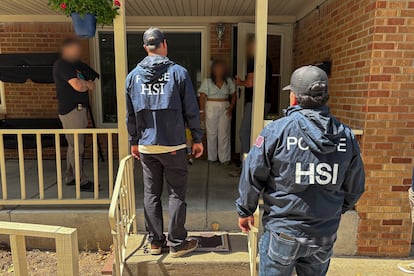
The main investigative unit of the United States Department of Homeland Security (DHS) has been vigorously promoting on social media an effort it considers crucial in the final weeks before the midterms: pursuing alleged large-scale election fraud by noncitizens — a claim that has obsessed President Donald Trump despite a lack of evidence.
That office, Homeland Security Investigations (HSI), has trawled databases with millions of voter records and knocked on doors in states including California, Kansas, and Texas looking for possible non-naturalized immigrants who may have voted in past elections or are registered to vote in the contest that will decide control of Congress on November 3.
Photos released by the agency itself show agents walking up to homes, knocking on doors and, in at least one instance, speaking with a woman outside a house. One post on X reads in uppercase: “AMERICAN ELECTIONS ARE FOR AMERICANS.” Another warned: “HSI is tracking down voter fraudsters and investigating alleged election crimes to protect the integrity of our elections and every American citizen’s vote.”
HSI in Northern California will investigate any allegations of noncitizen voting and is committed to ensuring the enforcement of federal election law. pic.twitter.com/gmrvDqTeSZ
— HSI NorCal (@HSISanFrancisco) September 11, 2026
The tactic is far removed from the usual duties of agents in a unit whose mission is to investigate illegal movements across the border, and it comes amid Trump’s push to stoke the same specter of alleged fraud he raised over the 2020 presidential election he lost to Democrat Joe Biden.
In June, the government justified the shift in Homeland Security agents’ work by arguing that “illegal votes dilute the ballots of U.S. citizens and undermine our democracy.”
As part of this campaign, the administration asked in August that agents from U.S. Immigration and Customs Enforcement (ICE) largely stop reviewing migrants’ applications for lawful status in the country in order to search for potential election fraud cases, The Washington Post reported. Immigration police officers under Trump are also now asking migrants during operations to detain and deport them whether they have registered to vote or voted in the United States, the newspaper added in a separate report.
Because of that — and amid fears that ICE agents might be hovering around polling places during the midterms — organizations representing minorities sued the government to prevent voter intimidation.
“It is reported that the Department of Homeland Security has reassigned hundreds of HSI and U.S. Citizenship and Immigration Services employees and adopted new internal directives to accelerate election-related investigations. Congress did not create the Department of Homeland Security to oversee elections or determine who is eligible to vote,” reads the lawsuit filed in September.
“Community members who previously welcomed outreach and help for voters are less willing to open their doors or attend community events [...] because they fear encounters with federal agents,” the filing adds.
With a focus on migrants who are allegedly registered to vote illegally, Homeland Security Secretary Markwayne Mullin said in July that about 250,000 noncitizens were registered to vote in a handful of states.
That claim has been refuted by studies, which agree that it is extremely rare for noncitizens to cast ballots in the United States. The Center for Election Innovation & Research (CEIR), a nonpartisan organization, updated its findings as recently as this September.
“CEIR’s review finds that sweeping allegations about possible noncitizen registration or voting appear to arise from misunderstandings, mischaracterizations, or outright fabrications about complex voter data,” it said on its website.
“While no system can ever be perfect, in every state, election officials and other agencies thoroughly investigate these claims whenever they arise. These investigations find extremely few cases of noncitizens registering and even fewer cases of noncitizens voting,” it added.
A much broader offensive
In addition to changes to the standard duties of HSI agents, Trump reactivated a controversial federal data system called SAVE to verify voters’ citizenship and used databases from other government agencies, documents the government itself provided to Democracy Forward showed after a Freedom of Information Act request.
The records showed HSI considered using undercover agents to investigate organizations the government suspects of registering noncitizens to vote, especially in New Jersey and Pennsylvania — the latter a swing state whose contests are key in the midterm elections.
“The records produced by HSI also note that the agency has obtained 26,235 U.S. Citizenship and Immigration Services (USCIS)-derived records, and 50.6 million voter roll records from the U.S. Department of Justice for investigating so-called voter fraud. Notably, ICE listed out priority states for each set of these records, including Texas, Pennsylvania, California, New Jersey, Minnesota, Michigan, Arizona, Florida, Georgia, and Ohio,” Democracy Forward said in a statement.
It appears that the White House has focused its crackdown specifically on California. On Monday, during a police operation that some consider disproportionate — and which was dubbed “Operation Protect the Vote” — federal agents arrested 11 people in various cities across the state, out of a total of 28 defendants.
They are accused of having registered illegally to vote and, in some cases, of having voted multiple times. Some of the defendants who have appeared in court told media outlets they do not recall registering to vote.
The operation is also part of a broader assault on California election officials. Last week the Justice Department (DOJ) filed a lawsuit accusing them of refusing to cooperate in verifying whether more than 20,000 people who are not U.S. citizens may be improperly listed on voter rolls. In a court response, state authorities said a review of a sample of 200 of those 20,000 records showed a sizable share — 38.9% — were people born in the United States.
On another front, this past Monday, the federal government asked a Los Angeles judge to issue a preliminary injunction ordering that those ballots be set aside “until we confirm that they are U.S. citizens.” Election officials continue to refuse to comply with the DOJ’s demands. They maintain that there are sufficient safeguards in place to verify who registers to vote and argue that the federal agency is violating a law that prohibits states from modifying voter rolls during the 90 days leading up to an election.
Sign up for our weekly newsletter to get more English-language news coverage from EL PAÍS USA Edition