Charisma or cash? Republicans are banking on their financial edge to stage a comeback in the polls
Donald Trump’s party remains in the running to retain control of the Senate thanks to the flood of millions of dollars from Super PACs
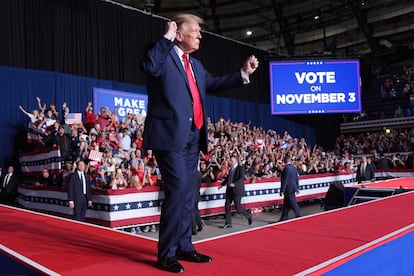
Charisma or cash: to win an election, candidates need at least one of those two factors. With two weeks to go until the U.S. midterm elections, Republicans are throwing everything they have into the closest states to try to climb back in polls that are unfavorable to them. They have the invaluable help of the vast sums Donald Trump raises through his Super PAC, the political action committee that pools donations coming from the ultraconservative MAGA movement.
The question of financing is decisive in U.S. political campaigns. This year’s elections are being seen as a referendum on the power of money in American politics: about $4.5 billion will be spent nationwide on campaign events, travel, and television, radio and social media ads to promote candidates and attack opponents.
Trump announced this week that he will invest more than $400 million in the Republican campaign. If confirmed, it would make his Super PAC the largest financial instrument in the U.S. elections.
Ahead of the November 3 vote, the data indicate the electoral race looks uneven in the key states that will decide control of the Senate: Republicans have managed to raise nearly $1 billion in the seven states that will determine the upper chamber’s future thanks to support from various interest groups, almost 30% more than the Democrats’ total funding.
In the midterm elections all 435 seats in the House of Representatives and one-third of the 100 Senate seats are up for grabs. The figures show that funding is widely distributed among candidates for both chambers.
For the most competitive House contests, a total of $713 million has been raised. For the Senate, where the battle is more hotly contested because the competition is statewide rather than by districts, candidates have gathered $727 million to compete in the tightest races, according to data from the Federal Election Commission (FEC).
Control of the Senate will be decided by who prevails in the seven closest states: Alaska, Iowa, Kansas, Michigan, Ohio, Maine, and Texas. That is where Republicans are concentrating all their financial efforts.
The head of Senate Democrats, veteran Chuck Schumer, sent a letter last week to his party colleagues asking: “Will the unprecedented tsunami of Republican money defeat the massive Democratic advantage in candidates, policies, and political climate?”
In the letter, obtained by EL PAÍS, the progressive leader wrote: “There are 22 days until Election Day, and two enormous forces are on a collision course: deep voter dissatisfaction with Republicans and an unprecedented flood of money aimed at overcoming their political liabilities.”
Schumer stresses that Republican funding comes “from corrupt money.” He added: “We see tens of millions of taxpayer dollars being used to boost Trump’s corrupt interests and to feed his ego with television ads paid for with citizens’ money. The funds come from wealthy donors and corporate interests with huge profits and stakes in Trump’s decisions.”
Schumer is right that Republican candidates receive much more funding from outside groups and Super PACs, but Democrats also benefit from a significant flow of contributions to candidates.
The difference is that the large sums arrive through these interest groups. Trump’s Super PAC had spent $277 million through last week, the White House revealed. The occupant of the Oval Office announced yesterday he would spend another $100 million through November 3. In addition, tech entrepreneur Elon Musk, a friend of the president, has donated $291 million to support Republican campaigns.
But the Republicans’ apparent advantage disappears when races are examined in detail, one by one.
For example, Democratic hopeful in Texas James Talarico is by far the candidate who has received the most donations in the Senate race, where polls give him a slight lead over conservative Ken Paxton. Talarico has raised $129 million in personal contributions, compared with his opponent’s $19.5 million. However, Paxton is backed by several Super PACs that give him the leading financial muscle in the contest.
The Republican funding advantage is not uniform across all races. The imbalance favored Republicans especially in Senate races, while the gap was much smaller in the most contested House districts, according to campaign advertising data published on October 19.
The differences between the two parties have narrowed as the campaign has progressed. Democrats, for example, received an important financial lifeline this week. Former New York mayor Michael Bloomberg, a powerful Democrat, announced on Tuesday that he will devote about $80 million to support his party’s candidates in the final stretch of the election campaign.
Three sources of funding
The political campaign financing system has three main sources. On one hand are individual citizens’ donations to candidates. Those have specific limits on the amounts, and on how funds can be spent. Then there are Super PACs, which allow unlimited fundraising from individuals, corporations, unions, and other committees and permit unlimited spending on independent electoral communications. Finally, there are funds provided by each party’s campaign committees.
A U.S. Supreme Court ruling issued on June 30 allows party campaign committees to allocate unlimited resources to activities coordinated with their candidates and permits unlimited redistribution of funds to the races the party cares about most.
The amount of money each candidate obtains is highly relevant. It allows them to buy more advertising, mobilize voters, and defend vulnerable districts. However, it does not guarantee that ads will persuade the electorate or that candidates will win.
Democrats benefit from advance planning. They bought television time and ads several weeks ago, before Super PAC money flooded Republican coffers. That foresight allowed them to secure ads at much lower prices than Republicans are paying in the final weeks of the campaign, when demand is higher and networks demand steeper rates.
Also, because much of Democratic funding comes from citizen contributions directly to candidates — a funding model with fewer spending restrictions that forces networks to offer lower rates than those contracted by Super PACs — it is a strategy that allows them to be more efficient in their campaigns.
Sign up for our weekly newsletter to get more English-language news coverage from EL PAÍS USA Edition