
The order to remove Trump’s name from the Kennedy Center leaves the institution’s closure in limbo
The US president reacted to the judge’s ruling by implying that he was washing his hands of the matter. That could mean the KC might be open next season without any music to fill it
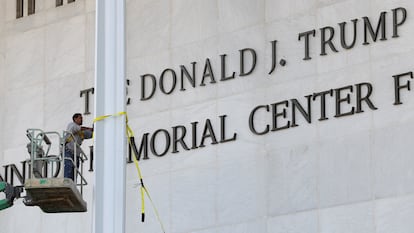

Since his return to the White House, Donald Trump has put into practice that old maxim that it’s better to ask for forgiveness than for permission — except that the president of the United States never apologizes. The order issued on Friday by a federal judge in Washington to remove the Republican’s name from the Kennedy Center (KC), the capital’s major center of music and opera that Trump renamed without permission, has left the cultural institution in a state of uncertainty after more than a year of political meddling from the White House.
The 94-page ruling not only says Trump should have gone through Congress to rename the KC, it also holds that he was not authorized to close it for two years for renovations, as he unilaterally announced in February. In other words, roughly three months after the cultural center’s board, filled by presidential appointees loyal to the president, unanimously approved renaming it The Donald J. Trump and John F. Kennedy Memorial Center for the Performing Arts.
The closure had been scheduled to start on July 4, coinciding with the celebrations for the 250th anniversary of U.S. independence. Trump’s plan, he said in a Truth Social post, was to undertake a complete rebuilding to transform “a tired, broken, and dilapidated Center, one that has been in bad condition, both financially and structurally for many years, and turn it into a World Class Bastion of Arts, Music, and Entertainment, far better than it has ever been before.”
In light of that announcement, the institution — which, like others of its kind, plans months if not years in advance — began preparing for a shutdown that now hangs in the balance. There have been layoffs of workers who may no longer be needed, cancellations of artistic engagements and postponement of programs.
Trump also reacted to the judge’s Friday ruling by implying that, given this setback, he was washing his hands of the matter. That could mean the KC might be open next season without the music to fill it. Nor would there be any opera, since the company that used the center as its home has left in protest at the White House’s interference.
A good number of artists had also canceled their commitments when Trump announced his intention to close the KC; among them was Philip Glass, one of the great living American composers, who had written a piece about President Abraham Lincoln for the independence anniversary that will now instead premiere at the Tanglewood festival in eastern Massachusetts.
1964 law
The ruling by Judge Christopher R. Cooper, appointed by President Barack Obama and confirmed unanimously by the Senate, was met with angry criticism and personal attacks from Trump. Cooper based his decision on the 1964 law that established the KC in honor of Kennedy, who had been assassinated two months earlier. That law states the institution “shall constitute the only national memorial to the late JFK within the city of Washington and its environs.” Relying on that provision, Democratic representative Joyce Beatty of Ohio filed the lawsuit. Beatty acknowledged the need to renovate the facilities, but not the need to close them to carry out that renovation.
In his Friday message, Trump wrote: “we are going to be working with Congress to transfer this failing Institution back to them so they can make a determination as to what to do with it. (…) Unless I am free to do what I do better than anyone else, bring this Institution back, physically, financially, and artistically, I have no interest in continuing what could only be a hopeless journey into ‘NEVER NEVER LAND.’’”
The takeover of the KC and the unilateral decision to subject it to renovations are part of an unusual campaign in which Trump, since his return to the White House, has been inserting himself in the local politics and culture of a city that voted more than 90% for his rival, Kamala Harris. The president has deployed the National Guard, torn down the East Wing of the White House to build a massive ballroom, and promised to erect a triumphal arch despite criticism from preservation activists and veterans.
Almost all his initiatives, which also reflect his past as a real estate developer who was not fond of following rules, have been challenged in court and, in some cases, like the KC’s, halted by a judge. None of these cases has that stopped Trump from pursuing his plans. Much less has it led him to apologize.
Sign up for our weekly newsletter to get more English-language news coverage from EL PAÍS USA Edition









































