
Trump, mayor (and emperor) of Washington
The president is shaping the US capital to his liking with works marked by corruption that reflect his authoritarian drift. Two judges have blocked the fund meant to compensate his allies allegedly ‘persecuted’ by Biden

Rare is the day Washington residents do not wake up to a new jolt courtesy of U.S. President Donald Trump. And it is not only — though it is also — because of the war with Iran, his use of the press to poison public opinion, or his disrespectful posts on Truth Social. It is because of the unilateral renovations that Trump is undertaking in the U.S. capital, like a mayor with unlimited budget and power, like a Roman emperor or a king obsessed with a city.
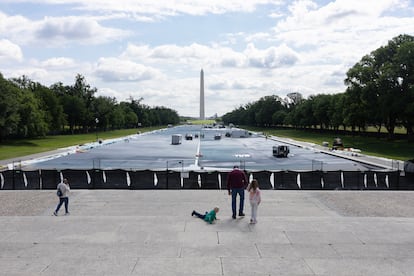
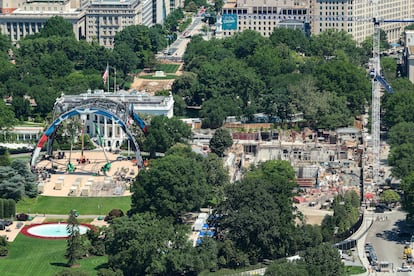
Last Monday, the surprise was a temporary structure visible from the rooftop of a hotel near the White House: a 30‑meter arch on its south side, where a mixed martial arts fight is scheduled for June 14, Donald Trump’s 80th birthday. The week before that, it was the return of water to fountains that had been dry for years. And earlier, the draining of the reflecting pool in front of the Lincoln Memorial to repaint it swimming‑pool blue; gold moldings sprouting everywhere inside the White House; the demolition of its East Wing to build a gigantic ballroom; and the plan to erect an imperial triumphal arch to commemorate the 250th anniversary of U.S. independence.
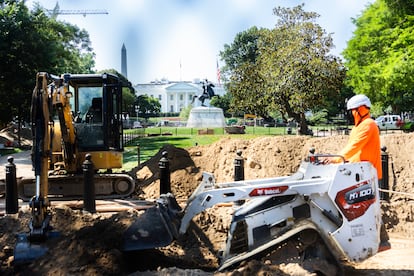
As a result of the demolition fever of a politician with a builder’s heart, Washington’s streets are now filled with trenches and cranes, closed parks and fenced‑off plazas, while courts fill with lawsuits seeking to stop — or at least slow down — some of these projects. All of it is part of a plan to “beautify Washington D.C.,” but above all it stems from an anomaly: the limited self‑government regime of the District of Columbia.
Washington’s local government depended on the House of Representatives until 1973, when Congress approved the Home Rule Act, a law won after years of fighting for a measure of self‑determination. Since then, the city has had councilmembers and a mayor — Muriel Bowser, who will step down in January after 12 years in office and a final stretch facing off against Trump, before whom she has been able to do very little.
Washington’s budget depends on Congress; its residents retain some control over the police; and the district has two senators and one representative “in the shadows.” Like those from Puerto Rico, they are in Congress to advocate for D.C.’s interests but, above all, to push for recognition of the district as the 51st state. In other words: they have a voice, but no vote.
Nearly unlimited power
That system helps explain much of Trump’s overreach, as he holds almost unlimited authority over federally owned land — the part of the city he is primarily reshaping. In the rest of that square carved by the Potomac River live the residents: roughly 700,000 people within a metropolitan area of six million that includes parts of Virginia and Maryland. They greeted Trump with hostility during his first presidency, and in 2024 they overwhelmingly backed his rival, Kamala Harris, with more than 90% of the vote. Now they are living with the consequences.
“Presidents’ attitudes toward the capital have been respectful, despite tensions. Trump has taken those tensions to an obscene level,” warns Paul Strauss, D.C.’s shadow senator since 1997 — a position the federal government does not pay — in a videoconference conversation. “None had shown such disrespect for the White House building. He wants to convert the Lincoln Memorial Reflecting Pool, which was designed with a dark bottom precisely to reflect the monument, into a resort pool, and he dreams of an arch in an authoritarian style as if the Germans had won World War II.”
Strauss — who is running for re‑election this November, because, he says, “it would not be right to give up now when so much is at stake” — notes that the harm to the city goes beyond the physical changes. “It’s also economic, and it began [last year] with the mass layoffs of civil servants,” he says.
That was followed in March 2025 by an executive order to make Washington “safe, beautiful and prosperous.” In August of that year, this ambition to make the capital “safe” led to the deployment of hundreds of National Guard troops. Trump justified the move by arguing the city had a problem with crime, even though this was not reflected in the statistics.
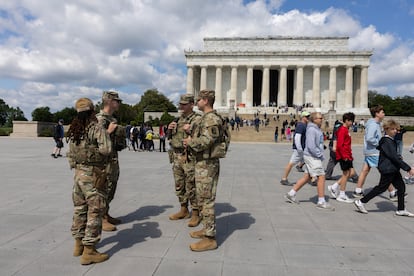
Nine months later, the troops are still in D.C. It is common to see them on corners, in groups of four, with little to do other than pose for tourists’ photos and keep a calm face when an angry resident yells at them to leave. They were also tasked with protecting the operations of Trump’s immigration police (the much-feared ICE), while the immigrant population lives in fear of deportation in a militarized city.
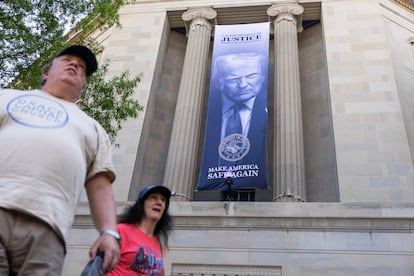
With a determination that presidential historian Russell Riley says “has no precedent,” Trump is also leaving his mark on the city by putting his name on everything — from the Kennedy Center (in a decision a judge struck down on Friday) to the Institute for Peace. Not waiting for posterity’s verdict, the Treasury Department wants to stamp his face on a new $250 bill, and the president has adorned iconic federal buildings with larger‑than‑life portraits and imagery more reminiscent of Pyongyang or Damascus than Washington.
Nowhere does the sight of his image invite a stronger metaphor for his autocratic tendencies than on the façade of the Justice Department, which Trump has turned into an instrument of revenge against those he perceives as his enemies. The latest on that list last week is columnist E. Jean Carroll, who won a civil defamation case against him after accusing him of a sexual assault in the 1980s in New York.
The U.S. president has also used that department to create a $1.776 billion fund to compensate those he claims were “politically persecuted” by his predecessor, Joe Biden. And that could include participants in the Capitol attack, whom he pardoned on his first day back in the Oval Office.
The announcement of the fund came after Trump withdrew a $10 billion lawsuit against the Internal Revenue Service (IRS) for allegedly leaking information about his income to the press. It was a surreal legal situation: the president was demanding damages from the United States, meaning the lawyers on both sides ultimately answered to him.
On Friday, two different judges intervened in a matter that has drawn criticism even among Republicans. First, the creation of the fund was temporarily suspended. A few hours later, a Florida judge reopened Trump’s lawsuit against the IRS, arguing that the agreement through which he dropped the case — which includes tax benefits for him and his family — raises suspicions of “manipulation of the judicial system.”
Because of these maneuvers, and reports of inflated contracts, no‑bid awards, personal enrichment, and irregular financing tied to his projects in Washington, the Sunday opinion section of The New York Times ran a doctored image on its cover: a worker sweeping a symbolic pile of red, white, and blue shavings — the colors of the U.S. flag — beneath block letters reading “Department of Corruption (founded May 18, 2026).”
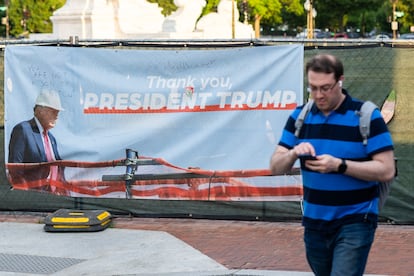
A smaller version of the president’s face has also appeared on billboards covering public‑space construction sites. They bear the signature of the National Park Service, the agency that manages those federally owned areas, and show the president wearing a construction helmet above the phrase “Thank you, PRESIDENT TRUMP.” It borders on the height of egotism: politicians often seek recognition, but thanking oneself is another matter.
Some Washington residents have welcomed certain renovations. For instance, the restoration of water to the pond in Meridian Hill Park, which poet Juan Ramón Jiménez frequented when he lived in the city, or to the fountains at the Christopher Columbus statue outside the train station. They had been out of service for nearly two decades, until last week, when the Transportation Secretary unveiled the restored complex — repeatedly vandalized during left‑wing protests. He also promised a $465 million investment to renovate the Amtrak terminal, the departure point for trains to New York.
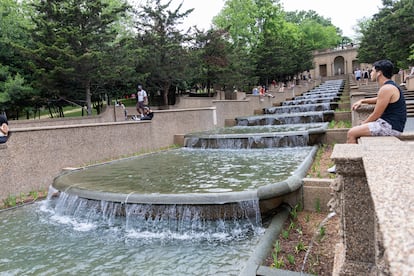
“I’m Trump’s biggest critic, but I appreciate that he is making these improvements to the city, neglected by politicians for too long. The capital of the United States did not deserve that neglect,” Lilliana Novack, a young Washington resident walking through Meridian Hill Park, said last week.
Senator Strauss notes that the functioning of those fountains was never a matter for local authorities but for the federal government — and therefore for Trump during his first term (2017–2021).
Anniversary deadline
Other touch‑ups, accelerated to be ready for the 250th anniversary celebration, have run into opposition from heritage conservation activists, veterans who have sued Trump over his triumphal arch — denouncing it as a “vain project” that disrespects the memory of the fallen — and some judges. The most persistent judge ordered a halt to construction on the ballroom the president wants to erect on the site of the former East Wing, which he demolished without permission. Despite that injunction, the president proudly showed the press last week that those works are underway.
Mary Graw, a law professor at the Catholic University of America, distinguishes in a phone interview two types of legal questions raised by Trump’s actions. The first concerns the limits of federal power over Washington. The second asks whether the president is authorized to invade areas of authority belonging to other parts of government — a question this president has been answering with a resounding yes for 16 months. “There is a saying in this country: shoot first, ask questions later. That is what Trump is doing in many cases,” Graw warns. “That works especially well with physical structures. Once destroyed, little can be done.”
In addition to those stalling tactics in court, there have also been street‑level acts of resistance by organizations such as Free DC or the Save America Movement, which plaster the city with posters mocking members of the administration.
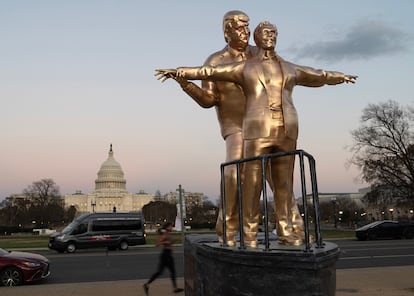
The most imaginative of these collectives is Secret Handshake, an anonymous art group that installs ephemeral satirical statues on the Mall. One depicted Trump and his former friend, the convicted sex offender Jeffrey Epstein, in a pose mimicking the famous bow‑scene embrace from Titanic. Another, titled A Throne Fit for a King, was a golden toilet set inside a marble‑lined bathroom. Marble is one of Trump’s favorite materials when undertaking renovations.
Sign up for our weekly newsletter to get more English-language news coverage from EL PAÍS USA Edition









































