
An Iranian woman adopted by a US military officer 50 years ago faces deportation: ‘The war makes it even more dangerous’
She received a removal order three weeks before the United States attacked Iran. Her case exemplifies the plight of people who were adopted as children and who, because they did not receive citizenship, can be deported
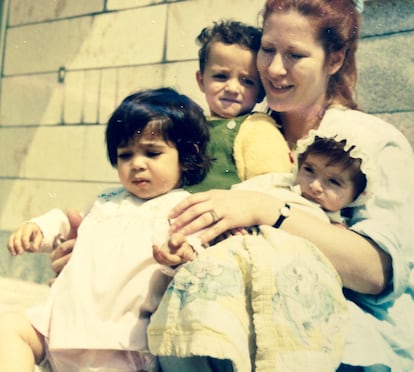

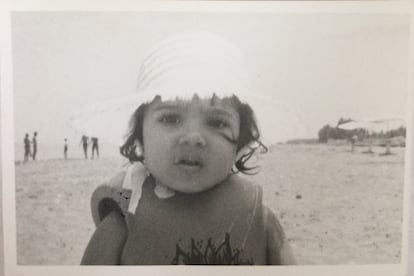
Just when she thought the prospect of being deported to Iran couldn’t get any worse, the country she considers her own, the United States, attacked her ancestral homeland. “This is all crazy. It’s surreal. It’s definitely more dangerous for me now,” says Buttons, the nickname she was given as a child because of her large, dark eyes, which this Iranian woman prefers to use to avoid being identified.
The U.S. and Israeli attack on Iran added further horror to the grim outlook she faces if the deportation order she received on February 7 from the Department of Homeland Security (DHS) is carried out. “I can’t imagine going under these circumstances; they’ve already killed six American service members,” she says, noting that she is the daughter of an American soldier, which would weigh heavily against her upon arrival in Iran. She would also face the challenges of being in a country where women have been stripped of their rights, as well as being a Christian in a Muslim state.
She still hopes that the armed conflict the Donald Trump administration has started in Iran, which is already having repercussions throughout the Middle East, will somehow benefit her, because she doesn’t understand how anyone can “send someone to a country that is being bombed and, what’s worse, someone who doesn’t have any family there.”
The DHS notification justifies the deportation order by stating that she overstayed her tourist visa. The truth is, her visa likely expired half a century ago, the same amount of time she has lived in the United States. Born in Iran and orphaned, she was adopted in 1972 by a U.S. military officer and his wife when she was just two years old. At three, her adoptive parents put her on a plane to the United States, and by five, her adoption papers were finalized.
From then on, her life was like that of millions of other Americans. “I grew up in an American family with a prisoner of war, an Air Force officer, who sacrificed himself for this country. I was educated in schools here, spent Sundays at church with my Christian family, and my only language is English,” she says in a telephone conversation with EL PAÍS. “Receiving a letter that says ‘we are not going to allow you to identify yourself as a U.S. citizen’ is truly painful. It’s very sad that this country is turning its back on me after 50 years of paying taxes and contributing as a citizen to my community,” laments this woman, who lives in California and works in the healthcare sector.
Although she is now in her fifties, it was only 18 years ago that she learned she couldn’t obtain a U.S. passport. Gathering documents from her deceased parents, she discovered they had applied for naturalization, but until then, her paperwork wasn’t in order. She maintains that she is a U.S. citizen and that an administrative issue — the loss of documents by the authorities — is responsible for her current situation.
Her case is not unique, as it stems from a legal loophole that existed until 2000, leaving thousands of people adopted abroad without U.S. citizenship, even though they arrived as very young children and have never known any other country. At that time, parents were obliged to apply for their children’s naturalization, but many were unaware of the requirement. Consequently, some don’t even know they are in this situation, but ultimately, this bureaucratic hurdle hasn’t prevented them from living as Americans.
“Historically, it was common for American adoptive parents to use temporary visas to bring their children over, but those visas expired before the adoption process was even finalized. This required changing their status to permanent residency, a step that parents often overlooked, which has blocked their path to citizenship,” explains Joy Alessi of the Adoptee Rights Campaign, an organization that has been fighting for their rights for years.
Cutoff point in 1983
The United States Congress recognized the problem this posed and, in 2000, passed the Child Citizenship Act, which automatically grants citizenship to foreign children adopted from abroad by American parents. However, the law is not retroactive and only applies to children under 18. This means that anyone born before February 27, 1983, is excluded.
“That’s when I got angry because I said, ‘How could they do this too?’ To say, ‘Well, half of you will get citizenship and receive all the promises of an adoption policy, but the rest will still be worried about ICE (Immigration and Customs Enforcement), and relegated to the sidelines,’” Buttons recounts.
Although the caveat seems unfair, in practice, the thousands affected had never felt threatened. Only now, with an administration like Trump’s, hostile to foreigners and which has prioritized carrying out the largest deportation in history, are they in danger of being deported for being undocumented. “There was a feeling that we could ignore it, that it would never be a big problem. But now we are at a point where we have a vulnerable population, potentially at risk of deportation. These are people who have lived here all their lives, Americans in every sense of the word, and, because of this legal loophole, they lack the security and protection they should have,” explains Hannah Daniel, director of government relations at World Relief, who for years advocated for the rights of adopted immigrants through the Ethics and Religious Freedom Commission (ERLC).
This group has been lobbying members of Congress for years to approve legislation that includes adopted people who were excluded from the 2000 law. It’s presented to the Capitol every year, but it never passes. According to Daniel, there are two main reasons why it’s not getting approved. One is that some legislators are hesitant to grant citizenship to members of the group who have committed a crime (a very small percentage). The other factor, in her opinion, and more widespread among members of Congress, is the lack of political will and a sense of urgency surrounding this issue. “When I met with members of Congress and their staff to talk about it, what I usually heard was: ‘Well, I understand why we need to do this, but these people will never be deported. This will never be a real problem.’ And now it is,” she points out.
The woman facing deportation to Iran has spent years asking to be recognized as she identifies herself: an American citizen. She is very active in her efforts and has approached many people, from the State Department to representatives, senators, and immigration officials, but she has received no support. Despite this, she never thought she would face deportation. “I always felt they would leave me alone because no one had ever put me in deportation proceedings. And, obviously, I never thought that would happen, because I’m not a criminal. I didn’t break the law. When I heard it on television, and they repeated it over and over: ‘We’re going after criminals’; I didn’t think it would affect me. I don’t know what happened that made them decide to try to deport me,” she says.
From the presidential campaign of November 2024 until today, 13 months into his second term, Trump has repeatedly stated that his anti-immigration campaign targets criminals, “the worst of the worst.” The reality is that ICE detention centers are overcrowded with people who have never committed a crime, and most of those deported have no criminal record. The list of those targeted for deportation now also includes people who were brought to the United States as children and have lived their entire lives as Americans. The largest group is of Korean origin, but there are people from some 50 different countries.
“They want to see it from an immigration perspective, but, in reality, it’s a failed adoption policy,” Buttons emphasizes. She already has her first court date scheduled. The judge understood the risk she faces and agreed to the request for a virtual hearing. She fears that she will have to appear in court for subsequent hearings, knowing that ICE agents are lurking outside the courts to arrest migrants. “I came here as a result of the decision of two administrations to give an orphan a home. And then this country decided to break its promises or disregard adoption laws. That’s the biggest problem people need to understand: that much of the adoption policy is a failure,” she concludes.
Sign up for our weekly newsletter to get more English-language news coverage from EL PAÍS USA Edition









































