
Trump, on how far he is willing to go with Greenland: ‘You’ll find out’
The US president exaggerated his achievements with a rambling speech at the White House in which he defended his immigration policy
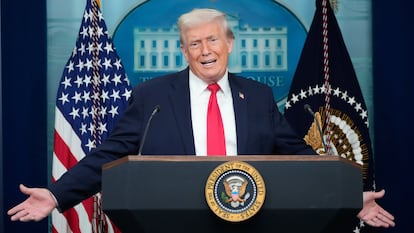

U.S. President Donald Trump started Tuesday, the first anniversary of his return to power, by turning the world order upside down with a series of messages on Truth, and planned to end it by traveling overnight to the Economic Forum in Davos, Switzerland, where the world’s economic, political, and technological powers meet every year. Halfway through the day, the Republican had another surprise in store: an unannounced appearance at the White House, replacing the weekly press conference held by his spokesperson, Karoline Leavitt.
It soon became clear that it would be a long — it ended up lasting almost two hours, including a monologue of over 80 minutes — and disjointed speech, in which Trump jumped from one topic to another with no apparent method, from domestic to international politics and from facts to exaggerations. Toward the end, he was asked by a reporter how far he would be willing to go in his imperialist quest to buy or otherwise acquire Greenland: “You’ll find out,” he replied.
“We have done more than any previous administration,” Trump proclaimed at the beginning of his appearance, which began almost an hour late and in a strange tone. Shortly before signing off, and after stating that he believed God was ‘proud’ of him, he insisted: “We inherited a mess and we made it a beautiful picture.”
Trump began speaking to the reporters crowding the room with a dismissive air, seemingly low on energy and without a script, as he shuffled through papers containing police records of alleged criminals in Minnesota — “the worst of the worst,” he said — and took the opportunity to attack some of his enemies, whom he called “sick,” and to repeat lies such as one he still maintains, more than five years later, that the Democrats “stole” the 2020 election from him.
“I’m going through this because I think we have plenty of time [before the Republican was due to leave for Switzerland]”, Trump said, as he continued to hold up effigies of alleged criminals, his sentences often left unfinished and the event rife with incoherence.
Shortly before the president’s appearance at the White House, his press office had released an 18-page document detailing what they consider to be the achievements of Trump 2.0’s first year, a list of 365 points, one for each day, which, according to Washington, prove a “new era of success and prosperity” in the United States. Trump held up a thick book from the podium in the press room, in what appeared to be an extended version of that text, and said, “I could read it for a week and we wouldn’t be finished.” Minutes later, he brandished it again and threw it on the floor.
The list released to the media is divided into 10 categories, with titles referring, for example, to “securing U.S. borders,” “rebuilding the economy,” and efforts to “make America healthy again.” As is often the case with Trump, among those 365 points, there are verified facts, exaggerations, and interpretations that are at odds with reality. The list makes no reference to how Trump has used his position over the past 12 months to increase his wealth, which, according to The New York Times on Tuesday, has grown by just over $1.4 billion.
When he took questions from the press, the U.S. president repeated familiar arguments. He focused on stating that he had lowered inflation, although it remains more or less where his predecessor, Joe Biden, left it. He said that companies “are coming back to the United States” and that he has lowered the price of medicines. This is only the beginning, he warned, “of the biggest drop in history.” By up to “600%,” he added, even though that is mathematically impossible.
He also boasted about low gasoline prices and having deployed the National Guard in several cities (he was especially proud in the case of Washington, D.C., about which he lied when he said that “crime has virtually disappeared”), as well as having “closed the border.”
He also insisted on defending tariffs, with the Supreme Court due to issue a ruling that could declare them unconstitutional. He attacked the plaintiffs in the case and once again pressured the judges who are reviewing it not to overturn his trade policy.
Before that review, the beginning of his speech had focused on Minnesota, the Democratic state that the U.S. president has targeted in recent weeks over a corruption case for which he has blamed the entire Somali community, and in particular the congresswoman of Somali origin, Ilhan Omar. His administration has also turned the state’s most populous city, Minneapolis, into the scene of the worst clashes between federal agents and protesters.
Trump is marking his first year back in the Oval Office a couple of weeks after ordering a reckless military operation to capture Venezuelan President Nicolás Maduro, which seems to have emboldened him on the international stage, and amid a global pressure campaign to take over Greenland by threatening his NATO and European Union partners with new tariffs.
Trump’s popularity has been in decline for over 300 days, and polls indicate that Americans are unhappy with the state of the economy — especially the cost-of-living crisis — the government’s excessive focus on international affairs at the expense of the domestic agenda, and the anti-immigrant terror campaign that his administration is waging in cities across the country.
Sign up for our weekly newsletter to get more English-language news coverage from EL PAÍS USA Edition









































