
The US-Europe standoff reaches Davos, set to hold a critical meeting on Greenland
The World Economic Forum celebrates its traditional annual meeting, marked by the transatlantic crisis and the assault on free trade and international institutions

The world is witnessing the death of an era, one that was to a large extent embodied and symbolized by the World Economic Forum in Davos. It was a time of free trade, borderless investment, democratic expansion, cosmopolitanism, and alliance among Atlantic democracies. Another era is now taking hold — the antithesis of that one: trade and financial fragmentation, democratic backsliding, nationalism, and a dramatic unraveling of the transatlantic relationship. This is the somber backdrop against which the World Economic Forum’s traditional annual conference opens this Tuesday in the Swiss Alpine resort, with a notable turnout of business and political leaders, among them Donald Trump, the figure leading the assault on the old world.
The U.S. president will meet at the forum with several of the traditional Atlantic allies with whom he is now engaged in an extremely tense standoff, one of the defining features of this new era. U.S. threats to take control of Greenland “the easy way or the hard” have pushed the transatlantic relationship to its lowest point since at least the Suez crisis. Trump has said on his social media platform that, after holding a phone call with NATO Secretary General Mark Rutte, he expects to convene a meeting in Davos with representatives of several countries to discuss Greenland.
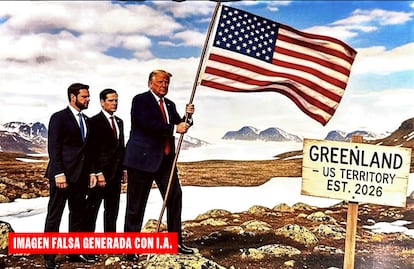
For days, European leaders have been shaping a forceful response to the U.S. decision to impose new tariffs on countries that have shown solidarity with Greenland, and the risk of escalation is very high. U.S. Treasury Secretary Scott Bessent said on Monday in Davos that proceeding with such retaliation “would be very unwise” and stressed that Trump’s words must be taken seriously. The president made his position clear by posting an image showing himself planting the U.S. flag on Greenlandic territory, in a piece of imagery reminiscent of the iconic photograph from Iwo Jima, and a sign reading: “U.S. territory est. 2026.”
Public statements from the United States suggest that the White House has no intention of backing down and believes it holds what is known in policy jargon as the “escalation advantage” — that is, a greater capacity to sustain a spiral of measures and countermeasures. It is counting on Europeans being paralyzed by their internal divisions and, in any case, lacking the ability to sustain a prolonged standoff.
Davos is set to host figures such as Friedrich Merz (Germany), Emmanuel Macron (France), Mark Carney (Canada) and Ursula von der Leyen (European Commission), among many others. Also attending will be Trump’s political allies, including Javier Milei (Argentina) and British opposition figure Nigel Farage. Of particular interest will be the role played by Italian Prime Minister Giorgia Meloni, theoretically close to Trump in ideological terms but showing clear signs of discomfort with his policies and a desire to maintain an image of reliability among European partners. She is expected to attend, although she is trying to avoid being seen as a participant in a forum against which, as a populist leader, she has long been highly critical, as has Farage.
On the sidelines of the official programme, there is anticipation surrounding possible meetings between the U.S. president and von der Leyen, as well as Mark Rutte.
Another key figure in Davos will be Ukraine’s president, Volodymyr Zelenskiy. Everything points to the standoff between Europe and the United States potentially resulting in reduced U.S. support for Kyiv. The White House is skilfully leveraging Europe’s dependence on U.S. security — and in particular the crisis triggered by the Russian invasion of Ukraine — to gain advantages in other areas, whether over Greenland or in the technology sector.
Indeed, the technology sector will be strongly represented in Davos, with figures such as Jensen Huang of Nvidia, Satya Nadella of Microsoft, and Alex Karp, CEO of Palantir — a company deeply intertwined with the Trump project, whether through business interests — including a $10 billion contract with the Pentagon for highly sensitive software, data, and AI development — or through ideology. Palantir’s chairman, Peter Thiel, has stated that democracy and freedom are incompatible.
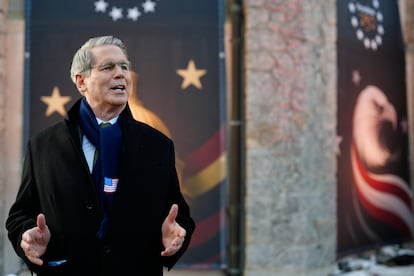
Significantly, along the Promenade — Davos’s main street, where government and corporate pavilions are concentrated — the USA House stands directly opposite Palantir’s building. The graphics on the U.S. pavilion feature an eagle silhouette whose design and scale convey a striking sense of aggression.
The prospects of artificial intelligence, and the dilemma of whether it can deliver productivity gains — and therefore returns — quickly and forcefully enough to justify the enormous investments currently being made, will undoubtedly be one of the central themes of the meeting. Nevertheless, geopolitical unease appears to dominate the horizon.
Of course, the Western world will not be the only one represented. The Forum includes the participation of China’s vice premier, He Lifeng, as well as the presidents of Indonesia (Prabowo Subianto), Egypt (Abdel Fattah al-Sisi), and Syria (Ahmed al-Sharaa), among others. Beijing is expected to further emphasize its traditional narrative of presenting itself as a responsible partner in the international community — task made much easier by the disruption caused by the White House. Many countries are rethinking their place in the world as a result, and this reassessment leaves room for a closer alignment with China, as seen in the cases of Canada and India.
Iran’s foreign minister, Abbas Aragchi, was also listed on the programme, but the World Economic Forum announced on Monday morning that it had withdrawn his invitation, explaining that while it had been extended last autumn, the “tragic loss of lives of civilians in Iran over past few weeks means that it is not right for Iranian government to be represented at Davos.”
Sign up for our weekly newsletter to get more English-language news coverage from EL PAÍS USA Edition









































